
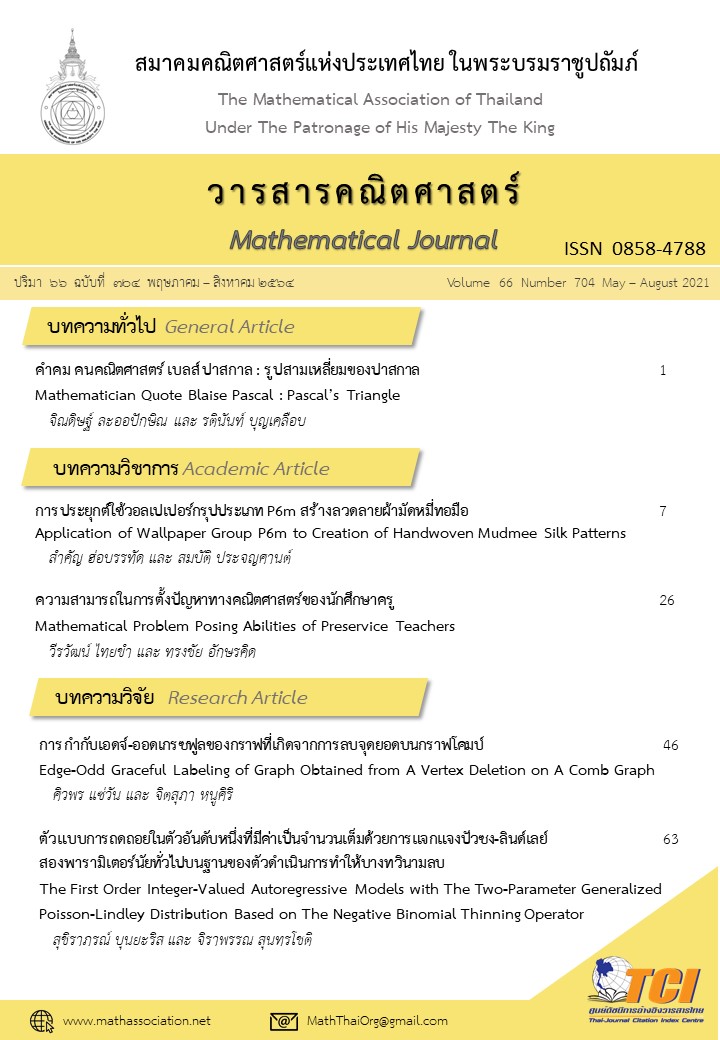
ตัวแบบการถดถอยในตัวอันดับหนึ่งที่มีค่าเป็นจำนวนเต็มด้วยการแจกแจงปัวซงลินด์เลย์สองพารามิเตอร์นัยทั่วไปบนฐานของตัวดำเนินการทำให้บางทวินามลบ
Article Sidebar
Main Article Content
บทคัดย่อ
บทความฉบับนี้นำเสนอตัวแบบการถดถอยในตัวอันดับหนึ่งที่มีค่าเป็นจำนวนเต็มด้วยการแจกแจงปัวซงลินด์เลย์สองพารามิเตอร์นัยทั่วไปบนฐานของตัวดำเนินการทำให้บางทวินามลบ และศึกษาสมบัติที่สำคัญทางความน่าจะเป็นและสถิติ เช่น ฟังก์ชันก่อกำเนิด ค่าคาดหมาย และ ความแปรปรวน โดยสุดท้ายได้พิจารณาการประมาณค่าพารามิเตอร์ของตัวแบบที่สร้างขึ้น
Article Details
เอกสารอ้างอิง
Aghababaei, J., Jones, M. and Lai, C.D. (2012). First-Order Integer Valued AR Processes with Zero Inflated Poisson Innovations. Journal of Time Series Analysis, 33 (6), p. 954 - 963.
Alzaid, A. A., Abdulhamid, A. and Omair, A. (2014). Poisson Difference Integer Valued Autoregressive Model of Order One. Bulletin of The Malaysian Mathe-Matical Sciences Society, 37 (2), p. 465 - 485.
Alzaid, A. A. and Al-Osh, M. A. (1988). First-Order Integer-Valued Autoregressive (INAR(1)) Process: Distributional and Regression Properties. Statistica Neerlandica, 42, p. 53 - 61.
Alzaid, A. A. and Al-Osh, M. A. (1993). Some Autoregressive Moving Average Processes with Generalized Poisson Marginal Distributions. Annals of The Institute of Statistical Mathematics, 45, p. 223 - 232.
Bakouch, H. S., Mohammadpour, M. and Shirozhan, M. (2019). Poisson-Lindley INAR(1) Model with Applications. Brazilian Journal of Probability and Statistics, 32, p. 262 - 280.
Bakouch, H. S. Ristic, M. M. and Nastic, A. S. (2009). A New Geometric First Order Integer-Valued Autoregressive (NGINAR(1)) Process. Statistical Planning and Inference, 139, p. 2218 - 2226.
Bhati, D., Sastry, D. and Qadri, P. (2015). New Generalized Poisson-Lindley Distribution: Applications and Properties. Austrian Journal of Statistics, 44 (4), p. 35 - 51.
Ghitany, M. E., Al-Mutairi, D. K. and Nadarajah, S. (2008). Zero-Truncated Poisson–Lindley Distribution and Its Application. Mathematics and Computers in Simulation, 79, p. 279 - 287.
Mahmoudi, E., Rostami, A. and Roozegar, R. (2018). A New Integer-Valued AR(1) Process with Poisson-Lindley Innovation. Statistics Applications, ArXiv:1802.00994v1.
Mahmoudi, E. and Zakerzadeh, H. (2010). Generalized Poisson–Lindley Distribution. Communications in Statistics, 39 (10), p. 1785 - 1798.
Marcelo, B., Klaus, L. P. and Vasconcellos, V. (2016). A Poisson INAR(1) Process with A Seasonal Structure. Journal of Statistical Computation and Simulation, 86 (2), p. 373-387.
McKenzie, E. (1985). Some Simple Models for Discrete Variate Time Series. Journal of the American Water Resources Association, 21, p. 645 - 650.
Sankaran, M. (1970). The Discrete Poisson-Lindley Distribution. Biometrics, 26, p. 145-149.
Shanker, R. and Sharma, S. (2013). A Two-Parameter Lindley Distribution for Modeling Waiting and Survival Times Data. Applied Mathematics, 4, p. 363 - 368.
Steutel, F. W. and Van-Harn, K. (1979). Discrete Analogues of Self-Decomposability and Stability. The Annals of Probability, 7 (5), p. 893 - 899.
Xiang, H., Nannan, Y. and Mi, C. (2018). Risk Aggregation Based on The Poisson INAR(1) Process with Periodic Structure. Lithuanian Mathematical Journal, 58, p. 505 - 515.
