Geological Analysis and Occupational Safety Risks in Traditional Oil Drilling in Ranto Peureulak, East Aceh, Indonesia 10.32526/ennrj/24/20250087
Article Sidebar
Main Article Content
Abstract
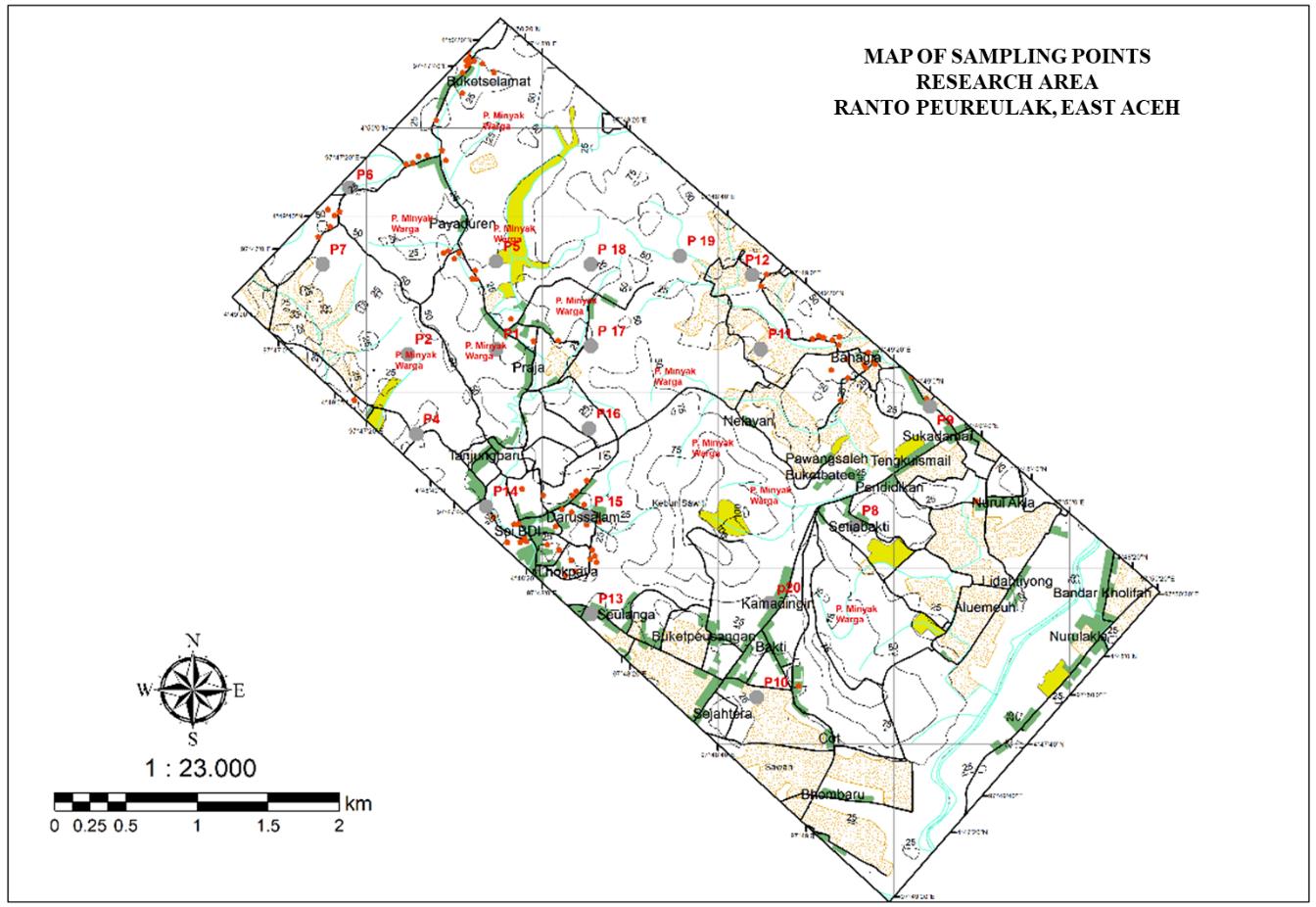
Aceh has abundant natural resources, including oil and natural gas. One of these resources is located in Ranto Peureulak, East Aceh Regency. This area has abundant crude oil reserves. However, due to the lack of government permits, the local community relies on traditional oil drilling methods. The purpose of this study is to assess the impact of traditional oil drilling carried out by the local community in Ranto Peureulak, East Aceh, in terms of both occupational safety and environmental impact. This study was conducted at 20 drilling sites in Ranto Peureulak, East Aceh. Occupational safety risk data was obtained through direct observation and analysis. In addition, physicochemical analysis was also carried out by comparing the analysis results at the drilling sites with the standard quality values set by Government of Indonesia Regulation No. 22 of 2021. The results of this study indicate that traditional crude oil drilling poses an extreme level of risk to occupational safety and the environment. Physicochemical analysis shows that several drilling sites have test values exceeding the established thresholds. Therefore, it can be concluded that traditional oil drilling activities have a very serious impact, both on human health and the surrounding environment.
Article Details

This work is licensed under a Creative Commons Attribution-NonCommercial 4.0 International License.
Published articles are under the copyright of the Environment and Natural Resources Journal effective when the article is accepted for publication thus granting Environment and Natural Resources Journal all rights for the work so that both parties may be protected from the consequences of unauthorized use. Partially or totally publication of an article elsewhere is possible only after the consent from the editors.
References
Ahn MK, Chilakala R, Han C, Thenepalli T. Removal of hardness from water samples by a carbonation process with a closed pressure reactor. Water 2018;10(1):Article No. 54.
Amoatey P, Baawain MS. Effects of pollution on freshwater aquatic organisms. Water Environment Research 2019;91(10):1272-87.
Benson C, Dimopoulos C, Argyropoulos CD, Mikellidou CV, Boustras G. Assessing the common occupational health hazards and their health risks among oil and gas workers. Safety Science 2021;140:Article No. 105284.
Breitburg D, Levin LA, Oschlies A, Grégoire M, Chavez FP, Conley DJ, et al. Declining oxygen in the global ocean and coastal waters. Science 2018;359(6371):eaam7240.
Budiana D, Dalimi R. The economics comparison of power plants fuelled by wellhead gas and liquefied natural gas in Aceh Province. IOP Conference Series Materials Science Engineering 2021;1041:Article No. 012019.
Byliński H, Gębicki J, Namieśnik J. Evaluation of health hazard due to emission of volatile organic compounds from various processing units of wastewater treatment plant. International Journal Environmental Research Public Health 2019;16(10):Article No. 1712.
Jiao N, Liu J, Edwards B, Lv Z, Cai R, Liu Y, et al. Correcting a major error in assessing organic carbon pollution in natural waters. Science Advances 2021;7(16):eabc7318.
Katipana D. Testing for lead (Pb) content in water spinach (Ipomoea aquatica F) at Pattimura University. Biopendix: Jurnal Biologi, Pendidikan dan Terapan 2015;1(2):153-9.
Khaidir M, Matsyah A, Dayyan M. Legality of traditional oil mining exploration in Ranto Peureulak, East Aceh. JURISTA: Jurnal Hukum dan Keadilan 2024;8(2):435-54.
Kumar A, Kumar A, MMS Cabral-Pinto, Chaturvedi AK, Shabnam AA, Subrahmanyam G, et al. Lead toxicity: Health hazards, influence on food chain, and sustainable remediation approaches. International Journal Environmental Research and Public Health 2020;17(7):Article No. 2179.
Kroepsch AC, Maniloff PT, Adgate JL, McKenzie LM, Dickinson KL. Environmental justice in unconventional oil and natural gas Drilling and production: A critical review and research agenda. Environmental Science Technology 2019;53(12): 6601-15.
Mahmood Y, Afrin T, Huang Y, Yodo N. Sustainable development for oil and gas infrastructure from risk, reliability, and resilience perspectives. Sustainability 2023;15(6):Article No. 4953.
Mushtaq N, Singh DV, Bhat RA, Dervash MA, Hameed OB. Freshwater contamination: Sources and hazards to aquatic biota. In: Fresh Water Pollution Dynamics and Remediation. Singapore: Springer Singapore; 2020. p. 27-50.
Nimma D, Devi OR, Laishram B, Ramesh JVN, Boddupalli S, Ayyasamy R, et al. Implications of climate change on freshwater ecosystems and their biodiversity. Desalination Water Treat 2025;321:Article No. 100889.
Olah GA, Goeppert A, Prakash GKS. Beyond Oil and Gas: The Methanol Economy. John Wiley and Sons; 2018.
Rahmawati SD, Ain C, Sabdaningsih A. Water quality and trophic status in Jatibarang Reservoir, Semarang. Saintek Perikanan: Indonesian Journal of Fisheries Science and Technology 2023;19(3):152-8.
Saravanan A, Senthil Kumar P, Jeevanantham S, Karishma S, Tajsabreen B, Yaashikaa PR, et al. Effective water/wastewater treatment methodologies for toxic pollutants removal: Processes and applications towards sustainable development. Chemosphere 2021;280:Article No. 130595.
Singh A, Sharma AK, Verma RL, Chopade RP, Pandit P, Nagar V, et al. Heavy metal contamination of water and their toxic effect on living organisms. In: Dorta DJ, de Oliveira DP, editor. The Toxicity of Environmental Pollutants. London: IntechOpen; 2022. p. 49.
Tadesse M, Tsegaye D, Girma G. Assessment of the level of some physico-chemical parameters and heavy metals of Rebu River in Oromia Region, Ethiopia. MOJ Biology and Medicine 2018;3(3):99-118.
Yang J, Zhang J, Du X, Gao T, Cheng Z, Fu W, et al. Ammonia inhibition in anaerobic digestion of organic waste: A review. International Journal of Environmental Science and Technology 2025;22(5):3927-42.
Zhang L, Xu EG, Li Y, Liu H, Vidal-Dorsch DE, Giesy JP. Ecological risks posed by ammonia nitrogen (AN) and un-ionized ammonia (NH3) in seven major river systems of China. Chemosphere 2018;202:136-44.
