A Numerical Investigation of Perforated Inlet Baffle Configurations on Flow Behavior in a Rectangular Oil / Water Separator using CFD 10.32526/ennrj/24/20250221
Article Sidebar
Main Article Content
Abstract
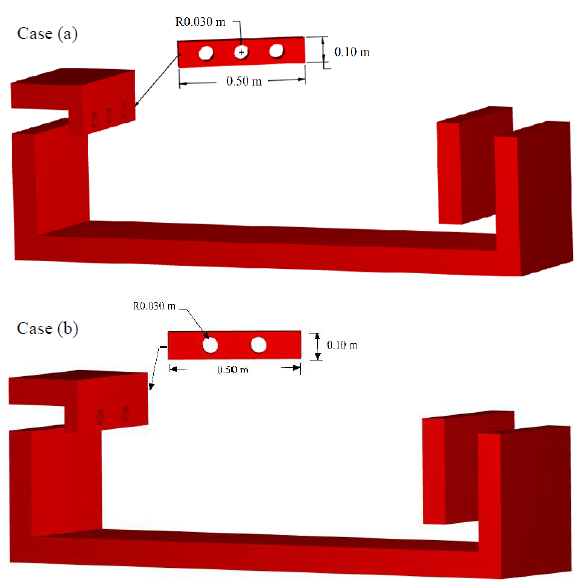
Gravity separation tanks are generally utilized to separate water and oil in treatment applications. The operating behavior of such tanks is likely to be sensitive to tank operation, as these factors will largely determine whether or not oil droplets stratify easily and float independently of water. Within the present investigations, the influences of several holes in the baffles on water and oil separation within a rectangular tank were explored through the utilization of a numerical model and the consequent simulation of fluid flow. Moreover, in order to ensure the credibility of the simulations, validation was carried out through utilization of a model based on work already conducted experimentally. FLOW-3D (version 11.04) software was applied to model a steady-state, incompressible flow within a two-dimensional (x-z) domain using the Reynolds Averaged-Navier-Stokes (RANS) equations. The RNG k-ε turbulence model was adopted to approximate the hydraulic behavior, while the volume of fluid (VOF) approach was employed to capture the air-water interface. In addition, the FAVOR (Fractional Area/Volume Obstacle Representation) technique was used to represent the geometric details of the perforated baffles. 2 perforated baffle geometry cases were explored: differing in the number of holes but with the same hole diameter in both cases. Performance was strongly validated through operational uniformity based on the standard deviation of horizontal velocity within the tank, and the flow field pattern was utilized to determine the characterization of the streamlines and recirculation areas. A kinetic energy analysis was carried out to illustrate turbulence in the flow approximation. The results indicated that an inlet baffle with fewer holes had significantly enhanced operating uniformity and lower turbulence compared with more holes, and correspondingly, these flow field patterns depicted more streamlined movement and lower recirculation areas.
Article Details

This work is licensed under a Creative Commons Attribution-NonCommercial 4.0 International License.
Published articles are under the copyright of the Environment and Natural Resources Journal effective when the article is accepted for publication thus granting Environment and Natural Resources Journal all rights for the work so that both parties may be protected from the consequences of unauthorized use. Partially or totally publication of an article elsewhere is possible only after the consent from the editors.
References
Acharya T, Potter T. A CFD study on hydrocarbon mean residence time in a horizontal oil-water separator. SN Applied Sciences 2021;3(4):1-10.
Adams EW, Rodi W. Modeling flow and mixing in sedimentation tanks. Journal of Hydraulic Engineering 1990;116(7):895-913.
Akpan DG. Performance of Internals in Three-Phase Tank Separators [dissertation]. Norway, Norwegian University of Science and Technology; 2013.
Al-Yacouby AM, Ahmed MM. A numerical study on the effects of perforated and imperforate baffles on the sloshing pressure of a rectangular tank. Journal of Marine Science and Engineering 2022;10(10):Article No. 1335.
Azimi H, Shabanlou S. U-shaped channels along the side weir for subcritical and supercritical flow regimes. ISH Journal of Hydraulic Engineering 2018;26(4):365-75.
Aziz TN. Analysis of Grease Abatement Devices and the Measurement of Fat, Oil, and Grease in Food Service Establishment Waste Streams [dissertation]. Raleigh, North Carolina, USA, North Carolina State University; 2010.
Efendioglu A, Mendez J, Turkoglu H. The numerical analysis of the flow and separation efficiency of a two-phase horizontal oil-gas separator with an inlet diverter and perforated plates. Advances in Fluid Mechanics 2014; 82:133-42.
Jameel AT, Muyubi SA, Karim MIA, Alam MZ. Removal of oil and grease as emerging pollutants of concern (EPC) in wastewater stream. IIUM Engineering Journal 2011;12(4):161-9.
Joshy A, MA A, Nambiar A. CFD Analysis and optimization of three phase oil separator. Proceedings of the International Conference on Systems, Energy and Environment; 2022 Aug 5-6; Kannur, Kerala, India; 2022.
Hafsi Z, Elaoud S, Mishra M, Wada I. Numerical study of droplets coalescence in an oil-water separator. Proceedings of the 7th International Conference on Advances in Mechanical Engineering and Mechanics; 2019 December 16-18; Hammamet, Tunisia; 2020. p. 449-54.
Hirt C, Sicilian J. A porosity technique for the definition of obstacles in rectangular cell meshes. Proceedings of the 4th International Conference on Ship Hydrodynamics; 1985 Sep 24-27; Washington, DC; 1985.
Hirt CW, Nichols BD. Volume of fluid (VOF) method for the dynamics of free boundaries. Journal of Computational Physics 1981;39(1):201-25.
Hussein HA, Abdullah R, Harun S, Abdulkhaleq M. Numerical model of baffle location effect on flow pattern in oil and water gravity separator tanks. World Applied Sciences Journal 2013;26(10):1351-6.
Ibrahim AA, Najim YM, Dawood AS. Three phase oil separator simulation using CFD analysis: A review study. Al-Rafidain Engineering Journal 2024;29(2):10-8.
Kim S, Kim H, Jeong HS, Kim Y. Optimal design of perforated baffles for enhancing oil-water separation performance using genetic algorithms. Results in Engineering 2025;26:Atticle No. 104668.
Keener KM, Ducoste JJ, Holt LM. Properties influencing fat, oil, and grease deposit formation. Water Environment Research 2008;80(12):2241-6.
Laleh AP, Svrcek WY, Monnery WD. Design and CFD studies of multiphase separators: A review. The Canadian Journal of Chemical Engineering 2012;90(6):1547-61.
Mattsson J, Hedström A, Viklander M, Blecken G-T. Fat, oil, and grease accumulation in sewer systems: Comprehensive survey of experiences of Scandinavian municipalities. Journal of Environmental Engineering 2014;140(3):Article No. 04014003.
Mee CG, Nor MIM. Flow pattern in a horizontal primary separator with a perforated baffle. Journal of the Institution of Engineers Malaysia 2011;72(3):19-25.
Metcalf, Eddy A. Wastewater Engineering: Treatment and Resource Recovery. 5th ed. McGraw-Hill Education; 2014.
Nascimento JBDS, Ferreira AD, Vasconcelos AL, De Farias Neto SR. Study of the influence of Semi-porous baffles on the three-phase separation efficiency in a horizontal separator vessel via CFD. Journal of Petroleum Science and Technology 2024;14(3):50-9.
Sadiq FA, Hussien HA, Zainol MR. Numerical investigation of hydraulic performance in Makhool Spillway Dam. Environment and Natural Resources Journal 2025;23(2):142-9.
Selim T, Hamed AK, Elkiki M, Eltarabily MG. Numerical investigation of flow characteristics and energy dissipation over piano key and trapezoidal labyrinth weirs under free-flow conditions. Modeling Earth Systems and Environment 2023;10(1):1253-72.
Shahrokhi M, Rostami F, Said MAM, Yazdi SRS. The effect of number of baffles on the improvement efficiency of primary sedimentation tanks. Applied Mathematical Modelling 2012;36(8):3725-35.
Southerland R. Sewer fitness: Cutting the fat. American City and County 2002;117(15):27-31.
Versteeg HK, Malalasekera W. An Introduction to Computational Fluid Dynamics the Finite Volume Method. 2nd ed. India: Pearson Education; 2007.
Wilkinson D, Waldie B, Nor MM, Lee HY. Baffle plate configurations to enhance separation in horizontal primary separators. Chemical Engineering Journal 2000;77(3):221-6.
Yakhot V, Smith LM. The renormalization group, the ɛ-expansion and derivation of turbulence models. Journal of Scientific Computing 1992;7(1):35-61.
Yakhot V, Orszag SA. Renormalization group analysis of turbulence. I. Basic theory. Journal of Scientific Computing 1986;1(1):3-51.
Yusuf F, Micovic Z. Prototype-scale investigation of spillway cavitation damage and numerical modeling of mitigation options. Journal of Hydraulic Engineering 2020;146(2):Article No. 04019057.
Yu L, Han M, He F. A review of treating oily wastewater. Arabian Journal of Chemistry 2017;10:1913-22.
