Spatio-Temporal Analysis of PM2.5 Concentrations through Integration of Aerosol Optical Depth and Sentinel-5P Data Using Google Earth Engine 10.32526/ennrj/24/20250246
Article Sidebar
Main Article Content
Abstract
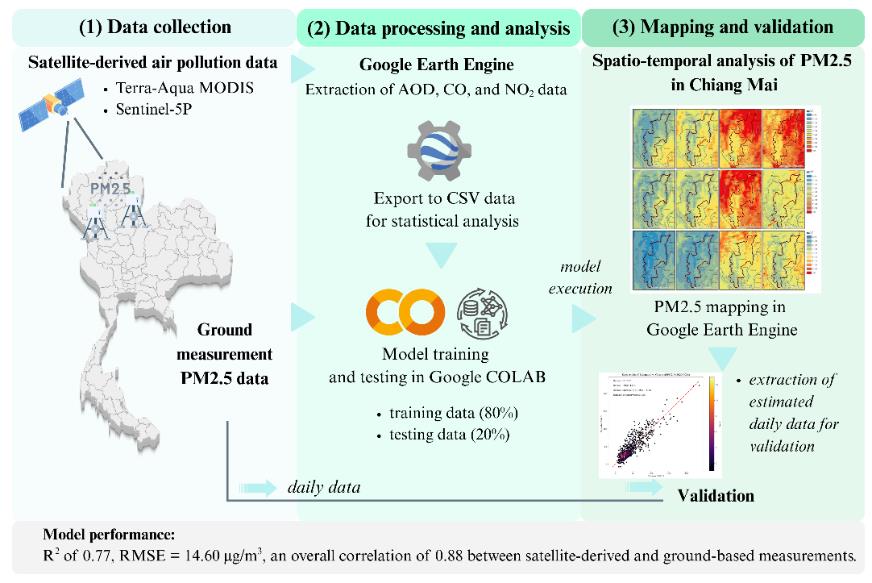
Air pollution in Northern Thailand is a persistent environmental issue, particularly during the dry season, posing significant health risks. This study used multiple remote-sensing data sources to explore spatio-temporal PM2.5 variations in Chiang Mai Province from 2020 to 2024. Ground-based PM2.5 measurements were merged with Terra-Aqua aerosol optical depth (AOD) and Sentinel-5P carbon monoxide (CO) and nitrogen dioxide (NO2) data within the Google Earth Engine platform. Multiple linear regression models were employed to estimate ground-level PM2.5 concentrations and generate spatial distribution maps. Central lowland and northern areas of Chiang Mai consistently exhibited higher PM2.5 levels, particularly in March and April. The model achieved an R2 of 0.77 and a root mean square error (RMSE) of 14.60 μg/m3, with an overall correlation of 0.88 between satellite-derived and ground-based measurements. Seasonal analysis revealed enhanced model performance during the burning period (January-April; R2=0.72, RMSE=17.31 μg/m3), compared with the non-burning period (May-December; R2=0.26, RMSE=8.32 μg/m3). During the 2020-2024 burning periods, average PM2.5 concentrations were 51.33, 45.62, 25.18, 49.81, and 41.11 μg/m3, respectively, peaking at 79.18±16.90 μg/m3 in March 2023. Integrating AOD with Sentinel-5P CO and NO2 data improved estimation accuracy and hotspot identification, highlighting the potential of cloud-based geospatial platforms for comprehensive air quality monitoring.
Article Details

This work is licensed under a Creative Commons Attribution-NonCommercial 4.0 International License.
Published articles are under the copyright of the Environment and Natural Resources Journal effective when the article is accepted for publication thus granting Environment and Natural Resources Journal all rights for the work so that both parties may be protected from the consequences of unauthorized use. Partially or totally publication of an article elsewhere is possible only after the consent from the editors.
References
Amnuaylojaroen T. Prediction of PM2.5 in an urban area of Northern Thailand using multivariate linear regression model. Advances in Meteorology 2022;1:Article No. 3190484.
Amnuaylojaroen T, Inkom J, Janta R, Surapipith V. Long range transport of Southeast Asian PM2.5 pollution to Northern Thailand during high Biomass burning episodes. Sustainability 2020;12(23):Article No. 10049.
Bran SH, Macatangay R, Surapipith V, Chotamonsak C, Chantara S, Han Z, et al. Surface PM2.5 mass concentrations during the dry season over Northern Thailand: Sensitivity to model aerosol chemical schemes and the effects on regional meteorology. Atmospheric Research 2022;277:Article No. 106303.
Buakhao L. Model for estimating PM2.5 concentration using aerosol optical depth data in the Muang District of Chiang Mai Province. YRU Journal of Science and Technology 2023;8(1):50-8 (in Thai).
Buya S, Gokon H, Huynh VN, Dam HC, Usanavasin S, Karnjana J, et al. Spatiotemporal association between monthly PM2.5 levels and cardiorespiratory mortality in Thailand (2015-2019). International Journal of Environmental Health Research 2026;36(1):41-52.
Chankaew K, Sinitkul R, Manuyakorn W, Roekworachai K, Kamalaporn H. Spatial estimation of PM2.5 exposure and its association with Asthma Exacerbation: A prospective study in Thai Children. Annals of Global Health 2022;88(1):Article No. 15.
Chansuebsri S, Kolar P, Kraisitnitikul P, Kantarawilawan N, Yabueng N, Wiriya W, et al. Chemical composition and origins of PM2.5 in Chiang Mai (Thailand) by integrated source apportionment and potential source areas. Atmospheric Environment 2024;327:Article No. 120517.
Chen B, Song Y, Kwan MP, Huang B, Xu B. How do people in different places experience different levels of air pollution? Using worldwide Chinese as a lens. Environmental Pollution 2018;238:874-83.
Chiang Mai Provincial Statistical Office. Chiang Mai Provincial Statistical Report: 2024 [Internet]. 2024 [cited 2025 Jun 10]. Available from: https://chiangmai.nso.go.th/reports-publications/provincial-statistics-report.html.
Fatima M, Butt I, Nasar-u-Minallah M, Atta A, Cheng G. Assessment of Air Pollution and its association with population health: Geo-statistical evidence from Pakistan. Geography, Environment, Sustainability 2023;16(2):93-101.
Ghasempour F, Sekertekin A, Kutoglu SH. Google earth engine based spatio-temporal analysis of air pollutants before and during the first wave COVID-19 outbreak over Turkey via remote sensing. Journal of Cleaner Production 2021;319:Article No. 128599.
Hair JF, Black WC, Babin BJ, Anderson RE. Multivariate Data Analysis. 8th ed. Andover, Hampshire: Cengage Learning EMEA; 2019.
Han S, Kundhikanjana W, Towashiraporn P, Stratoulias D. Interpolation-based fusion of Sentinel-5P, SRTM, and regulatory-grade ground stations data for producing spatially continuous maps of PM2.5 concentrations nationwide over Thailand. Atmosphere 2022;13(2):Article No. 161.
Handschuh J, Erbertseder T, Schaap M, Baier F. Estimating PM2.5 surface concentrations from AOD: A combination of SLSTR and MODIS. Remote Sensing Applications: Society and Environment 2022;26:Article No. 100716.
Holloway T, Miller D, Anenberg S, Diao M, Duncan B, Fiore AM, et al. Satellite monitoring for air quality and health. Annual Review of Biomedical Data Science 2021;4(1):417-47.
Junpen A, Pansuk J, Kamnoet O, Cheewaphongphan P, Garivait S. Emission of air pollutants from rice residue open burning in Thailand, 2018. Atmosphere 2018;9(11):Article No. 449.
Kaewmesri P, Uamkasem B, Koedkurang K, Chalermpong P, Sriwilas P, Tupbamroong J, et al. Investigating the relationship between particulate matter (PM2.5) concentration and aerosol optical depth (AOD) over Thailand during the dry period. IOP Conference Series: Earth and Environmental Science 2024;1412:Article No. 012004.
Kamton R, Satienperakul K, Yotapakdee T, Nunthasen K. Haze-relate air pollution and impacts on healthy in Chiang Mai province. Thai Interdisciplinary and Sustainability Review 2019;8(1):265-73 (in Thai).
Lalitaporn P, Boonmee T. Analysis of tropospheric nitrogen dioxide using satellite and ground based data over Northern Thailand. Engineering Journal 2019;23(6):19-35.
Mei L, Strandgren J, Rozanov V, Vountas M, Burrows JP, Wang Y. A study of the impact of spatial resolution on the estimation of particle matter concentration from the aerosol optical depth retrieved from satellite observations. International Journal of Remote Sensing 2019;40(18):7084-112.
Pardthaisong L, Sin-ampol P, Suwanprasit C, Charoenpanyanet A. Haze pollution in Chiang Mai, Thailand: A road to resilience. Procedia Engineering 2018;212:85-92.
Paluang P, Thavorntam W, Phairuang W. The Spatial-temporal emission of air pollutants from biomass burning during haze episodes in Northern Thailand. Fire 2024;7(4):Article No. 122.
Pathakoti M, Muppalla A, Hazra S, Venkata MD, Lakshmi KA, Sagar VK, et al. Measurement report: An assessment of the impact of a nationwide lockdown on air pollution: A remote sensing perspective over India. Atmospheric Chemistry and Physics 2021;21(11):9047-64.
Pollution Control Department. Thailand Air and Noise Pollution Situation and Management Report, 2023 [Internet]. 2023 [cited 2025 May 15]. Available from: http://air4thai.com/ tagoV2/tago_file/books/book_file/eef68f0fe6195accf1e101ff3c204fe0.pdf.
Rirugchart P, Losiri C, Sitthi A. The Application of google earth engine on PM2.5 estimation and its distribution pattern in Saraburi Province, Thailand. International Journal of Geoinformatics 2025;21(1):26-42.
Sapbamrer P, Assavanopakun P, Panumasvivat J. Decadal trends in ambient air pollutants and their association with COPD and lung cancer in Upper Northern Thailand: 2013-2022. Toxics 2024;12(5):Article No. 321.
Sakti AD, Anggraini TS, Ihsan KTN, Misra P, Trang NTQ, Pradhan B, et al. Multi-air pollution risk assessment in Southeast Asia region using integrated remote sensing and socio-economic data products. Science of the Total Environment 2023;854:Article No. 158825.
Son R, Stratoulias D, Kim HC, Yoon JH. Estimation of surface PM2.5 concentrations from atmospheric gas species retrieved from TROPOMI using deep learning: Impacts of fire on air pollution over Thailand. Atmospheric Pollution Research 2023;14(10):Article No. 101875.
Song J, Hong X, Yu K, He B, Wu S, Hu K, et al. Spatiotemporal estimation and analysis of PM2.5 concentrations in Wuhan utilizing multisource remote sensing data and NOx as inputs for machine learning models. IEEE Sensors Journal 2025;25(4):6812-24.
Song Y, Huang B, He Q, Chen B, Wei J, Mahmood R. Dynamic assessment of PM2.5 exposure and health risk using remote sensing and geo-spatial big data. Environmental Pollution 2019;253:288-96.
Suriyawong P, Chuetor S, Samae H, Piriyakarnsakul S, Amin M, Furuuchi M, et al. Airborne particulate matter from biomass burning in Thailand: Recent issues, challenges, and options. Heliyon 2023;9(3):e14261.
Tan H, Chen Y, Mao F, Wilson JP, Zhang T, Cui X, et al. PM2.5 estimation and its relationship with NO2 and SO2 in China from 2016 to 2020. International Journal of Digital Earth 2024;17(1):Article No. 2398055.
Wongnakae P, Chitchum P, Sripramong R, Phosri A. Application of satellite remote sensing data and random forest approach to estimate ground-level PM2.5 concentration in Northern region of Thailand. Environmental Science and Pollution Research 2023;30(38):88905-17.
