Modeling PM2.5: Temperature Interactions Using Predator-Prey Dynamics 10.32526/ennrj/24/20250249
Article Sidebar
Main Article Content
Abstract
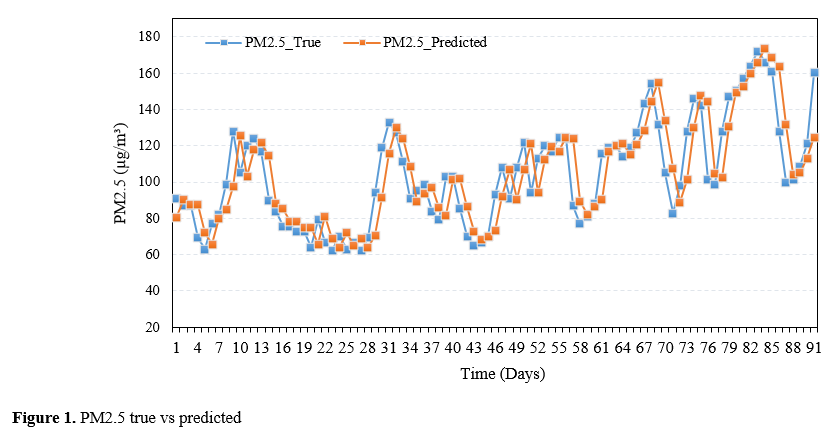
This study introduces a novel application of the predator-prey concept to model and forecast daily PM2.5 concentrations, with PM2.5 treated as the prey and temperature as the predator. This formulation reflects the commonly observed inverse relationship between pollution levels and temperature in urban atmospheric environments. A dynamic equation was constructed to describe the rate of change in PM2.5, incorporating both intrinsic growth and the suppressive effect of temperature. Regular environmental cycles are also incorporated into the model structure. Parameters were estimated using daily observational data collected over a three-month period. The model successfully captures short-term variation and broader seasonal trends in PM2.5, despite relying on temperature as the sole external variable. This approach provides a simplified yet interpretable framework that explains how pollution levels respond to environmental drivers over time. It represents a conceptual shift from purely statistical models by offering an ecological perspective on air quality dynamics. Predictive validation yielded RMSE values of 15.7036 for PM2.5 and 0.9425 for temperature, demonstrating strong agreement with observed data. This is the first study to adapt predator-prey principles to describe and predict the interaction between temperature and PM2.5 on a daily time scale.
Article Details

This work is licensed under a Creative Commons Attribution-NonCommercial 4.0 International License.
Published articles are under the copyright of the Environment and Natural Resources Journal effective when the article is accepted for publication thus granting Environment and Natural Resources Journal all rights for the work so that both parties may be protected from the consequences of unauthorized use. Partially or totally publication of an article elsewhere is possible only after the consent from the editors.
References
Basak GK, Lee P. Asymptotic properties of an estimator of the drift coefficients of multidimensional Ornstein-Uhlenbeck processes that are not necessarily stable. Electronic Journal of Statistics 2008;2(1):1309-44.
Fold NR, Allison MR, Wood BC, Thao PTB, Bonnet S, Garivait S, et al. An assessment of annual mortality attributable to ambient PM2.5 in Bangkok, Thailand. International Journal of Environmental Research and Public Health 2020;17(19):Article No. 7298.
Holling CS. The components of predation as revealed by a study of small-mammal predation of the European Pine Sawfly. The Canadian Entomologist 1959a;91(5):293-320.
Holling CS. Some characteristics of simple types of predation and parasitism. The Canadian Entomologist 1959b;91(7):385-98.
Jianhua W, Susumu O. Effects of meteorological conditions on PM2.5 concentrations in Nagasaki, Japan. International Journal of Environmental Research and Public Health 2015;12(8):9089-101.
Ketjalan A, Humphries U, Suadee W. A study on PM2.5 concentration in Bangkok, Thailand: A case study of Bang Na Station. International Journal of Advanced and Applied Sciences 2023;10(10):55-61.
Lai N, Song W, Wang M, Zhao L, Zhou J, Cai X, et al. Qualitative and quantitative analyses of meteorological impacts on fine particle pollution in winters of cold region in China. Processes 2024;12(12):Article No. 2713.
Lu H, Ma X. Hybrid decision tree-based machine learning models for short-term water quality prediction. Chemosphere 2020;249:Article No. 126169.
Medhi D, Sarma G, Shyam A. Stability analysis of linear systems using the Routh-Hurwitz Criterion: Theory and applications. Journal of Computational Analysis and Applications 2024;33(8):903-7.
Miao Y, Liu S, Sheng L, Huang S, Li J. Influence of boundary layer structure and low-level jet on PM2.5 pollution in Beijing: A case study. International Journal of Environmental Research and Public Health 2019;16(4):Article No. 616.
Murray JD. Mathematical Biology I: An Introduction. 3rd ed. New York, NY: Springer; 2002.
Phosri A, Ueda K, Phung VLH, Tawatsupa B, Honda A, Takano H. Effects of ambient air pollution on daily hospital admissions for respiratory and cardiovascular diseases in Bangkok, Thailand. Science of the Total Environment 2018;651:1144-53.
Rizwan AM, Dennis LYC, Liu C. A review on the generation, determination and mitigation of Urban Heat Island. Journal of Environmental Sciences 2008;20(1):120-8.
Ruttanawongchai S, Raktham C, Khumsaeng T. The influence of meteorology on ambient PM2.5 and PM10 concentration in Chiang Mai. Journal of Physics: Conference Series 2018;1144(1):Article No. 012088.
Sirithian D, Thanatrakolsri T. Relationships between meteorological and particulate matter concentrations (PM2.5 and PM10) during the haze period in urban and rural areas, Northern Thailand. Air, Soil and Water Research 2022;5(2):1-15.
Themairi A, Alqudah MA. Predator-prey model of Holling-type II with harvesting and predator in disease. Italian Journal of Pure and Applied Mathematics 2020;43:744-53.
Winalai C, Nanthasen S, Chadsuthi S. The effect of weather on PM2.5 in Bangkok area and Bangkok metropolitan region using machine learning. Life Sciences and Environment Journal 2022;23(2):409-21.
Yang Q, Yuan Q, Li T, Shen H, Zhang L. The relationships between PM2.5 and meteorological factors in China: Seasonal and regional variations. International Journal of Environmental Research and Public Health 2017;14(12): Article No. 1510.
Yang Z, Yang X, Xu C, Wang Q. The effect of meteorological features on pollution characteristics of PM2.5 in the South Area of Beijing, China. Atmosphere 2023;14(12):Article No. 1753.
