Unified Green E-Waste Management Framework for Sustainable Campus Development: Case Study of Malaysian Public Universities 10.32526/ennrj/24/20250258
Article Sidebar
Main Article Content
Abstract
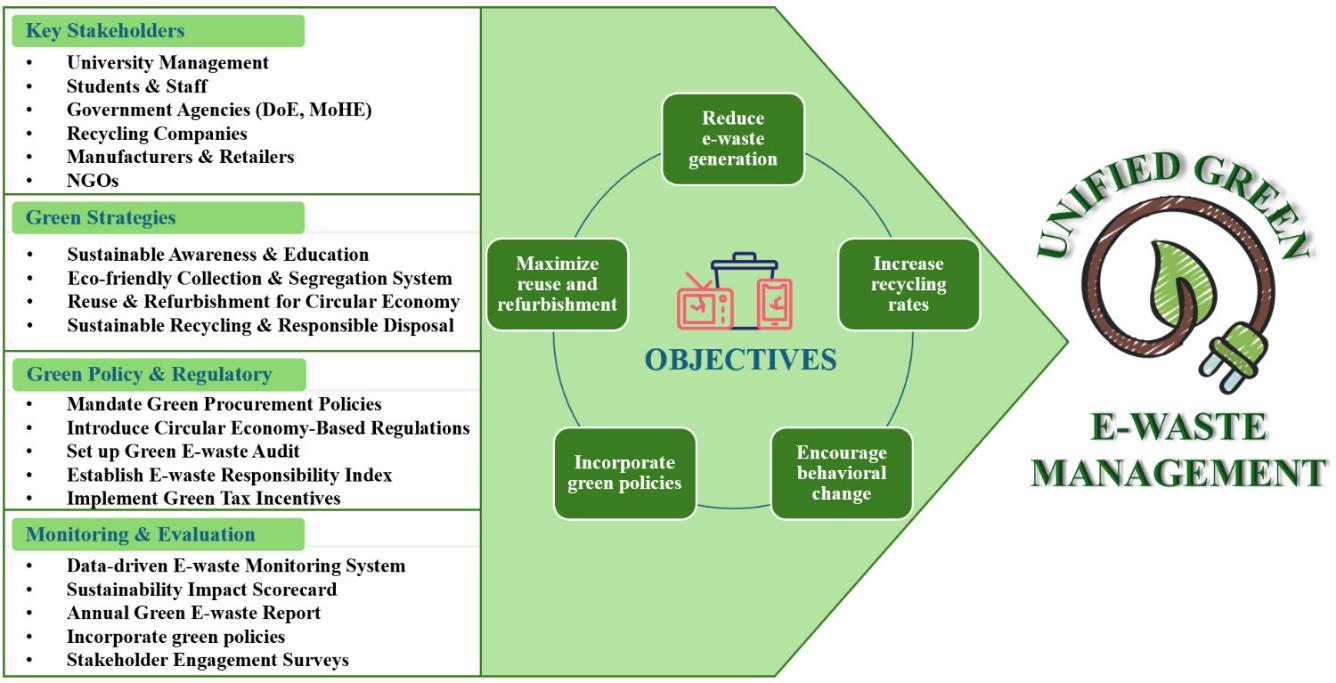
Electronic waste (e-waste) has become the fastest-growing waste stream globally, presenting complex environmental and regulatory challenges that are particularly evident in higher education institutions. In Malaysia, public universities are significant contributors to e-waste generation due to their extensive reliance on information and communication technologies, laboratory equipment, and administrative devices. Although regulatory frameworks, such as the Environmental Quality (Scheduled Wastes) Regulations 2005, exist, current practices in universities remain fragmented, focusing largely on asset disposal under Ministry of Finance guidelines and neglecting gaps in behavioral, infrastructural, and policy integration. This study introduces the Unified Green E-waste Management Framework (UGEMF), a holistic model specifically designed for Malaysian public universities. The framework was developed through qualitative methods, including document analysis, in-depth interviews with key stakeholders, and a review of institutional practices, regulatory documents, and best-practice case studies. The findings highlight barriers, including limited awareness, bureaucratic constraints, and the absence of institutionalized policies, while also identifying emerging best practices, such as refurbishment initiatives, decentralized collection points, and cross-sector collaborations. By operationalizing circular economy principles within the higher education context, UGEMF contributes theoretically to sustainability and waste management literature, while offering practical guidance for policymakers and administrators. Its adoption can transform e-waste management in Malaysian public universities from fragmented compliance processes into comprehensive, integrated sustainability strategies. This approach supports national green growth targets and sustainable campus development.
Article Details

This work is licensed under a Creative Commons Attribution-NonCommercial 4.0 International License.
Published articles are under the copyright of the Environment and Natural Resources Journal effective when the article is accepted for publication thus granting Environment and Natural Resources Journal all rights for the work so that both parties may be protected from the consequences of unauthorized use. Partially or totally publication of an article elsewhere is possible only after the consent from the editors.
References
Ahmed K, Dubey MK, Kumar A, Dubey S. Artificial intelligence and IoT driven system architecture for municipality waste management in smart cities: A review. Measurement: Sensors 2024;36:Article No. 101395.
Akhtar R. Managing E-Waste is Key to Our Sustainability [Internet]. 2024 [cited 2025 Jan 2]. Available from: https://theedgemalaysia.com/node/703393.
Andeobu L, Wibowo S, Grandhi S. Environmental and health consequences of e-waste: A critical review. Sustainability 2023;15(13):Article No. 10405.
Barcelo J, Artuz MT, Tansengco M, Herrera D, Chuayana JM, Esguerra R. Waste analysis and characterization study in a Philippine science and technology research and development institution. Environment and Natural Resources Journal 2024;22(6):547-64.
Bernama. Over half a million tonnes of e-waste processed as at June 2025, DOE wants tougher control [Internet]. 2025 [cited 2025 Sep 15]. Available from: https://bernama.com/en/ news.php?id=2451587.
Borges RM, Zagui GS, Bortoletto-Santos R, Ismail IAL, Souza MT, Simão L, et al. Data collection and elaboration of guidelines for waste electrical and electronic equipment management in Brazilian private higher education institutions. Sustainability 2024;16(24):Article No. 11091.
Bowen GA. Document analysis as a qualitative research method. Qualitative Research Journal 2009;9(2):27-40.
Braun V, Clarke V. Thematic Analysis: A Practical Guide. London: SAGE; 2021.
Creswell JW, Poth CN. Qualitative Inquiry and Research Design: Choosing among Five Approaches. 4th ed. Thousand Oaks (CA): SAGE; 2018.
Cristi KM. Redefining the e-waste management framework at the University of Leeds: Challenges and opportunities for sustainability. Proceedings of the Sustainable Ecological Engineering Design for Society (SEEDS); 29-31 Aug 2023; Ipswich, UK: University of Suffolk; 2024.
Dawodu A, Dai H, Zou T, Zhou H, Lian W, Oladejo J, et al. Campus sustainability research: Indicators and dimensions to consider for the design and assessment of a sustainable campus. Heliyon 2022;8(12):e11864.
Dayaday MG, Galleto FA Jr. Electronic waste management of higher education institutions in South Central Mindanao, Philippines. Environment and Natural Resources Journal 2022;20(5):534-42.
Department of Environment (DOE) Malaysia. Environmental Quality (Scheduled Wastes) Regulations 2005 (P.U.(A) 294/2005). Putrajaya, Malaysia: DOE; 2005.
Department of Environment (DOE) Malaysia. Guidelines for the Transboundary Movement of used Electrical and Electronic Equipment in Malaysia. Putrajaya, Malaysia: DOE; 2021.
Department of Environment (DOE) Malaysia. Environmental Quality Act 1974 (Act 127). Consolidated Text. Putrajaya, Malaysia: DOE; 2022.
Ermayendri D, Simarmata M, Arianto W, Reflis, Riwandi, Sukiyono K. Dynamic integrated model for sustainable solid waste management in Bengkulu City. Environment and Natural Resources Journal 2025;23(6):494-515.
Giurea R, Miino MC, Torretta V, Rada EC. Approaching sustainability and circularity along waste management systems in universities: An overview and proposal of good practices. Frontiers in Environmental Science 2024;12:Article No. 1363024.
Grandhi SP, Dagwar PP, Dutta D. Policy pathways to sustainable e-waste management: A global review. Journal of Hazardous Materials Advances 2024;16:Article No. 100473.
Hashim R, Salleh NA, Ibrahim JA, Zahari FM. E-waste management practices through the eyes of responsible departments at Malaysian public universities. Journal of Advanced Research in Applied Sciences and Engineering Technology 2025;52(1):309-19.
International Telecommunication Union, United Nations Institute for Training and Research (ITU and UNITAR). Global E-Waste Monitor 2024. Geneva/Bonn: ITU/UNITAR; 2024.
KPMG Malaysia. Extended Producer Responsibility: Stepping Stone to Malaysia’s Circular Economy. Kuala Lumpur: KPMG; 2023.
Korhonen J, Honkasalo A, Seppälä J. Circular economy: The concept and its limitations. Ecological Economics 2018;143:37-46.
Lincoln YS, Guba EG. Naturalistic Inquiry. Beverly Hills (CA): SAGE; 1985.
Malaysia Green Technology and Climate Change Corporation (MGTC). Government Green Procurement (GGP) Guidelines 2.0. Putrajaya, Malaysia: MGTC; 2018.
Ministry of Investment, Trade and Industry (MITI). Circular Economy Policy Framework for the Manufacturing Sector in Malaysia. Kuala Lumpur, Malaysia: Ministry of Investment, Trade and Industry; 2024.
Mlelwa R, Rother HA. Reviewing the current state of legacy POP-brominated flame retardants in plastic childcare products and toys: A scoping review protocol. Systematic Reviews 2024;13:Article No. 148.
Molina ÁA, Helldén D, Alfvén T, Niemi M, Leander K, Nordenstedt H, et al. Integrating the United Nations Sustainable Development Goals into higher education globally: A scoping review. Global Health Action 2023;16(1):Article No. 2190649.
Noranarttakun P, Pharino C. How does the green industry policy impact a developing country? A case study of the electronic products and electrical equipment manufacturing sector in Thailand. Environment and Natural Resources Journal 2021;19(5):402-12.
Okeke ES, Enochoghene A, Ezeudoka BC, Kaka SD, Chen Y, Mao G, et al. Heavy metal risks around e-waste sites and comparable municipal dumpsites in major African cities. Toxicology 2024;501:Article No. 153711.
Oliveira MC, Proença J. Sustainable campus operations in higher education institutions: A systematic literature review. Sustainability 2025;17(2):Article No. 607.
Ramasubramanian B, Tan J, Chellappan V, Ramakrishna S. Recent advances in extended producer responsibility initiatives for plastic waste management in Germany and UK. Materials Circular Economy 2023;5(1):Article No. 6.
Rimantho D, Syaiful S, Nurfaida, Sulandari U. Electronic waste bank model as a solution for implementing circular economy: Case study DKI Jakarta, Indonesia. Frontiers in Built Environment 2022;8:Article No. 1030196.
Rodríguez-Guerreiro MJ, Torrijos V, Soto M. A review of waste management in higher education institutions: The road to zero waste and sustainability. Environments 2024;11(12):Article No. 293.
Shad KM. Sustainable e-waste management in Malaysia: Legal and policy frameworks. IIUM Law Journal 2020;28(2):265-90.
Stankevičienė J, Nikanorova M, Çera G. Analysis of green economy dimension in the context of circular economy. Economics and Management 2020;23(1):4-18.
Sugiarto A, Lee CW, Huruta AD. A systematic review of the sustainable campus concept. Behavioral Sciences 2022;12(5):Article No. 130.
UI GreenMetric. Methodology and Indicators. Depok: Universitas Indonesia; 2024.
World Health Organization (WHO). Children and Digital Dumpsites: E-waste Exposure and Child Health. Geneva: WHO; 2021.
World Health Organization (WHO). Q&A: Children and Digital Dumpsites—E-Waste and Health. Geneva: WHO; 2024.
Yaacob NS, Nik Azman NAN, Mohd Salleh S, Alrazi B. Assessing the relationship of knowledge and attitudes on e-waste recycling practices among students of higher learning institutions. Journal of Nusantara Studies 2025;10(1):353-72.
Yee GCJ, Humhashinee H, Kottegodage K, Perera SP, Lim L, Hen Z. Waste matters: Investigating the knowledge, awareness, and practice of electrical and electronic waste management among undergraduate medical students. Environmental Disease 2024;3(1):e2024002.
Yin RK. Case Study Research and Applications: Design and Methods. 6th ed. Thousand Oaks (CA): SAGE; 2018.
Yusof Y, Tun Ismail WNA, Mohd Noor NAA, Abu Bakar MA. E-Waste Management Toward Environmental Sustainability in Malaysia. IGI Global; 2023. p. 239-59.
