
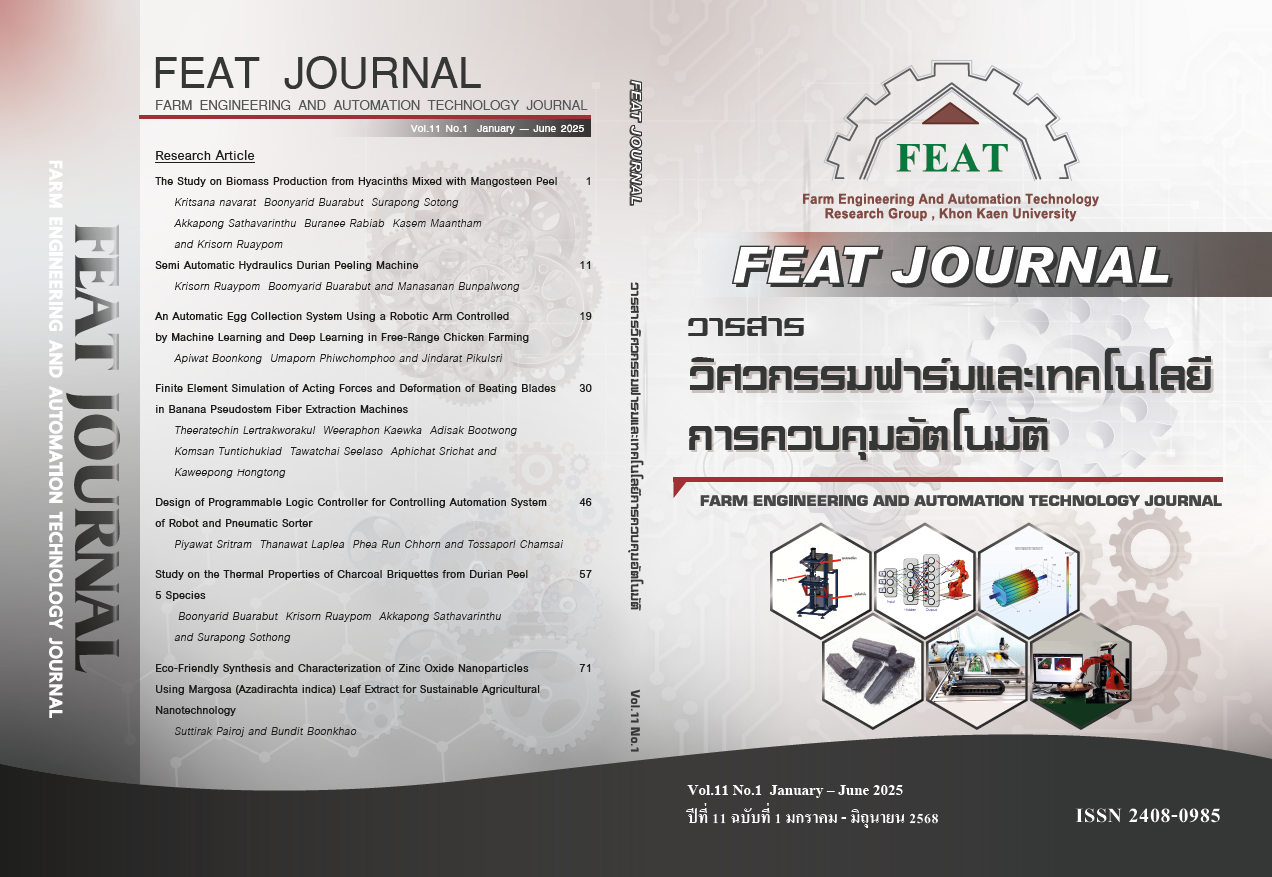
การสังเคราะห์และวิเคราะห์ลักษณะของอนุภาคนาโนซิงค์ออกไซด์ที่เป็นมิตรต่อสิ่งแวดล้อมโดยใช้สารสกัดจากใบสะเดา (Azadirachta indica) เพื่อประยุกต์ใช้ในนาโนเทคโนโลยีทางการเกษตรอย่างยั่งยืน
Article Sidebar
Main Article Content
บทคัดย่อ
This study presents a sustainable method for synthesizing zinc oxide nanoparticles (ZnO NPs) using aqueous leaf extracts of Azadirachta indica (Margosa), serving as natural reducing and capping agents. The green synthesis approach aligns with environmentally conscious practices by eliminating harmful chemicals and minimizing toxic byproducts. The physicochemical characteristics of the ZnO NPs were thoroughly investigated using established analytical techniques. UV-Vis spectroscopy identified a distinct absorption peak at 363 nm, and the direct band-gap energy was calculated as 3.4 eV. FTIR analysis confirmed the involvement of biomolecules, such as proteins, aromatic compounds, and alcohols, in the reduction and stabilization processes. SEM imaging revealed the formation of agglomerated nanoparticles, while EDX confirmed the elemental composition of zinc and oxygen. DLS measurements estimated the average particle size to be approximately 47.2 nm. The results support the viability of using agricultural plant-based materials for the eco-friendly and cost-efficient production of metal oxide nanoparticles, contributing to advancements in green nanotechnology within agricultural and farm engineering applications.
Article Details

อนุญาตภายใต้เงื่อนไข Creative Commons Attribution-NonCommercial-NoDerivatives 4.0 International License.
วารสารวิศวกรรมฟาร์มและเทคโนโลยีควบคุมอัตโนมัติ (FEAT Journal) มีกําหนดออกเป็นราย 6 เดือน คือ มกราคม - มิถุนายน และ กรกฎาคม - ธันวาคม ของทุกปี จัดพิมพ์โดยกลุ่มวิจัยวิศวกรรมฟาร์มและเทคโนโลยีควบคุมอัตโนมัติ คณะวิศวกรรมศาสตร์มหาวิทยาลัยขอนแก่น เพื่อเป็นการส่งเสริมและเผยแพร่ความรู้ ผลงานทางวิชาการ งานวิจัยทางด้านวิศวกรรมศาสตร์และเทคโนโลยีพร้อมทั้งยังจัดส่ง เผยแพร่ตามสถาบันการศึกษาต่างๆ ในประเทศด้วย บทความที่ตีพิมพ์ลงในวารสาร FEAT ทุกบทความนั้นจะต้องผ่านความเห็นชอบจากผู้ทรงคุณวุฒิในสาขาที่เกี่ยวข้องและสงวนสิทธิ์ ตาม พ.ร.บ. ลิขสิทธิ์ พ.ศ. 2535
เอกสารอ้างอิง
Mohd Yusof H, Mohamad R, Zaidan UH, Abdul Rahman NA. Microbial synthesis of zinc oxide nanoparticles and their potential application as an antimicrobial agent and a feed supplement in animal industry: a review. J Anim Sci Biotechnol. 2019;10:57.
Li N, Jiao F, Pan X, Ding Y, Feng J, Bao X. Size effects of ZnO nanoparticles in bifunctional catalysts for selective syngas conversion. ACS Catal. 2018;9(2):960–6.
Strunk J, Kähler K, Xia X, Muhler M. The surface chemistry of ZnO nanoparticles applied as heterogeneous catalysts in methanol synthesis. Surf Sci. 2009;603(10–12):1776–83.
Wahab R, Hwang IH, Kim YS, Musarrat J, Siddiqui MA, Seo HK, et al. Non-hydrolytic synthesis and photo-catalytic studies of ZnO nanoparticles. Chem Eng J. 2011;175:450–7.
Hegde VN, MV V, PT M, HB C. Study on structural, morphological, elastic and electrical properties of ZnO nanoparticles for electronic device applications. J Sci Adv Mater Devices. 2024;9(3).
Djurišić AB, Ng AMC, Chen XY. ZnO nanostructures for optoelectronics: material properties and device applications. Prog Quantum Electron. 2010;34(4):191–259.
Gbur T, Čuba V, Múčka V, Nikl M, Knížek K, Pospíšil M, et al. Photochemical preparation of ZnO nanoparticles. J Nanopart Res. 2011;13(10):4529–37.
Sun L, Wang Y, Wang R, Wang R, Zhang P, Ju Q, et al. Physiological, transcriptomic, and metabolomic analyses reveal zinc oxide nanoparticles modulate plant growth in tomato. Environ Sci Nano. 2020;7(11):3587–604.
Garza-Alonso CA, Juarez-Maldonado A, Gonzalez-Morales S, Cabrera-De la Fuente M, Cadenas-Pliego G, Morales-Diaz AB, et al. ZnO nanoparticles as potential fertilizer and biostimulant for lettuce. Heliyon. 2023;9(1):e12787.
Lin D, Xing B. Phytotoxicity of nanoparticles: inhibition of seed germination and root growth. Environ Pollut. 2007;150(2):243–50.
Tymoszuk A, Wojnarowicz J. Zinc oxide and zinc oxide nanoparticles impact on in vitro germination and seedling growth in Allium cepa L. Materials (Basel). 2020;13(12):2744.
Mirakhorli T, Ardebili ZO, Ladan-Moghadam A, Danaee E. Bulk and nanoparticles of zinc oxide exerted their beneficial effects by conferring modifications in transcription factors, histone deacetylase, carbon and nitrogen assimilation, antioxidant biomarkers, and secondary metabolism in soybean. PLoS One. 2021;16(9):e0256905.
Xun H, Ma X, Chen J, Yang Z, Liu B, Gao X, et al. Zinc oxide nanoparticle exposure triggers different gene expression patterns in maize shoots and roots. Environ Pollut. 2017;229:479–88.
Pejam F, Ardebili ZO, Ladan-Moghadam A, Danaee E. Zinc oxide nanoparticles mediated substantial physiological and molecular changes in tomato. PLoS One. 2021;16(3):e0248778.
Faizan M, Bhat JA, Chen C, Alyemeni MN, Wijaya L, Ahmad P, et al. Zinc oxide nanoparticles (ZnO-NPs) induce salt tolerance by improving the antioxidant system and photosynthetic machinery in tomato. Plant Physiol Biochem. 2021;161:122–30.
Wang XP, Li QQ, Pei ZM, Wang SC. Effects of zinc oxide nanoparticles on the growth, photosynthetic traits, and antioxidative enzymes in tomato plants. Biol Plant. 2018;62(4):801–8.
Pedruzzi DP, Araujo LO, Falco WF, Machado G, Casagrande GA, Colbeck I, et al. ZnO nanoparticles impact on the photosynthetic activity of Vicia faba: effect of particle size and concentration. NanoImpact. 2020;19:100246.
Faizan M, Faraz A, Yusuf M, Khan ST, Hayat S. Zinc oxide nanoparticle-mediated changes in photosynthetic efficiency and antioxidant system of tomato plants. Photosynthetica. 2018;56(2):678–86.
Yin H, Casey PS, McCall MJ, Fenech M. Effects of surface chemistry on cytotoxicity, genotoxicity, and the generation of reactive oxygen species induced by ZnO nanoparticles. Langmuir. 2010;26(19):15399–408.
Kumari M, Khan SS, Pakrashi S, Mukherjee A, Chandrasekaran N. Cytogenetic and genotoxic effects of zinc oxide nanoparticles on root cells of Allium cepa. J Hazard Mater. 2011;190(1–3):613–21.
Malik A, Alshehri MA, Alamery SF, Khan JM. Impact of metal nanoparticles on the structure and function of metabolic enzymes. Int J Biol Macromol. 2021;188:576–85.
A S, A S, N M. Role of zinc nutrition for increasing zinc availability, uptake, yield, and quality of maize (Zea mays L.) grains: an overview. Commun Soil Sci Plant Anal. 2020;51(15):2001–21.
Xie J, Wang H, Duan M, Zhang L. Synthesis and photocatalysis properties of ZnO structures with different morphologies via hydrothermal method. Appl Surf Sci. 2011;257(15):6358–63.
Gerbreders V, Krasovska M, Sledevskis E, Gerbreders A, Mihailova I, Tamanis E, et al. Hydrothermal synthesis of ZnO nanostructures with controllable morphology change. CrystEngComm. 2020;22(8):1346–58.
Laudise RA, Ballman AA. Hydrothermal synthesis of zinc oxide and zinc sulfide. J Phys Chem. 2002;64(5):688–91.
Hasnidawani JN, Azlina HN, Norita H, Bonnia NN, Ratim S, Ali ES. Synthesis of ZnO nanostructures using sol-gel method. Procedia Chem. 2016;19:211–6.
Brayner R, Dahoumane SA, Yepremian C, Djediat C, Meyer M, Coute A, et al. ZnO nanoparticles: synthesis, characterization, and ecotoxicological studies. Langmuir. 2010;26(9):6522–8.
Jadoun S, Chauhan NPS, Zarrintaj P, Barani M, Varma RS, Chinnam S, et al. Synthesis of nanoparticles using microorganisms and their applications: a review. Environ Chem Lett. 2022;20(5):3153–97.
Mutukwa D, Taziwa RT, Khotseng L. A review of plant-mediated ZnO nanoparticles for photodegradation and antibacterial applications. Nanomaterials (Basel). 2024;14(14):1097.
Khanpara P, Jadeja Y. A complete review on medicinal plant: margosa tree. J Med Plants Stud. 2022;10(5):131–40.
Sekhar EC, Rao KSVK, Rao KMS, Alisha SB. A simple biosynthesis of silver nanoparticles from Syzygium cumini stem bark aqueous extract and their spectrochemical and antimicrobial studies. J Appl Pharm Sci. 2018;8(1):73–9.
Bhuyan T, Mishra K, Khanuja M, Prasad R, Varma A. Biosynthesis of zinc oxide nanoparticles from Azadirachta indica for antibacterial and photocatalytic applications. Mater Sci Semicond Process. 2015;32:55–61.
Sangeetha G, Rajeshwari S, Venckatesh R. Green synthesis of zinc oxide nanoparticles by Aloe barbadensis Miller leaf extract: structure and optical properties. Mater Res Bull. 2011;46(12):2560–6.
Hassan MS, Naz N, Ali H, Ali B, Akram M, Ali B, et al. Morphoanatomical and physiological adaptations of Triticum aestivum L. against allelopathic extract of Trianthema portulacastrum L. (Horse purslane). ACS Omega. 2023;8(39):35874–83.
Khan I, Saeed K, Khan I. Nanoparticles: properties, applications and toxicities. Arab J Chem. 2019;12(7):908–31.
Ezealisiji KM, Siwe-Noundou X, Maduelosi B, Nwachukwu N, Krause RWM. Green synthesis of zinc oxide nanoparticles using Solanum torvum (L) leaf extract and evaluation of the toxicological profile of the ZnO nanoparticles–hydrogel composite in Wistar albino rats. Int Nano Lett. 2019;9(2):99–107.
Gharpure S, Ankamwar B. Albizia lebbeck-mediated ZnO phytosynthesis and their non-antimicrobial and biocompatibility studies. Appl Nanosci. 2022;13(6):4497–513.
Saputra IS, Yulizar Y. Biosynthesis and characterization of ZnO nanoparticles using the aqueous leaf extract of Imperata cylindrica L. IOP Conf Ser Mater Sci Eng. 2017;188:012014.
Ngoepe NM, Mbita Z, Mathipa M, Mketo N, Ntsendwana B, Hintsho-Mbita NC. Biogenic synthesis of ZnO nanoparticles using Monsonia burkeana for use in photocatalytic, antibacterial and anticancer applications. Ceram Int. 2018;44(14):16999–7006.
