
Reducing Preform Material Loss through Process Improvement in Small-Sized Carbonated Beverage Bottling
Article Sidebar
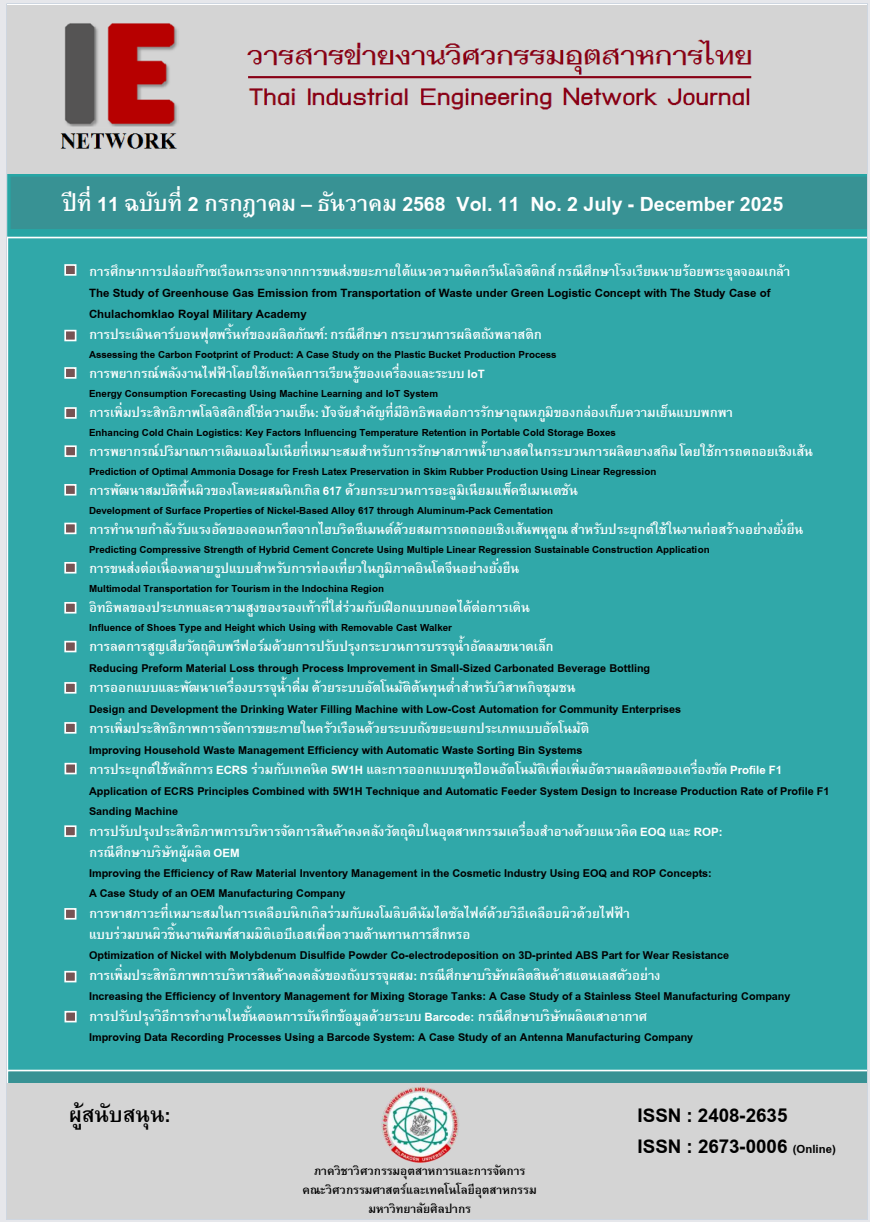
Main Article Content
Abstract
This research aimed to reduce preform material loss in a small-sized carbonated beverage bottling process. The study was conducted in five steps: (1) studying the production process, (2) collecting material loss data, (3) prioritizing potential causes, (4) identifying root causes, and (5) implementing process improvements. Three critical points with the highest material loss were identified: the blowing machine, the liquid level detection unit, and the preform dumping area. To analyze the root causes, the Why-Why analysis technique was applied together with a fishbone diagram to systematically categorize contributing factors. The improvement actions included applying the Centerline (CL) technique to standardize cap conveyor settings and the Cleaning, Inspection, and Lubrication (CIL) technique to ensure machine condition reliability. Standard operating procedures and inspection checklists were also developed.
The results showed that the material loss rate across the three points decreased from 8.26% to 1.16%, a reduction of 7.10%. This resulted in a cost reduction from approximately 6.46 million THB per year to 1.43 million THB per year, or 77.91%. Moreover, the proposed improvement approach can be extended to other production lines using similar machinery.
Article Details

This work is licensed under a Creative Commons Attribution-NonCommercial-NoDerivatives 4.0 International License.
บทความ ข้อมูล เนื้อหา รูปภาพ ฯลฯ ที่ได้รับการตีพิมพ์ในวารสารฯ ถือเป็นลิขสิทธิ์ของวารสารฯ หากบุคคลหรือหน่วยงานใดต้องการนำทั้งหมดหรือส่วนหนึ่งส่วนใดไปเผยแพร่ต่อหรือเพื่อกระทำการใดๆ จะได้รับอนุญาต แต่ห้ามนำไปใช้เพื่่อประโยชน์ทางธุรกิจ และห้ามดัดแปลง
References
ศูนย์อัจฉริยะเพื่ออุตสาหกรรมอาหาร. รายงานวิเคราะห์ตลาดเครื่องดื่ม [อินเทอร์เน็ต]. 2567. [เข้าถึงเมื่อ 13 ต.ค. 2567]. Available from: https://fic.nfi.or.th/market-intelligence-detail.php?smid=369
ผู้จัดการออนไลน์. เทรนด์ล้ำขวด PET บรรจุภัณฑ์แห่งยุค [อินเทอร์เน็ต]. 2567. [เข้าถึงเมื่อ 13 ต.ค. 2567]. Available from:
https://gotomanager.com/content/203/
ธนากร เมียงอารมณ์ และวรวิทย์ ลีลาวรรณ.การเพิ่มประสิทธิภาพกระบวนการเคลื่อนย้ายบรรจุภัณฑ์น้ำดื่มบรรจุขวด โดยใช้แนวคิดไคเซ็น: กรณีศึกษาโรงงานน้ำดื่ม. วารสารวิจัยเทคโนโลยีอุตสาหกรรม มหาวิทยาลัยราชภัฏพระนคร. 2563; 2(1): 1–8.
ชัยวัฒน์ กิตติเดชา และอภิชาติ ชัยกลาง.การปรับปรุงประสิทธิภาพของกระบวนการผลิตน้ำดื่มบรรจุขวดด้วยเทคนิคการศึกษางาน. วารสารเทคโนโลยีการผลิตและการจัดการ. 2565; 1:1–9.
ณัฏฐ์ณพัชร์ อ่อนตาม. เทคนิคการบริหารงานแบบ PDCA (Deming Cycle) Management Techniques. วารสารสมาคมพัฒนาวิชาชีพการบริหารการศึกษาแห่งประเทศไทย วารสารสมาคมพัฒนาวิชาชีพการบริหารการศึกษาแห่งประเทศไทย มหาวิทยาลัยราชกัฏอุบลราชธานี. 2562; 3: 1-8.
Thai Display. ไคเซ็น (Kaizen) คืออะไร [อินเทอร์เน็ต]. 2567 [เข้าถึงเมื่อ 13 ต.ค. 2567]. Available from:
https://www.thaidisplay.com/kaizen.
ศักชัย อรุณรัศมีเรือง.ไคเซ็น : หัวใจสู่ความสำเร็จของอุตสาหกรรมญี่ปุ่น.วารสาร ธุรกิจปริทัศน์ มหาวิทยาลัยหัวเฉียวเฉลิมพระเกียรติ. 2556; 1: 1-12.
Joel D. Levitt. Leadership Skills for Maintenance Supervisors and Managers. Boca Raton, FL: CRC Press; 2021.
lshikawa K. What is Total Quality Control? The Japanese Way. Prentice-Hall; 1985.
สุพัฒตรา ศรีญาณลักษณ์และปัณณาภัสส์ ปุณณภาศศิภัส. การลดของเสียในกระบวนการผลิตเส้นใยสังเคราะห์ไนลอน.วารสารข่ายงานวิศวกรรมอุตสาหการไทย. 2566; 1: 1-11
ธนิดา สุนารักษ์. การปรับปรุงประสิทธิภาพการผลิต กรณีศึกษาสายการบรรจุผลิตภัณฑ์แป้ง.วารสารข่ายงานวิศวกรรมอุตสาหการไทย.2559; 3: 51-60.
วรุทัย เดชตานนท์ และจิรวัฒน์ โลพันดุง.การเพิ่มผลผลิตในขั้นตอนการบรรจุน้้าดื่ม กรณีศึกษา โรงผลิตน้้าดื่มทับแก้ว มหาวิทยาลัยราชภัฏนครราชสีมา.วารสารวิชาการวิทยสารบูรณาการเทคโนโลยีอุตสาหกรรมและวิศวกรรมประยุกต์2564; 2: 62-74.
ประภาพรรณ เกษราพงศ์และสุพัฒตรา ศรีญาณลักษณ์. การลดข้อบกพร่องในกระบวนการผลิตตู้แช่อาหารด้วยเทคนิคซิกซ์ ซิกม่า.วิศวกรรมสารเกษมบัณฑิต. 2562; 2: 9-28.
อฐิลักษณ์ เตียวติ, บุญชัย แซ่สิ้ว, ศุภชัย วรรัตน์. การปรับปรุงกระบวนการผลิตเพื่อลดของเสียในกระบวนการผลิต โดยใช้หลัก ควบคุมคุณภาพ 7 อย่าง :กรณีศึกษาการผลิตขึ้นรูปพลาสติกด้วยระบบสุญญากาศ. เอกสารสืบเนื่องจากการประชุมวิชาการข่ายงานวิศวกรรมอุตสาหการ ประจำปี พ.ศ. 2557 30-31 ตุลาคม 2557; สมุทรปราการ. หน้า 1-6.
Wilson P. Root Cause Analysis: The Core of Problem Solving and Corrective Action. Milwaukee, WI: ASQ Quality Press; 1999.
Andersen B, Fagerhaug T. Root Cause Analysis. 2nd ed. Milwaukee, WI: ASQ Quality Press; 2006.
Mahmoud MA, Maravelakis MS. Root cause analysis of an out-of-control process using a logical analysis of data and an exponentially weighted moving average control chart. J Intell Manuf. 2023;34(2):589-602.
Liker, J. K.The Toyota way: 14 management principles from the world's greatest manufacturer. New York. McGraw-Hill. (2004).
