
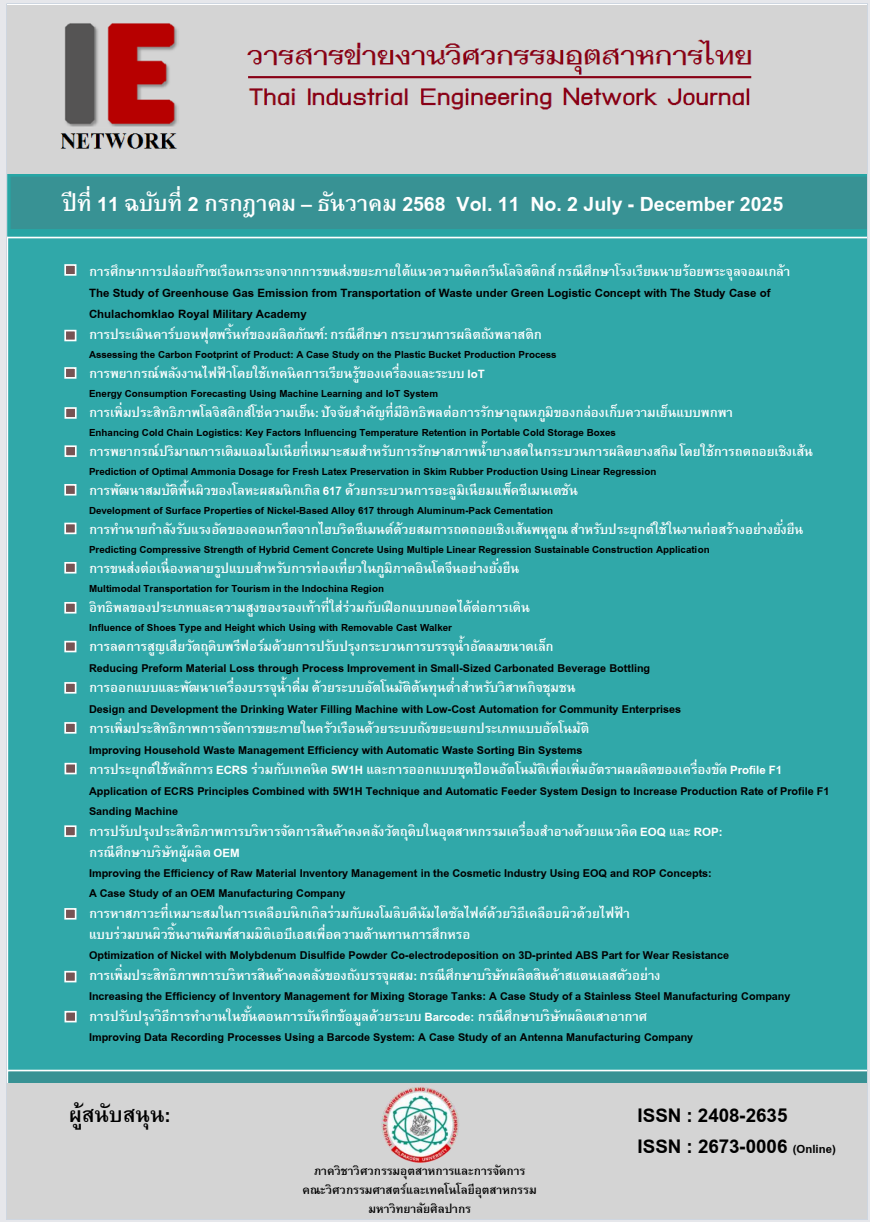
การพยากรณ์พลังงานไฟฟ้าโดยใช้เทคนิคการเรียนรู้ของเครื่องและระบบ IoT
Article Sidebar
Main Article Content
บทคัดย่อ
งานวิจัยนี้นำเสนอแบบจำลองการพยากรณ์ปริมาณการใช้พลังงานไฟฟ้าของเครื่องปรับอากาศในห้องเซิร์ฟเวอร์ ด้วยการใช้การเรียนรู้ของเครื่อง (Machine learning : ML) และระบบอินเตอร์เน็ตของสรรพสิ่ง (Internet of Things : IoT) การศึกษานี้รวบรวมข้อมูลอุณหภูมิ ความชื้นภายนอกห้องเซิร์ฟเวอร์ ค่าพลังงานไฟฟ้าของเครื่องปรับอากาศโดยใช้เทคโนโลยี IoT วิธีดำเนินการศึกษาแบ่งออกเป็น 3 ส่วน คือ ส่วนแรกรวบรวมข้อมูลอุณหภูมิ ความชื้น และค่าพลังงานไฟฟ้าด้วยระบบ IoT ส่วนที่สองสร้างแบบจำลองการพยากรณ์ปริมาณพลังงานไฟฟ้า ในบทความนี้ได้เลือกวิธีการพยากรณ์ 4 วิธีได้แก่ LSTM Bi-LSTM ANN และ ARIMA ส่วนสุดท้ายทำการเปรียบเทียบผลลัพธ์จากค่า MSE RMSE และ MAPE ผลการศึกษาพบว่า ระบบ IoT สามารถเก็บรวบรวมข้อมูลได้อย่างแม่นยำและรวดเร็ว ส่วน Machine Learning ช่วยเพิ่มความแม่นยำในการพยากรณ์ค่าพลังงานไฟฟ้าโดยสามารถเรียนรู้รูปแบบจากข้อมูลจำนวนมากที่เก็บผ่าน IoT ได้อย่างมีประสิทธิภาพ ส่วนการพยากรณ์ค่าพลังงานไฟฟ้านั้น วิธี LSTM เป็นโมเดลที่ได้ผลที่ดีที่สุดในด้านของความแม่นยำ โดยพิจารณาจากค่า MSE และ RMSE ที่ต่ำที่สุด ในขณะที่ ARIMA มีค่า MAPE ต่ำที่สุด ซึ่งแสดงให้เห็นว่าวิธี LSTM เหมาะสมสำหรับการพยากรณ์ค่าพลังงานไฟฟ้าในการศึกษานี้มากที่สุด อย่างไรก็ตามการเลือกรูปแบบการพยากรณ์ขึ้นอยู่กับลักษณะของปัญหาและความต้องการในการใช้งานจริง รูปแบบการพยากรณ์นี้ช่วยให้ผู้ใช้สามารถประเมินการใช้พลังงานล่วงหน้าและจัดการพลังงานอย่างมีประสิทธิภาพได้
Article Details

อนุญาตภายใต้เงื่อนไข Creative Commons Attribution-NonCommercial-NoDerivatives 4.0 International License.
บทความ ข้อมูล เนื้อหา รูปภาพ ฯลฯ ที่ได้รับการตีพิมพ์ในวารสารฯ ถือเป็นลิขสิทธิ์ของวารสารฯ หากบุคคลหรือหน่วยงานใดต้องการนำทั้งหมดหรือส่วนหนึ่งส่วนใดไปเผยแพร่ต่อหรือเพื่อกระทำการใดๆ จะได้รับอนุญาต แต่ห้ามนำไปใช้เพื่่อประโยชน์ทางธุรกิจ และห้ามดัดแปลง
เอกสารอ้างอิง
ปรีชา อาการศ และ กูสกานา กูบาฮา. การศึกษาความสัมพันธ์ระหว่างอุณหภูมิภายนอกและการใช้พลังงานของเครื่องปรับอากาศของอาคารอเนกประสงค์มหาวิทยาลัยเทคโนโลยีพระจอมเกล้าธนบุรี. วารสารวิชาการประชุมสภาข้าราชการ พนักงาน และลูกจ้าง มหาวิทยาลัยแห่งประเทศไทย (ปขมท). 2562; 8(2): 80-89.
อัชญา สีหะสิงห์ และ ศุทธา ศรีเผด็จ. ความชื้นในห้องพักที่มีห้องน้้าในตัวส่งผลต่อค่าไฟฟ้าจากเครื่องปรับอากาศ. วารสารสาระศาสตร์. 2564; ฉบับที่ 4: 908-919.
นรินทร์ พนาวาส. การพัฒนาระบบเฝ้าระวังความปลอดภัยห้องดาต้าเซ็นเตอร์ด้วยเทคโนโลยีอินเทอร์เน็ตเพื่อสรรพสิ่ง. วารสารสหศาสตร์ศรีปทุม ชลบุรี. 2567; 10(1): 61-76.
อรรถกร เก่งพล และ อลงกรณ์ คล้ายคลึง. การประยุกต์ใช้ตัวแบบโครงข่ายประสาทเทียมแบบคอนโวลูชัน และตัวแบบทางคณิตศาสตร์ในการคัดแยกมะนาวตามมาตรฐานสินค้าเกษตร เลขที่ มกษ. 27-2560 โดยใช้เครื่องจักรเรียนรู้. เอกสารสืบเนื่องจากการประชุมวิชาการข่ายงานวิศวกรรมอุตสาหการประจำปี พ.ศ. 2567. 15-17 พฤษภาคม พ.ศ. 2567; โรงแรมเซ็นทารา. จังหวัดอุบลราชธานี; 2567. หน้า 497-505.
Laghrissi F, Douzi S, Douzi K, Hssina B. 2021. “Intrusion detection systems using long short term memory (LSTM)”. Big Data, Vol. 8(1).
Naik D, Jaidhar CD. A novel Multi‑Layer Attention Framework for visual description prediction using bidirectional LSTM. International Journal of Big Data. 2022; 9.
Punyota W, Kengpol A. 2021. “Prediction of Vegetarian Food Preferences for the Aging Society”, Proceeding of the International Conference on Engineering and Technology; 2021 May 27-28; Krabi, Thailand. 2021.
Wen T, Liu Y, Bai YH, Liu H, et al. Modeling and forecasting CO2 emissions in China and its regions using a novel ARIMA-LSTM model. International Journal of Heliyon. 2023; 9.
ทรรศมล วงศ์จิตสุขเกษม และ ดาริชา สุธีวงศ์. การพยากรณ์ราคาเศษเหล็กในประเทศไทยโดยใช้เทคนิคทางสถิติและการเรียนรู้ของเครื่อง. เอกสารสืบเนื่องจากการประชุมวิชาการข่ายงานวิศวกรรมอุตสาหการประจำปี พ.ศ. 2567. 15-17 พฤษภาคม พ.ศ. 2567; โรงแรมเซ็นทารา. จังหวัดอุบลราชธานี; 2567. หน้า 255-261.
ไกรวิทย์ ชูชาต. การพัฒนาระบบตรวจวัดการใช้พลังงานไฟฟ้าในอาคารบนแพลตฟอร์มอินเทอร์เน็ตของสรรพสิ่ง กรณีศึกษาอาคารศรีวิศววิทยา [วิทยานิพนธ์ วิศวกรรมศาสตรมหาบัณฑิต]. มหาวิทยาลัยสงขลานครินทร์. 2565.
Wassef Hasan M. 2023. Building an IoT temperature and humidity forecasting model based on long short-term memory (LSTM) with improved whale optimization algorithm. International Journal of Memories - Materials, Devices, Circuits and Systems. 2023; 6.
ภาณุเดช คุณชม. การพยากรณ์การใช้พลังงานไฟฟ้าของอาคารสำนักงานด้วยแบบจำลองการขับเคลื่อนด้วยข้อมูล [อินเตอร์เน็ต]. 2565. [เข้าถึงเมื่อ 23 พฤศจิกายน 2564]. เข้าถึงได้จาก: https://libdoc.dpu.ac.th/thesis/Panudet.Khun.pdf
Balaji S, Karthik S. Energy Prediction in IoT Systems Using Machine Learning Models. International Journal of Computers, Materials & Continua. 2022; 75(1): 443-459.
Faiq M, Tan KG, Liew CP, Hossain F, Tso C, Lim LL, et al. Prediction of energy consumption in campus buildings using long short-term memory. International Journal of Alexandria Engineering. 2023; 67: 65-76.
El-Azab HI, Swief RA, El-Amary NH, Temraz HK. Machine and deep learning approaches for forecasting electricity price and energy load assessment on real datasets. International Journal of Ain Shams Engineering. 2024; 15(4).
Berriel RF, Lopes AT, Rodrigues A, Varejão FM, Oliveira-Santos T. Proceedings of the International Joint Conference on Neural Networks (IJCNN); 2017 May 4-19; Anchorage, AK, USA. 2017. p.4283-4290
