Effects of rice bran protein-anthocyanin complex particle on antioxidant and textural property of processed cheese
Keywords:
Processed cheese, Anthocyanin, Rice bran protein, Complex component, AntioxidantAbstract
Rice bran protein-anthocyanin complex particle (PAP) was prepared by replacing a sodium salt emulsifier used for producing processed cheese. The rice bran protein was isolated from the bran of parboiled rice and anthocyanin was extracted from Riceberry broken rice. Anthocyanin at 5 (PAP-5), 10
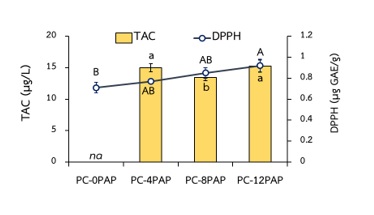
(PAP-10), and 15 (PAP-15) mL were used to produce PAP and they formed PAP by 79.8%, 15.4%, and 58.2%, respectively. The PAP-15 showed the highest DPPH antioxidant activity of 331 µg GAE/g. It was selected to use as the material for the preparation of processed cheese (PC) by adding into the control formula at 4 (PC/PAP4), 8 (PC/PAP8), and 12 (PC/PAP12) g. As the content of PAP-15 increased, the lightness of the cheese decreased. The DPPH activity of the PAP cheeses were 1.1-1.3 times higher than that of the control. The hardness of cheeses with PAP-15 (184.31-295.40 g) were significantly lower than that of the control (595.42 g). It could caused by that the PAP-15 particles interrupted the forming of the protein network in the processed cheese. A further study on the improvement of the textural property of the PC, such as using PAP with hydrocolloids and alternative emulsifiers, in order to develop processed chees with PAP with an antioxidant benefit that is accepted by consumers.
References
สาโรจน์ รอดคืน และสิริรุ่ง วงศ์สกุล. (2556). การผลิตโปรตีนเข้มข้นจากรำข้าวอินทรีย์ด้วยกรรมวิธีแบบเกษตรอินทรีย์เปรียบเทียบกับวิธีดั้งเดิม. (รายงานการวิจัย , มหาวิทยาลัยแม่ฟ้าหลวง).
AOAC. (2005). Official Methods of Analysis of AOAC International (18th Eds). MD, USA: AOAC International.
Černíková, M., Buňka, F., Pospiech, M., Tremlová, B., Hladká, K., Pavlínek, V., & Březina, P. (2010). Replacement of traditional emulsifying salts by selected hydrocolloids in processed cheese production. International Dairy Journal, 20(5), pp. 336-343.
Chittapalo, T., & Noomhorm, A. (2009). Ultrasonic assisted alkali extraction of protein from defatted rice bran and properties of the protein concentrates. International Journal of Food Science & Technology, 44(9), pp. 1843-1849.
Giusti, M. M., & Wrolstad, R. E. (2001). Characterization and measurement of anthocyanins by UV-visible spectroscopy. Current Protocols in Food Analytical Chemistry, 00(1), pp. F1.2.1-F1.2.13.
Jiamyangyuen, S., Nuengchamnong, N., & Ngamdee, P. (2017). Bioactivity and chemical components of Thai rice in five stages of grain development. Journal of Cereal Science, 74, pp. 136-144.
Ju, M., Zhu, G., Huang, G., Shen, X., Zhang, Y., Jiang, L., & Sui, X. (2020). A novel pickering emulsion produced using soy protein-anthocyanin complex nanoparticles. Food Hydrocolloids, 99, pp. 105329.
Li, H., Qin, A., Yu, H., Han, Y., Zheng, S., Li, H., & Yu, J. (2020). Effects of pre-emulsification with heat-treated whey protein on texture and microstructure of processed cheese. LWT, 124, pp. 109185.
Mozuraityte, R., Berget, I., Mahdalova, M., Grønsberg, A., Øye, E. R., & Greiff, K. (2019). Sodium reduction in processed cheese spreads and the effect on physicochemical properties. International Dairy Journal, 90, pp. 45-55.
Ngamdee, P., & Jiamyangyuen, S. (2018). Effective antioxidant activities of anthocyanins as affected by pH of antioxidant assays. Walailak Journal of Science and Technology (WJST), 16(11), pp. 875-885.
Onmankhong, J., Jongyingcharoen, J. S., & Sirisomboon, P. (2021). The influence of processing parameters of parboiled rice on its physiochemical and texture properties. Journal of Texture Studies, 52(2), pp. 219-227.
Přikryl, J., Hájek, T., Švecová, B., Salek, R. N., Černíková, M., Červenka, L., & Buňka, F. (2018). Antioxidant properties and textural characteristics of processed cheese spreads enriched with rutin or quercetin: The effect of processing conditions. LWT, 87, pp. 266-271.
Settapramote, N., Laokuldilok, T., Boonyawan, D., & Utama-ang, N. (2018). Physiochemical, antioxidant activities and anthocyanin of Riceberry rice from different locations in Thailand. Food and Applied Bioscience Journal, 6(Special), pp. 84–94.
Shahbazi, M., Jäger, H., & Ettelaie, R. (2021). Application of pickering emulsions in 3D printing of personalized nutrition. Part II: functional properties of reduced-fat 3D printed cheese analogues. Colloids and Surfaces A: Physicochemical and Engineering Aspects, 624, pp. 126760.
Zhang, H. J., Zhang, H., Wang, L., & Guo, X. N. (2012). Preparation and functional properties of rice bran proteins from heat-stabilized defatted rice bran. Food Research International, 47(2), pp. 359-363.
Downloads
Published
How to Cite
Issue
Section
License
Copyright (c) 2024 SCIENCE AND TECHNOLOGY RESEARCH JOURNAL NAKHON RATCHASIMA RAJABHAT UNIVERSITY

This work is licensed under a Creative Commons Attribution-NonCommercial-NoDerivatives 4.0 International License.
เนื้อหาและข้อมูลในบทความที่ลงตีพิมพ์ในวารสารวิจัย วิทยาศาสตร์และเทคโนโลยี มหาวิทยาลัยราชภัฏนครราชสีมา ถือเป็นข้อคิดเห็นและความรับผิดชอบของผู้เขียนบทความโดยตรงซึ่งกองบรรณาธิการวารสาร ไม่จำเป็นต้องเห็นด้วย หรือร่วมรับผิดชอบใด ๆ
บทความ ข้อมูล เนื้อหา รูปภาพ ฯลฯ ที่ได้รับการตีพิมพ์ในวารสารวิจัย วิทยาศาสตร์และเทคโนโลยี มหาวิทยาลัยราชภัฏนครราชสีมา ถือเป็นลิขสิทธิ์ของวารสารวิจัย วิทยาศาสตร์และเทคโนโลยี มหาวิทยาลัยราชภัฏนครราชสีมา หากบุคคลหรือหน่วยงานใดต้องการนำทั้งหมดหรือส่วนหนึ่งส่วนใดไปเผยแพร่ต่อหรือเพื่อกระทำการใด ๆ จะต้องได้รับอนุญาตเป็นลายลักอักษรจากวารสารวิจัย วิทยาศาสตร์และเทคโนโลยี มหาวิทยาลัยราชภัฏนครราชสีมา ก่อนเท่านั้น