Optimization of mimosine extraction using experimental design
Keywords:
Mimosine, Experimental design, Box–Behnken method, Response surface methodology, Natural deep eutectic solventAbstract
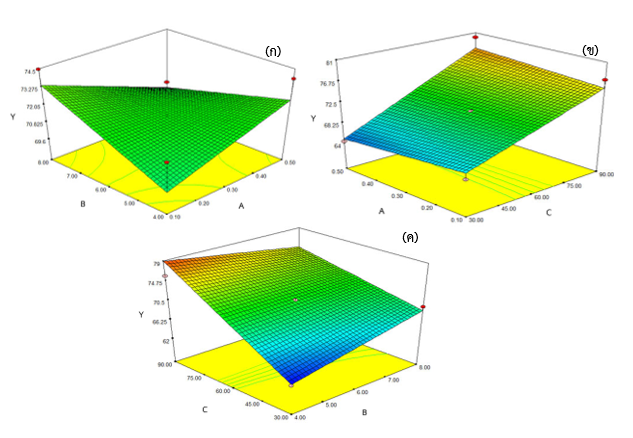
Mimosine is free amino acid, mainly found in lead tree (Leucaena leucocephala). The objective of this research was to study the optimization conditions for extraction of mimosine from young leaves of Leucana Leucocephala using aqueous choline chloride solution as a natural deep eutectic solvent (NADES) by the maceration method. The factors affecting the extraction of mimosine from young leaves of Leucana Leucocephala were concentration NADES, pH, time, the volume of NADES and temperature. The Box–Behnken method and response surface methodology (RSM) were used for experimental design. The obtained extracts solution of mimosine, were analyzed by UV Visible spectroscopy at 282 nm. At a NADES concentration of 0.50 molal pH 6 and an extraction time of 90 minutes, the maximum amount of mimosine was 80.03 ± 2.29 mg/g, and at 50.00 ml volume of NADES, pH 7 and temperature of 90 °C, the maximum amount of mimosine was 76.46 ± 0.95 mg/g. Studies have shown that extraction of mimosine from young leaves of Leucana Leucocephala with NADES improves the efficiency of the mimosine extraction than conventional extraction with hot water.
References
ประไพศรี สุทัศน์ ณ อยุธยา และพงศ์ชนัน เหลืองไพบูลย์. (2551). การออกแบบและวิเคราะห์การทดลอง (Design and Analysis of Experiments). สมุทรปราการ: สำนักพิมพ์ท้อป.
Anitha, R., Jayavelu, S., & Murugesan, K. (2005). Antidermatophytic and bacterial activity of mimosine. Phytotherapy Research, 19(11), pp.992-993. https://doi.org/10.1002/ptr.1761
Brewbaker, J. L., & Hylin, J. W. (1965). Variation in mimosine content among Leucaena species and related Mimosaceae. Crop Science, 5(4), pp.348-351. https://doi.org/10.2135/cropsci1965.0011183X000500040019x
Champanerkar, P.A., Vaidya, V.V., Shailajan, S. & Menon, S.N. (2010). A sensitive, rapid and validated liquid chromatography ? tandem mass spectrometry (LC-MS-MS) method for determination of Mimosine in Mimosa pudica Linn. Natural Science, 2(7), pp.689-695. https://doi.org/10.4236/ns.2010.27088
Chang, H. C., Liu, L. T., Hung, W. C., & Wang, C. J. (1999). Mimosine inhibits proliferation of hepatoma cells by inducing apoptosis through mitochondrial stress. Toxicology and Applied Pharmacology, 157(1), pp.52-60. https://doi.org/10.1006/taap.1999.8677
Dai, Y., Gold, B., Vishwanatha, J. K., & Rhode, S. L. (1994). Mimosine inhibits viral DNA synthesis through ribonucleotide reductase. Virology, 205(1), pp.210-216. https://doi.org/10.1006/viro.1994.1636
Dai, Y., van Spronsen, J., Witkamp, G.-J., Verpoorte, R., & Choi, Y. H. (2013). Natural deep eutectic solvents as new potential media for green technology. Analytica Chimica Acta, 766, pp.61-68. https://doi.org/10.1016/j.aca.2012.12.019
Hallak, M., Vazana, L., Shpilberg, O., Levy, I., Mazar, J., & Nathan, I. (2008). A molecular mechanism for mimosine-induced apoptosis involving oxidative stress and mitochondrial activation. Apoptosis, 13(1), pp.147-155. https://doi.org/10.1007/s10495-007-0156-7
Honda, M. D. H., & Borthakur, D. (2019). Mimosine concentration in Leucaena leucocephala under various environmental conditions. Tropical Grasslands-Forrajes Tropicales, 7(2), pp.164-172. https://doi.org/10.17138/TGFT(7)164-172
Ilham, Z., Hamidon, H., & Rosji, N.A. (2015). Extraction and quantification of toxic compound mimosine from biomass residues of Leucaena leucocephala. Procedia Chemistry, 16, pp.164-170. https://doi.org/10.1016/j.proche.2015.12.029
Kubota, S., Fukumoto, Y., Ishibashi, K., Soeda, S., Kubota, S., Yuki, R., Nakayama, Y., Aoyama, K., Yamaguchi, N., & Yamaguchi, N. (2014). Activation of the prereplication complex is blocked by mimosine through reactive oxygen species-activated ataxia telangiectasia mutated (ATM) protein without DNA damage. Journal of Biological Chemistry, 289(9), pp.5730-5746. https://doi.org/10.1074/jbc.M113.546655
Lalitha, K. & Kulothungan, S. R. (2004). Determination of mimosine by a sensitive indirect spectrophotometric method. Talanta, 63(3), pp.635-640. https://doi.org/10.1016/j.talanta.2003.12.006
Méchali, M. (2010). Eukaryotic DNA replication origins: Many choices for appropriate answers. Nature Reviews Molecular Cell Biology, 11(10), pp.728-738. https://doi.org/10.1038/nrm2976
Montgomery, D. C. (2017). Design and Analysis of Experiments (9th ed.). New York: John Wiley & Sons.
Nair, L. S., Menon, S. N., Shailajan, S., Baing, M. M., & Sane, R. T. (2007). Reverse phase high performance thin layer chromatographic quantification of mimosine from whole plant of Mimosa pudica Linn. Journal of Planar Chromatography – Modern TLC, 20(1), pp.49-51. https://doi.org/10.1556/jpc.20.2007.1.7
Nguyen, B. C. Q., Chompoo, J., & Tawata, S. (2015). Insecticidal and Nematicidal Activities of Novel Mimosine Derivatives. Molecules, 20(9), pp.16741-16756. https://doi.org/10.3390/molecules200916741
Nguyen, V. H., & Tawata, S. (2016). Mimosine: Biosynthesis and biological activities. Journal of Agricultural and Food Chemistry, 64(22), pp.4237-4245. https://doi.org/10.1002/ptr.5636
Puchala, R., Davis, J. J., & Sahlu, T. (1996). Determination of mimosine and 3,4-dihydroxypyridine in milk and plasma of goats. Journal of Agricultural and Food Chemistry, 685(2), pp.375-378.https://doi.org/10.1016/S0378-4347(96)00221-6
Ramesh, S., Venkatesan, G., Karthikeyan, K., Sundari, C. K., & Chandran, C. (2021). Studies on the active components of sensitive plant Mimosa pudica L. (Mimosaceae). Plant Cell Biotechnology and Molecular Biology, 22(57&58), pp.88-96.
Renz J. (1936). Uber das mimosin. Zeitschrift fur Physiologische Chemie, 244, pp.153-158.
Sahid, I., Ishak, M. S., Bajrai, F. S., Jansar, K. M., & Yusoff, N. (2017). Quantification and herbicidal activity of mimosine from Leucaena leucocephala (Lam.) de Wit. Transactions on Science and Technology, 4(2), pp.62-67.
Tangendjaja, B. & Wills, R. B. H. (1980). Analysis of mimosine and 3-hydroxy-4(1H)-pyridone by high- performance liquid chromatography, Journal of Chromatography A . 202(2), pp.317-318. https://doi.org/10.1016/S0021-9673(00)81746-X
Watson, P. A., Hanauske-Abel, H. H., Fiint, A. & Lalande, M. (1991). Mimosine arrests cell cycle progression at the G1-Sphase border. Cytometry, 12(3), pp.242–246. https://doi.org/10.1002/cyto.990120306
Wu, C., Yuan, H., Jia G., Wang, Z. & Wu, X. (2011). Determination of Mimosine and 2,3-Dihydroxypyridine in Leucaena leucocephala by Reversed Phase High-Performance Liquid Chromatography. Applied Mechanics and Materials, 140, pp.296-301. https://doi.org/10.4028/www.scientific.net/AMM.140.296
Downloads
Published
How to Cite
Issue
Section
License
Copyright (c) 2025 SCIENCE AND TECHNOLOGY RESEARCH JOURNAL NAKHON RATCHASIMA RAJABHAT UNIVERSITY

This work is licensed under a Creative Commons Attribution-NonCommercial-NoDerivatives 4.0 International License.
เนื้อหาและข้อมูลในบทความที่ลงตีพิมพ์ในวารสารวิจัย วิทยาศาสตร์และเทคโนโลยี มหาวิทยาลัยราชภัฏนครราชสีมา ถือเป็นข้อคิดเห็นและความรับผิดชอบของผู้เขียนบทความโดยตรงซึ่งกองบรรณาธิการวารสาร ไม่จำเป็นต้องเห็นด้วย หรือร่วมรับผิดชอบใด ๆ
บทความ ข้อมูล เนื้อหา รูปภาพ ฯลฯ ที่ได้รับการตีพิมพ์ในวารสารวิจัย วิทยาศาสตร์และเทคโนโลยี มหาวิทยาลัยราชภัฏนครราชสีมา ถือเป็นลิขสิทธิ์ของวารสารวิจัย วิทยาศาสตร์และเทคโนโลยี มหาวิทยาลัยราชภัฏนครราชสีมา หากบุคคลหรือหน่วยงานใดต้องการนำทั้งหมดหรือส่วนหนึ่งส่วนใดไปเผยแพร่ต่อหรือเพื่อกระทำการใด ๆ จะต้องได้รับอนุญาตเป็นลายลักอักษรจากวารสารวิจัย วิทยาศาสตร์และเทคโนโลยี มหาวิทยาลัยราชภัฏนครราชสีมา ก่อนเท่านั้น