Using the iNaturalist Application to Promote Science Learning Outside the Classroom through a Natural Learning Resource (Community Forest : Khao Noi)
Keywords:
Science Learning, Digital Technology, iNaturalist, Natural Learning ResourcesAbstract
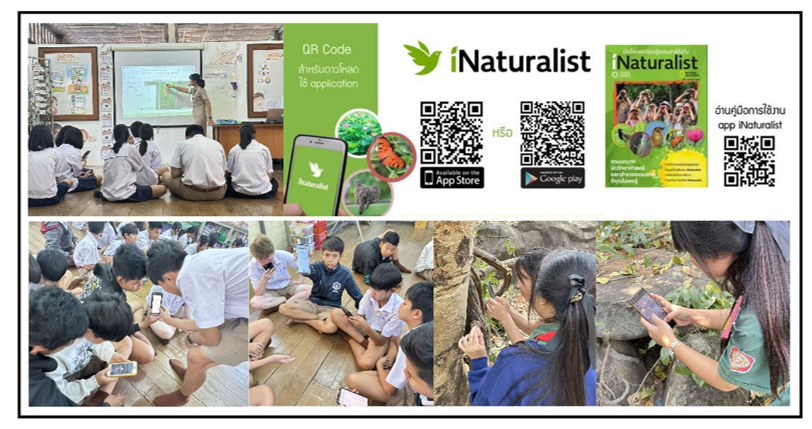
This research aimed to: 1) develop an outdoor natural learning resource at "Phu Khao Noi Community Forest"; 2) examine students' satisfaction with the use of the iNaturalist application for exploring and learning about biodiversity; and 3) study students’ academic achievement in the unit "Living Things and the Environment," which integrates classroom learning with hands-on experiences in natural settings. The sample group consisted of 31 lower secondary students from Wat Cham Phak Phaeo School. The study utilized the iNaturalist application as a tool for exploring and developing the learning resource, along with lesson plans, pre- and post-tests, and a satisfaction questionnaire. The results revealed that the outdoor learning resource "Phu Khao Noi Community Forest" was rated as highly appropriate for educational activities by 21 teachers and staff (= 4.19, SD = 0.50), particularly in terms of biodiversity and its alignment with science content. Students showed a statistically significant improvement in academic achievement after the learning activities (t = 17.62, p < 0.05) and expressed a positive level of satisfaction with the use of the iNaturalist application (= 3.17, SD = 0.61). The findings suggest that integrating natural learning environments with digital technology is a practical approach to enhancing modern science education. It is especially suitable for youth development, as it fosters scientific process skills through meaningful learning in outdoor contexts.
References
กระทรวงศึกษาธิการ. (2544). การวัดผลสัมฤทธิ์ทางการเรียน. กรุงเทพมหานคร: โรงพิมพ์มหาวิทยาลัยศรีนคริน ทรวิโรฒ.
กระทรวงศึกษาธิการ. (2560). หลักสูตรแกนกลางการศึกษาขั้นพื้นฐาน พุทธศักราช 2551 (ฉบับปรับปรุง พ.ศ. 2560). กรุงเทพมหานคร: โรงพิมพ์ชุมนุมสหกรณ์การเกษตรแห่งประเทศไทย จำกัด.
ชัชวาลย์ สุนทรสวัสดิ์. (2566). โครงการ Explore: เครือข่ายการวิจัยด้านการจัดการภูมิทัศน์ป่าไม้ในเอเชียตะวันออกเฉียงใต้. วารสารศึกษาธรรมชาติ, 19(2), น.60-75.
ดวงใจ สระทอง. (2564). การศึกษาแนวทางการใช้ iNaturalist ในการเรียนการสอนในประเทศไทย. วารสารวิทยาศาสตร์การศึกษา, 23(4), น.98-112.
ทรงพล พวงทอง. (2564). การศึกษาความรู้และการใช้งานแอป iNaturalist สำหรับการเรียนการสอน. วารสารเทคโนโลยีการศึกษา, 13(1), น.50-65.
นภัสสร ชาญสงค์. (2566). การใช้แหล่งเรียนรู้ภายนอกห้องเรียนเพื่อเสริมทักษะกระบวนการทางวิทยาศาสตร์ในโรงเรียน.วารสารวิทยาศาสตร์การศึกษา, 21(3), น.76-85.
นัทธพงศ์ พิชิตชัย. (2564). การประยุกต์ใช้ iNaturalist ในการเรียนการสอนสิ่งแวดล้อม. วารสารวิจัยทางธรรมชาติ, 18(2), น.95-104.
วรรณี แกมเกตุ. (2555). การวัดผลและประเมินผลการเรียนรู้. กรุงเทพมหานคร: สำนักพิมพ์แห่งจุฬาลงกรณ์มหาวิทยาลัย.
วิจารณ์ ภาควิจิต. (2566). ป่าชุมชนในฐานะแหล่งเรียนรู้ในหลักสูตรวิทยาศาสตร์. วารสารการศึกษาธรรมชาติ, 21(4), น.50-66.
ศิริภา สกุลมานะ. (2565). ผลของการใช้แอป iNaturalist ต่อการเรียนรู้ของนักเรียนในวิชาวิทยาศาสตร์. วารสารการเรียนการสอน, 20(1), น.89-98.
School Beyond the Horizon. (2566). รายงานโครงการ School Beyond the Horizon: การส่งเสริมการเรียนรู้เชิงปฏิบัติและการตระหนักรู้ทางนิเวศวิทยาผ่านกิจกรรม Citizen Science ในโรงเรียนชนบทประเทศไทย. page facebook ห้องเรียนสุดขอบฟ้า. https://www.facebook.com/HorizonHomeschool?_rdc=1&_rdr#
Ballard, H. L., Dixon, C. G. H., & Harris, E. M. (2017). Youth-focused citizen science: Examining the role of environmental science learning and agency for conservation. Biological Conservation, 208, pp.65-75.
Borg, W. R., & Gall, M. D. (1989). Educational research: An introduction (5th ed.). New York: Longman. Donnelly, D. (2024). Biodiverse Thailand: Conservation for Species at Risk. https://www.academia.edu/118001856/Biodiverse_Thailand_Conservation_for_Species_at_Risk
Echeverria, A., Ariz, I., Moreno, J., Peralta, J., & Gonzalez, E. M. (2021). Learning Plant Biodiversity in Nature: The Use of the Citizen–Science Platform iNaturalist as a Collaborative Tool in Secondary Education. Sustainability, 13(2), pp.1-12. https://doi.org/10.3390/su13020735
Forti, L. R. (2023). Connecting science education to biodiversity and conservation with citizen science and project-based learning in Brazil. Journal of Environmental Education Research, 29(1), pp.15-30.
Herodotou, C., Ismail, N., Benavides Lahnstein, A. I., Aristeidou, M., Young, A. N., Johnson, R. F., Higgins, L.M., Khanaposhtani, M. G., Robinson, L. D., & Ballard, H. L. (2023). Young people in iNaturalist: A blended learning framework for biodiversity monitoring. International Journal of Science Education, Part B, 14(2), pp.129-156.
Liu, Y. L., & Jiralerspong, T. (2023). Network analysis of the iNaturalist citizen science community. arXiv preprint. https://doi.org/10.48550/arXiv.2310.10693
Nugent, A., Clemmer, M., & Kennedy, L. (2022). Engaging students with biodiversity: Using the iNaturalist platform in environmental education. Journal of Environmental Education, 53(1), pp.1-12.
Price, C. A., Lee, H.-S., & Malatesta, K. (2014). Driving student interest and engagement in citizen science: Exploring the impact of features and motivations. Science Education, 98(4), pp.663-685.
Richey, R. C., & Klein, J. D. (2007). Design and development research: Methods, strategies, and issues. Mahwah, New Jersey: Lawrence Erlbaum Associates.
Rickinson, M., Severin, T., & Hall, G. (2022). School-based outdoor learning in natural environments: A global review of effectiveness. Environmental Education Review, 18(4), pp.322-338.
Stevenson, R., Merrill, C., & Burn, P. (2021). Useful biodiversity data were obtained by novice observers using iNaturalist during college orientation retreats. Citizen Science: Theory and Practice, 6(1), p.27.
Toral, S. L., Banos, R., & Martinez, E. (2022). Using iNaturalist to engage students in environmental science and ecology: A study of educational outcomes. International Journal of Environmental and Science Education, 17(4), pp.215-229.
Villaseñor, N. R., Porter, A. T., & Lara, R. J. (2020). Enhancing biology education through field-based use of the iNaturalist app. Science Education International, 31(4), pp.328-337.
Downloads
Published
How to Cite
Issue
Section
License
Copyright (c) 2025 SCIENCE AND TECHNOLOGY RESEARCH JOURNAL NAKHON RATCHASIMA RAJABHAT UNIVERSITY

This work is licensed under a Creative Commons Attribution-NonCommercial-NoDerivatives 4.0 International License.
เนื้อหาและข้อมูลในบทความที่ลงตีพิมพ์ในวารสารวิจัย วิทยาศาสตร์และเทคโนโลยี มหาวิทยาลัยราชภัฏนครราชสีมา ถือเป็นข้อคิดเห็นและความรับผิดชอบของผู้เขียนบทความโดยตรงซึ่งกองบรรณาธิการวารสาร ไม่จำเป็นต้องเห็นด้วย หรือร่วมรับผิดชอบใด ๆ
บทความ ข้อมูล เนื้อหา รูปภาพ ฯลฯ ที่ได้รับการตีพิมพ์ในวารสารวิจัย วิทยาศาสตร์และเทคโนโลยี มหาวิทยาลัยราชภัฏนครราชสีมา ถือเป็นลิขสิทธิ์ของวารสารวิจัย วิทยาศาสตร์และเทคโนโลยี มหาวิทยาลัยราชภัฏนครราชสีมา หากบุคคลหรือหน่วยงานใดต้องการนำทั้งหมดหรือส่วนหนึ่งส่วนใดไปเผยแพร่ต่อหรือเพื่อกระทำการใด ๆ จะต้องได้รับอนุญาตเป็นลายลักอักษรจากวารสารวิจัย วิทยาศาสตร์และเทคโนโลยี มหาวิทยาลัยราชภัฏนครราชสีมา ก่อนเท่านั้น