Effects of Dried Lemongrass Leaf (Cymbopogon citratus) Supplement in Diets on the Growth Performance of Nile Tilapia (Oreochromis niloticus)
Keywords:
Dried Lemongrass leaves, Growth performance, Nile tilapiaAbstract
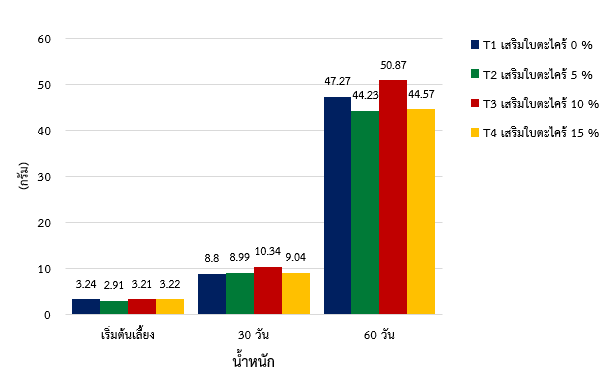
The study aimed to study the growth efficiency of Nile tilapia supplemented with dried lemongrass leaves at four different levels 0, 5, 10 and 15 %, The fish were cultured in cages with dimensions of 1 x 1 x 1.20 m. wide and 100 percent deep, The fish were cultured at a density of 50 fish per cage and feed with protein 30 % in every treatment, The experiment was designed in a completely randomized design (CRD) for 60 days, At the end of the experiment, the third treatment supplemented with 10 percent dried lemongrass leaves had a final growth rate in terms of weight of 50.87±14.63 g., length of 13.30±1.30 cm., daily weight gain of 2.04±0.12 g./day, and specific growth rate of 45.52±0.09 %/day, The feed conversion ratio was 0.52±0.08, the feed efficiency was 1.93±0.81 with no statistical difference (p>0.05), and the weight gain was 47.66±0.06 g. with statistical difference (p<0.05), The first treatment without supplementing lemongrass leaves had the highest survival rate of 85±0.01 % with statistical difference (p<0.05), That the addition of dried lemongrass leaves in the formula has no statistical effect, but adding dried lemongrass in the formula in an appropriate amount can increase the growth performance of Nile tilapia.
References
เกวลิน หนูฤทธิ์ และพัชนี บุญเอก. (2566). สถานการณ์สินค้าปลานิลและผลิตภัณฑ์ปี 2565 และแนวโน้มปี 2566.
กรมประมง กระทรวงเกษตรและสหกรณ์. https://www.fisheries.go.th/strategy/fisheconomic/
Monthly%20report/tilapia/12.%E0%B8%AA%E0%B8%96%E0%B8%B2%E0%B8%99%E0%B8%81%E0%B8%B2%E0%B8%A3%E0%B8%93%E0%B9%8C%E0%B8%9B%E0%B8%A5%E0%B8%B2%E0%B8%99%E0%B8%B4%E0%B8%A5%20Q4%2065%20%E0%B8%9B%E0%B8%A3%E0%B8%B1%E0%B8%9A%2020.03.66-Copy.pdf
เกตุนภัส ศรีไพโรจน์, รุ่งกานต์ กล้าหาญ, พงศ์นรินทร์ เมฆขุนทด, และทองอยู่ อุดเลิศ. (2556). การเปรียบเทียบอัตราการเจริญเติบโตของสายพันธุ์ปลานิลที่เลี้ยงในจังหวัดพะเยา. วารสารเกษตร, 29(2), น.137-144.
ธวัช กิตติบัญชากุล, ชัยภูมิ บัญชาศักดิ์, จำเริญ เที่ยงธรรม, สุพัตร์ ฟ้ารุ่งสาง, และปราโมทย์ สฤษดิ์นิรันดร์. (2558).
ประสิทธิภาพน้ำมันหอมระเหยต่อการยับยั้งเชื้อแบคทีเรียก่อโรคในสัตว์ปีก. ในการประชุมทางวิชาการของมหาวิทยาลัยเกษตรศาสตร์ ครั้งที่ 53 (น.859). กรุงเทพฯ: สำนักพิมพ์มหาวิทยาลัยเกษตรศาสตร์.
นพดล ศุกระกาญจน์, กฤษณะ เรืองคล้าย, และพันธสิทธิ์ โชคสวัสดิกร. (2563). ผลของการเสริมน้ำมันหอมระเหยในอาหารต่อการเจริญเติบโต องค์ประกอบเลือด ภูมิคุ้มกันแบบไม่จำเพาะ และความต้านทานโรคของปลานิล (Oreochromis niloticus). Thai Science and Technology Journal (TSTJ), 29(2), น.203-215.
ไมตรี ดวงสวัสดิ์ และจารุวรรณ สมศิริ. (2528). คุณสมบัติน้ำและวิธีการวิเคราะห์สำหรับการวิจัยทางการตกปลา. ใน ไมตรี ดวงสวัสดิ์ และจารุวรรณ สมศิริ (บ.ก.), คุณภาพน้ำและวิธีการวิเคราะห์เพื่อการวิจัยประมง. (น.93). กรุงเทพฯ: สถาบันประมงน้ำจืดแห่งชาติ (กรมประมง).
รพรรณี เผ่าทองสุข, ยุคลธร สถาปนศิริ, วัลวิภา เสืออุดม, และวิภาพรรณ ขณะภักดี. (2562). การเปรียบเทียบคุณภาพน้ำและการเจริญเติบโตของปลาสลิดในบ่อเลี้ยงปลาสลิดแบบดั้งเดิม แบบผสมผสาน และแบบภูมิปัญญา. (รายงานวิจัยฉบับสมบูรณ์, มหาวิทยาลัยหัวเฉียวเฉลิมพระเกียรติ).
รักชนก ภูพัฒน, วุฒิชัย ศรีช่วย, และมูฮัมหมัดคอย ยูโซะ. (2560). การเปรียบเทียบสารออกฤทธิ์ชีวภาพจาก ลำต้นและใบของตะไคร้หอมในพื้นที่จังหวัดนราธิวาส. วารสารนราธิวาสราชนครินทร์, 9(1), น.136-142.
วิมล จันทรโรทัย. (2536). อาหารสัตว์น้ำความก้าวหน้าของการศึกษาความต้องการสารอาหารของปลาและกุ้ง. ใน วิมล จันทรโรทัย (บ.ก.), 50 ปี คณะประมง. (น.99-106). กรุงเทพฯ: มหาวิทยาลัยเกษตรศาสตร์.
สมัชชา สุวรรณกาญจน์, ณรงค์ชัย โมใหญ่, รุ่งกานต์ กล้าหาญ, สุริยัญ แสงหงษ์, และสุนทรี ชาญกิจ. (2562). กิจกรรมของเอนไซม์ทริปซิน และไคโมทริปซิน และอัตราส่วนของเอนไซม์ทริปซิน/ไคโมทริปซิน (T/C ratio) ในทางเดินอาหารของปลาเวียนที่อุณหภูมิต่างกัน. วารสารแก่นเกษตร, 47(ฉบับพิเศษ 1), น.1217-1224.
สุทัศน์ เผือกจีน และยงยุทธ ทักษิณ. (2544). การเลี้ยงปลานิลเพศผู้ 3 สายพันธุ์ในบ่อดิน. กรมประมง กระทรวงเกษตรและสหกรณ์. https://elibonline.fisheries.go.th/elib/cgi-bin/opacexe.exe?op=856x1&db=Main&skin=u&lpp=20&pat=%CA%D8%B7%D1%C8%B9%EC+%E0%BC%D7%CD%A1%A8%D5%B9+%E1%C5%D0%C2%A7%C2%D8%B7%B8+%B7%D1%A1%C9%D4%B3&cat=aut&a=2&b=2&f=2&u=%2Fbooks%2F2027.pdf&a8l=7E9C6402D8147BE230A34063&bid=1221&a8k=48739
Boyd, C.E. (1990). Water quality in ponds for aquaculture. In Boyd, C.E. (Ed.) (p.482). Water quality in ponds for aquaculture (First edition). Alabama: Auburn University.
Campos, J., Schmeda-Hirschmann, G., Leiva, E., Guzmán, L., Orrego, R., Fernández, P., & Aguayo, C. (2014). Lemon grass (Cymbopogon citratus (D.C) Stapf) polyphenols protect human umbilical vein endothelial cell (HUVECs) from oxidative damage induced by high glucose, hydrogen peroxide and oxidized low density lipoprotein. Food Chemistry, 151, pp.175-181.
Chitmanat, C. (2013). Effects of herbal products on fish immunity. KKU Research Journal (Graduate Studies), 18(2), pp.257-268.
Chakraborty S.B., Mazumdar D., Chatterji U., & Banerjee S. (2011). Growth of mixed-sex and monosex Nile tilapia in different culture systems. Turkish Journal of Fisheries and Aquatic Sciences, 11, pp.131-138.
Dangkulwanich, M. & Charaslertrangsi, T. (2020). Hydrodistillation and antimicrobial properties of lemongrass oil (Cymbopogon citratus, Stapf) : An undergraduate laboratoryexercise bridging chemistry and microbiology. Journal of food science education, 19(2), pp.41-48.
Harikrishnan, R., Balasundaram, C., & Heo, M. S. (2011). Impact of plant products on innate and adaptive immune system of cultured finfish and shellfish. Aquaculture, 317, pp.1-15.
Leite, J. R., Seabra, M. V., Maluf, E., Assokut, K., Sucheki, D., Tufik, S., & Caclini, E. A. (1986). Pharmacology of lemon grass (Cymbopogon citratus, Stapf) III. Assessment of eventual toxic, hypnotic and anxiolytic effects on humans. Journal of Ethnopharmacology, 17, pp.75-81.
Marcusso, P. F., Aguinaga, J. Y., Claudiano, G. S., Eto, S. F., Fernandes, D. C., Mello, H., Marinho Neto, F. A., Salvador, R., Moraes, J. R. E., & Moraes, F. R. (2015). Influence of temperature on Streptococcus agalactiae infection in Nile tilapia. Brazilian Journal of Veterinary Research and Animal Science, 52(1), pp.57-62.
Reverter, M., Bontemps, N., Lecchini, D., Banaigs, B., & Sasal, P. (2014). Use of plant extracts in fish aquaculture as an alternative to chemotherapy Current status and future perspectives. Aquaculture, 433, pp.50-61.
Santoso, U., Lee, M. C., & Nan, F. H. (2013). Effects of dietary katuk leaf extract on growth performance, feeding behavior and water quality of grouper Epinephelus coioides. Aceh International Journal of Science and Technology, 2(1), pp.17-25.
Shah, G., Shri, R., Panchal, V., Sharma, N., Singh, B., & Mann, A. S. (2011). Scientific basis for the therapeutic use of Cymbopogon citratus, Stapf (Lemon grass). Journal of Advanced Pharmaceutical Technology & Research, 2(1), pp.3–8.
Soltan, M. A., Hanafy, M. A., & Wafa, M. I. A. (2008). Effect of replacing fish meal by a mixture of different plant protein sources in Nile Tilapia (Oreochromis niloticus L.) diets. Global Veterinaria, 2(4), pp.157-164.
Solomon, B., Sahle, F.F., Gebre-Mariam, T., Asres, K, & Neubert, R.H.H. (2012). Microencapsulation of citronella oil for mosquito-repellent application: Formulation and in vitro permeation studies. European. Journal of Pharmaceutics and Biopharmaceutics, 80, pp.61-66.
Thangam, R., Suresh, V., & Kannan, S. (2014). Optimized extraction of polysaccharides from Cymbopogon citratus and its biological activities. International journal of biological macromolecules, 65, pp.415-423.
Venzon, L., Mariano, B. N. L., Somensi, B. L., Boeing, T., Souza, P. de, Wagner, M. T., Andrade, F. S. de, Luciane Nesello, N. A., & Silva, M. L. da. (2018). Essential oil of Cymbopogon citratus (lemon grass) and geraniol, but not citral, promote gastric healing activity in mice. Biomedicine & Pharmacotherapy, 98, pp.118–124.
Downloads
Published
How to Cite
Issue
Section
License
Copyright (c) 2025 SCIENCE AND TECHNOLOGY RESEARCH JOURNAL NAKHON RATCHASIMA RAJABHAT UNIVERSITY

This work is licensed under a Creative Commons Attribution-NonCommercial-NoDerivatives 4.0 International License.
เนื้อหาและข้อมูลในบทความที่ลงตีพิมพ์ในวารสารวิจัย วิทยาศาสตร์และเทคโนโลยี มหาวิทยาลัยราชภัฏนครราชสีมา ถือเป็นข้อคิดเห็นและความรับผิดชอบของผู้เขียนบทความโดยตรงซึ่งกองบรรณาธิการวารสาร ไม่จำเป็นต้องเห็นด้วย หรือร่วมรับผิดชอบใด ๆ
บทความ ข้อมูล เนื้อหา รูปภาพ ฯลฯ ที่ได้รับการตีพิมพ์ในวารสารวิจัย วิทยาศาสตร์และเทคโนโลยี มหาวิทยาลัยราชภัฏนครราชสีมา ถือเป็นลิขสิทธิ์ของวารสารวิจัย วิทยาศาสตร์และเทคโนโลยี มหาวิทยาลัยราชภัฏนครราชสีมา หากบุคคลหรือหน่วยงานใดต้องการนำทั้งหมดหรือส่วนหนึ่งส่วนใดไปเผยแพร่ต่อหรือเพื่อกระทำการใด ๆ จะต้องได้รับอนุญาตเป็นลายลักอักษรจากวารสารวิจัย วิทยาศาสตร์และเทคโนโลยี มหาวิทยาลัยราชภัฏนครราชสีมา ก่อนเท่านั้น