Optimum Hot Air Drying Condition for Shallot with Pandanus Powder
Keywords:
Shallot with pandanus powder, drying temperature, drying time, ratio of shallot powder and pandanus powder, total phenolic content, antioxidant activityAbstract
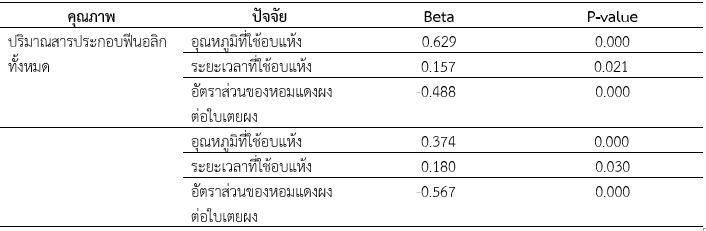
This research was conducted to investigate effects of drying conditions by using hot air oven on the qualities of shallot with pandanus powder and to optimum the optimal drying conditions for shallot with pandanus powder. Drying conditions were drying temperature i.e. 60 70 and 80 "C and drying time i.e. 10 11 and 12 h. Ratio of shallot powder and pandanus powder were 1:1 3:1 and 5:1. Qualities of shallot with pandanus powder were total phenolic content and antioxidant activity. The results indicated drying conditions and ratio of shallot powder and pandanus powder significantly affect to total phenolic content and antioxidant activity of shallot with pandanus powder. The optimal drying temperature and
drying time were 80 degree Celsius and 10 h, respectively. The optimal ratio of shallot powder and pandanus powder was 1:1. This optimum condition demonstrated the highest total phenolic content about 13.61±0.04 milligrams equivalent of gallic acid per gram shallot with pandanus powder (dry weight) and antioxidant activity 12.05±0.18 milligrams equivalent of ascorbic acid per gram shallot with pandanus powder (dry weight).
References
กัลยา วานิชย์บัญชา. (2543). การใช้ SPSS for Windows ในการวิเคราะห์ข้อมูล. กรุงเทพฯ: โรงพิมพ์ห้างหุ้นส่วนจำกัด ซี เคแอนด์ เอส โฟโต้สตูดิโอ.
ธีระวุฒิ ปัญญา. (2561). สุดยอดตำรับยาอายุวัฒนะจากผักพื้นบ้านใกล้ตัว. กรุงเทพฯ: บริษัทแฮปปี้บุ๊คพับลิชชิ่งจำกัด.
สำนักงานเศรษฐกิจการเกษตร. (2568). หอมแดง: ร้อยละและปริมาณผลผลิตจากการเก็บเกี่ยวรายดือน ระดับประเทศ รายภาคและจังหวัดปีเพาะปลูก 2566/67. http://www.oae.go.th/view/ตารางแสดงรายละเอียดหอมแดง/TH-TH
Abdulmonem, I., Manohar, C.M., Hayward, G. & Neethirajan, S. (2017). Antiproliferative activity of Ontario grown onions against colorectal adenocarcinoma cells. Food Research International, 96, pp.12-18.
Cheng, A., Chen, X., Jin, Q., Wang, W., Shi, J. & Liu, Y. (2013). Comparison of phenolic content and antioxidant capacity of red and yellow onions. Czech Journal of Food Science, 31(5), pp.501-508.
Ghasemzadeh, A. & Jaafar, H.Z. (2013). Profiling of phenolic compopunds and their antioxidant and anticancer activities in pandan (Pandanus amaryllifolius Roxb.) extracts from different locations of Malaysia. BMC Complementary and Alternative Medicine, 13(1), pp.1-9.
Jaikhamwang, N., Juapprasop, T. & Boonprakob, N. (2023). Antibacterial and antioxidant activities of shallot (Allium ascalonicum) extract in Lablae District, Uttaradit Province. Journal of Thai Traditional & Alternative Medicine, 21(3), pp.650-660.
Katsube, T., Tsurunaga, Y., Sugiyama, M., Furuno, T. & Yamasaki, Y. (2009). Effect of air-drying temperature on antioxidanr capacity and stability of polyphenolic compounds in mulberry (Morus alba L.) leaves. Food Chemistry, 113(4), pp.964-969.
Lee, W.J. & Choi, S.W. (2012). Quantitative changes in polyphenolic compounds in mulberry (Morus alba L.) leaves in relation to varieties, harvest period and heat processing. Preservative Nutrition and Food Science, 17(4), pp.280-285.
Quyen, N.T.C., Quyen, N.T.N., Nhan, L.T.H., & Toan, T.Q. (2020). Antioxidant activity, total phenolics and flavonoids contents of Pandanus amaryllifolius (Roxb.), IOP Conference Series: Material Science and Engineering (pp.1-8). Seattle, United States: Washington State Convention Center.
Musika, J. & Musika, T. (2021). Development of healthy shallot herbal tea (Allium ascalonicum L.) with antioxidant activities. Journal of Food Technology, Siam University, 16(2), pp.148-159.
Singh, B.N., Singh, B.R. & Singh, R.L. (2009). Polyphenolics from various extracts/fractions of red onion (Allium cepa) peel with potent antioxidant and antimutagenic activities. Food and Chemical Toxicology, 47(6), pp.1161-1167.
Suchada, L. (2016). Influences of modified atmosphere and drying conditions on quality of mulberry leaf powder. (Dissertation Doctor of Philosopy, Ubonratchathani University).
Viera, V.B., Piovesan, N., Rodrigues, J.B., Mello, R.O., Prestes, R.C., Santos, R.C.V., Vaucher, R.A., Hautrive, T.P. & Kubota, E.H. (2017). Extraction of phenolic compounds and evaluation of the antioxidant and antimicrobial capacity of red onion skin (Allium cepa L.). International Food Research Journal, 24(3), pp.990-999.
Yang, J., Meyers, K.J., Heide, J. & Liu, R.H. (2004). Varietal differences in phenolic content and antioxidant and antiproliferative activities in onions. Agricultural and Food Chemistry, 52(22), pp.6787-6793.
Downloads
Published
How to Cite
Issue
Section
License
Copyright (c) 2025 SCIENCE AND TECHNOLOGY RESEARCH JOURNAL NAKHON RATCHASIMA RAJABHAT UNIVERSITY

This work is licensed under a Creative Commons Attribution-NonCommercial-NoDerivatives 4.0 International License.
เนื้อหาและข้อมูลในบทความที่ลงตีพิมพ์ในวารสารวิจัย วิทยาศาสตร์และเทคโนโลยี มหาวิทยาลัยราชภัฏนครราชสีมา ถือเป็นข้อคิดเห็นและความรับผิดชอบของผู้เขียนบทความโดยตรงซึ่งกองบรรณาธิการวารสาร ไม่จำเป็นต้องเห็นด้วย หรือร่วมรับผิดชอบใด ๆ
บทความ ข้อมูล เนื้อหา รูปภาพ ฯลฯ ที่ได้รับการตีพิมพ์ในวารสารวิจัย วิทยาศาสตร์และเทคโนโลยี มหาวิทยาลัยราชภัฏนครราชสีมา ถือเป็นลิขสิทธิ์ของวารสารวิจัย วิทยาศาสตร์และเทคโนโลยี มหาวิทยาลัยราชภัฏนครราชสีมา หากบุคคลหรือหน่วยงานใดต้องการนำทั้งหมดหรือส่วนหนึ่งส่วนใดไปเผยแพร่ต่อหรือเพื่อกระทำการใด ๆ จะต้องได้รับอนุญาตเป็นลายลักอักษรจากวารสารวิจัย วิทยาศาสตร์และเทคโนโลยี มหาวิทยาลัยราชภัฏนครราชสีมา ก่อนเท่านั้น