Relationship of eutrophication, phytoplankton and water quality: some generalities in Chanthaburi River, Thailand
Keywords:
eutrophication, phytoplankton, ecological index, water quality, Chanthaburi RiverAbstract
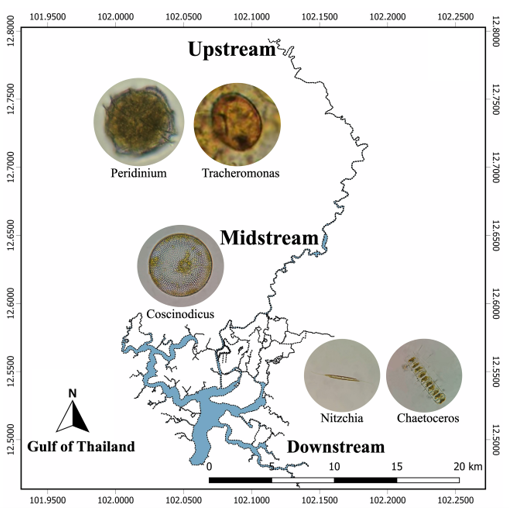
This study investigated on the interrelationships among eutrophication, phytoplankton abundance and diversity, and water quality parameters in the Chanthaburi River, Eastern Gulf of Thailand. Field surveys were conducted at upstream, midstream, and downstream sites during the rainy, winter, and summer seasons. A total of 191 phytoplankton species representing seven taxonomic classes were identified, with Bacillariophyceae and Chlorophyceae the most dominant. Chlorophyceae peaked upstream in summer, while Bacillariophyceae prevailed downstream. Ecological indices Shannon-Wiener’s diversity and Margalef’s richness were highest at the upstream during the rainy season, whereas Pielou’s evenness was maximum at the midstream in summer. Statistical analysis revealed significant positive correlations between dissolved oxygen and all ecological indices, highlighting the influence of physico-chemical gradients and hydrological variation on the community structure of phtoplankton. Overall, the longitudinal profile of Chanthaburi river indicated a mesotrophic ecological status.
References
Adams, J., Taljaard, S., van Niekerk, L., & Lemley, D.A. (2020). Nutrient enrichment as a threat to the ecological resilience and health of South African microtidal estuaries. African Journal of Aquatic Science, 45(1-2), pp.23-40.
Akinnawo, S.O. (2023). Eutrophication: Causes, consequences, physical, chemical and biological techniques for mitigation strategies. Environmental Challenges, 12, p.100733. https://doi.org/10.1016/j.envc.2023.100733
Ansari, A.A., Gill, S.S., & Khan, F.A. (2011). Eutrophication: Threat to aquatic ecosystems. In Ansari, A.A., & Gill, S.S. (Eds.), Eutrophication: Causes, consequences and control (pp.143-170) Dordrecht : Springer.
Bharathi, M.D., Venkataramana, V., & Sarma, V.V.S.S. (2022). Phytoplankton community structure is governed by salinity gradient and nutrient composition in the tropical estuarine system. Continental Shelf Research, 234, p.104643. https://doi.org/10.1016/j.csr.2021.104643
Bukowska, A., Kaliński, T., Koper, M., Kostrzewska-Szlakowska, I., Kwiatowski, J., Marzec, H.M., & Jasser, I. (2017). Predicting blooms of toxic cyanobacteria in eutrophic lakes with diverse cyanobacterial communities. Scientific Reports, 7(1), pp.1–12.
Camargo, J.A., Alonso, Á., & Puente, M. (2005). Eutrophication downstream from small reservoirs in mountain rivers of Central Spain. Water Research, 39(14), pp.3376-3384.
Chakraborty, S., Karmaker, D., Rahman, Md.A., Bali, S.C., Das, S.K., & Hossen, R. (2021). Impacts of pH and salinity on community composition, growth and cell morphology of three freshwater phytoplankton. Plant Science Today, 8(3), pp.655-661.
Cui , Z., Gao, W., Li, Y., Wang, W., Wang, H., Liu, H., Fan, P., Fohrer, N., & Wu, N. (2023). Dissolved oxygen and water temperature drive vertical spatiotemporal variation of phytoplankton community: evidence from the largest diversion water source area. International Journal of Environmental Research and Public Health, 20(5), p.4307. https://doi.org/10.3390/ijerph20054307
Desikachary, T.V. (1959). Cyanophyta. New Delhi : Indian Council of Agricultural Research. pp.12-686.
Dokulil, M.T., & Teubner, K. (2012). Deep living Planktothrix rubescens modulated by environmental constraints and climate forcing. Hydrobiologia, 698, pp.29-46.
Du, H., Chen, Z., Mao, G., Chen, L., Crittenden, L., Li, R.Y.M., & Chai, L. (2019). Evaluation of eutrophication in freshwater lakes: A new non-equilibrium statistical approach. Ecological Indicators, 102, pp.686-692.
Dutta, S., Dhan, S.A., Uddin, Sk.N., & Saha, B. (2023). Phytoplankton as an indicator of eutrophication. Ecology, Environment and Conservation, 29(3), pp.1042-1052.
Francé, J., Varkitzi, I., Stanca, E., Cozzoli, F., Skejic, S., Ungaro, N., Vascotto, I., Mozetic, P., Gladan, Z.N., Assimakopoulou, G., Pavlidou, A., Zervoudaki, S., Pagou, K., & Basset, A. (2021). Large-scale testing of phytoplankton diversity indices for environmental assessment in Mediterranean sub-regions (Adriatic, Ionian and Aegean Seas). Ecological Indicators, 126, p.107630. https://doi.org/10.1016/j.ecolind.2021.107630
Gao, W., Xiong, F., Lu, Y., Xin, W., Wang, H., Feng, G., Kong, C., Fang, L., Gao, X., & Chen, Y. (2024). Water quality and habitat drive phytoplankton taxonomic and functional group patterns in the Yangtze River. Ecological Processes, 13, p.1-15.
Gireesh, R., Varghese, M., & Thomas. V.J. (2015). Phytoplankton - collection, estimation, classification and diversity. Kochi : Central Marine Fisheries Research Institute.
Gusmaweti, & Deswati, L. (2018). Community structure, phytoplankton density and physicalchemical factor of batang palangki waters of sijunjung regency, west sumatera. IOP Conference Series: Earth and Environmental Science, 130, p.012023.
Henson, S.A., Cael, B.B., Allen, S.R., & Dutkiewicz, S. (2021). Future phytoplankton diversity in a changing climate. Nature Communications, 12, p.5372.
Huang, B., Wei, N., Hu, Y., & Mao, H. (2021). Microbial communities in water during red tides along the coast of China-A case study of Prorocentrum Donghaiense red tide in the East China Sea. Journal of Marine Science, 3(1), pp.29-38.
Huang, G., Xue, H., Liu, H., Ekkawatpanit, C., & Sukhapunnapha, T. (2019). Duality of seasonal effect and river bend in relation to water quality in the Chao Phraya River. Water, 11(4), p.656. https://doi.org/10.3390/w11040656
Jiang, H.B., Hutchins, D.A., Zhang, H.R., Feng, Y.Y., Zhanng, R.F., Sun, W.W., Ma, W., Bai, Y., Wells, M., He, D., Jiao, N., Wang, Y., & Chai, F. (2024). Complexities of regulating climate by promoting marine primary production with ocean iron fertilization. Earth-Science Reviews, 249, p.104675.
Jiang, L., & Xia, M. (2017). Wind effects on the spring phytoplankton dynamics in the middle reach of the Chesapeake Bay. Ecological Modelling, 363, pp.68-80.
Kunpradid, T., Chaimongkhon, P., & Tagun, R. (2024). Seasonal dynamics and environmental drivers of phytoplankton composition in a tropical dam over 5 years in Chiang Mai, Thailand. Trends in Science, 21(8), p.7930. https://doi.org/10.48048/tis.2024.7930
Margalef, R. (1967). Some concepts relative to the organization of plankton. Oceanography and Marine Biology - An Annual Review, 5, pp.257-289.
Marjang, N., & Merkley, G.P. (2009). Surface velocity coefficients for application of the float method in rectangular and compound open channels. Irrigation Science, 27, pp.457-470.
Meerssche, E.V., Greenfield, D.I., & Pinckney, J.L. (2018). Coastal eutrophication and freshening: Impacts on Pseudo-nitzschia abundance and domoic acid allelopathy. Estuarine, Coastal and Shelf Science, 209, pp.70-79. https://doi.org/10.1016/j.ecss.2018.05.013
Minggat, E., Roseli, W., & Tanaka, Y. (2021). Nutrient absorption and biomass production by the marine diatom Chaetoceros Muelleri: effects of temperature, salinity, photoperiod, and light intensity. Journal of Ecological Engineering, 22(1), pp.231-240. https://doi.org/10.12911/22998993/129253
Napaldet, J.T. (2023). Plant species and ecosystem diversity along national road in mountain sites: The case of Kennon Road in Cordillera Central Range, Philippines. Taiwania, 68(3), pp.339-348.
Nhien, H.T.H., & Giao, N.T. (2024). Evaluation of surface water quality using biodiversity indices in phu my species- habitat conservation area, Kien Giang Province, Vietnam. Ecological Engineering & Environmental Technology, 25(3), pp.102-112. https://doi.org/10.12912/27197050/178386
Niyoyitungiye, L, Giri, A., & Mishra, B.P. (2020). Quantitative and qualitative analysis of phytoplankton population in relation to environmental factors at the targeted sampling stations on the Burundian littoral of Lake Tanganyika. International Journal of Fisheries and Aquatic Studies, 8(1), pp.110-121.
Padisák, J., Crossetti, L.O., & Naselli-Flores, L. (2009). Use and misuse in the application of the phytoplankton functional classification: A critical review with updates. Hydrobiologia, 621(1), pp.1-19.
Prescott, G.W. (1962). Algae of the Western Great Lake Area. Dubuque Iowa : WM. C. Brown Company Publisher.
Reynolds, C.S. (2006). Ecology of phytoplankton. Cambridge: Cambridge University Press.
Sharma, B.K., & Sharma, S. (2022). Phytoplankton diversity of a demineralized urban wetland of Meghalaya State of Northeast India: The spatio-temporal variations and the role of abiotic factors. Research in Ecology, 4(2), pp.3-23.
Solórzano, G.G., Martinez, M.G.O., Vazquez, A.L., Garfias, M.B.M., Zuñiga, R.E.Q., & Conforti, V. (2011). Trachelomonas (Euglenophyta) from a eutrophic reservoir in Central Mexico. Journal of Environmental Biology, 32, pp.463-471.
Taipale, S.J., Vuorio, K., Strandberg, U., Kahilainen,K.K., Järvinen, M., Hiltunen, M., Peltomaa, E., & Kankaala, P. (2016). Lake eutrophication and brownification downgrade availability and transfer of essential fatty acids for human consumption. Environment International, 96, pp.156-166.
Thai Meteorological Department. (2024). Annual weather summary 2024. Bangkok : Ministry of Digital Economy and Society.
Tilman, D., Kilham, S.S., & Kilham, P. (1982). Phytoplankton community ecology: The role of limiting nutrients. Annual Review of Ecology and Systematics, 13, pp.349-372.
Wang, J., & Zhang, Z. (2020). Phytoplankton, dissolved oxygen and nutrient patterns along a eutrophic river-estuary continuum: Observation and modeling. Journal of Environmental Management, 261, p.110233.
Xiong, W., Li, J., Chen, Y., Shan, B., Wang, W., & Zhan, A. (2016). Determinants of community structure of zooplankton in heavily polluted river ecosystems. Scientific Reports, 6, pp.22043-22053.
Yoon, S.J., Lee, J., Kim, H.G., Kwon, B.O., Kim, J., Hong, S., & Khim, J.S. (2024). Phytoplankton assemblage responses to massive freshwater inputs and anthropogenic toxic substances contamination in the Geum River Estuary, South Korea. Marine Pollution Bulletin, 199, p.116020. https://doi.org/10.1016/j.marpolbul.2023.116020
Yu, H., Shi, X., Zhao, S., Sun, B., Liu, Y., Arvola, L., Li, G., Wang, Y., Pan, X., Wu, R., & Tian, Z. (2022). Primary productivity of phytoplankton and its influencing factors in cold and arid regions: A case study of Wuliangsuhai Lake, China. Ecological Indicators, 144, p.109545.
https://doi.org/10.1016/j.ecolind.2022.109545
Zhu, Y., Miao, Q., Lyu, H., Zheng, Y., Liu, W., Li, Y., Li, J., Chen, F., & Miao, S. (2025). An approach for mapping phytoplankton communities in freshwater lakes based on phytoplankton absorption features. Water Research, 282, p.123665. https://doi.org/10.1016/j.watres.2025.123665
Downloads
Published
How to Cite
Issue
Section
License
Copyright (c) 2025 SCIENCE AND TECHNOLOGY RESEARCH JOURNAL NAKHON RATCHASIMA RAJABHAT UNIVERSITY

This work is licensed under a Creative Commons Attribution-NonCommercial-NoDerivatives 4.0 International License.
เนื้อหาและข้อมูลในบทความที่ลงตีพิมพ์ในวารสารวิจัย วิทยาศาสตร์และเทคโนโลยี มหาวิทยาลัยราชภัฏนครราชสีมา ถือเป็นข้อคิดเห็นและความรับผิดชอบของผู้เขียนบทความโดยตรงซึ่งกองบรรณาธิการวารสาร ไม่จำเป็นต้องเห็นด้วย หรือร่วมรับผิดชอบใด ๆ
บทความ ข้อมูล เนื้อหา รูปภาพ ฯลฯ ที่ได้รับการตีพิมพ์ในวารสารวิจัย วิทยาศาสตร์และเทคโนโลยี มหาวิทยาลัยราชภัฏนครราชสีมา ถือเป็นลิขสิทธิ์ของวารสารวิจัย วิทยาศาสตร์และเทคโนโลยี มหาวิทยาลัยราชภัฏนครราชสีมา หากบุคคลหรือหน่วยงานใดต้องการนำทั้งหมดหรือส่วนหนึ่งส่วนใดไปเผยแพร่ต่อหรือเพื่อกระทำการใด ๆ จะต้องได้รับอนุญาตเป็นลายลักอักษรจากวารสารวิจัย วิทยาศาสตร์และเทคโนโลยี มหาวิทยาลัยราชภัฏนครราชสีมา ก่อนเท่านั้น