Morphological diversity and Physicochemical factors in habitat of Green Algae (Zygnemataceae) in Mueang District, Phetchabun Province, Thailand
Keywords:
Physicochemical factors, Fresh water macro-algae, Phetchabun ProvinceAbstract
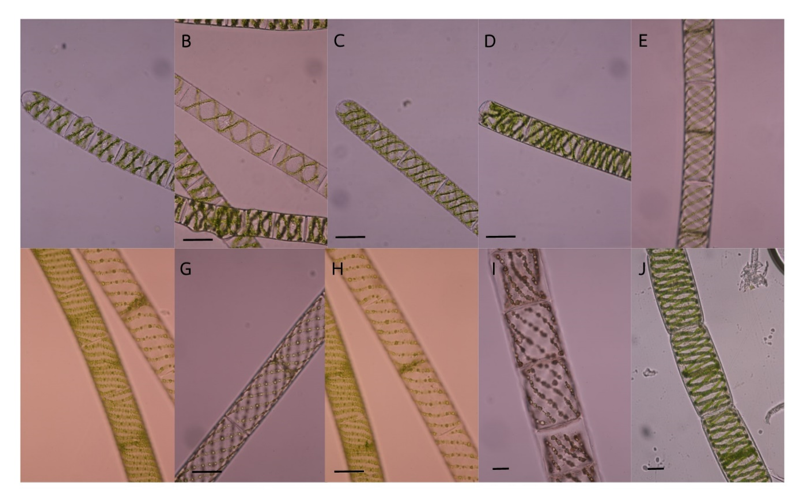
Spirogyra, a common green algae, exhibits wide distribution across various freshwater ecosystems. This study investigated the occurrence and associated environmental parameters of Spirogyra. Samples were collected from rice paddies and ponds in Mueang District, Phetchabun Province between September and November 2025. Algal identification relied on the examination of morphological characteristics under a light microscope, while water samples were concurrently analyzed for physicochemical factors, including water temperature, turbidity, pH, electrical conductivity (EC), and dissolved oxygen (DO). The findings revealed that Spirogyra was predominantly observed in the rice paddy habitats. A total of 17 distinct morphological species of Spirogyra were identified. The aquatic environments supporting their growth were characterized by lentic conditions, relatively high transparency, neutral pH, moderate DO levels, and comparatively high EC values. These physicochemical characteristics represent the optimal environmental conditions found to facilitate the successful distribution of this algae in the study area.
References
ปริญญา มูลสิน. (2559). ความหลากหลายของสาหร่ายขนาดใหญ่และคุณภาพน้ำบางประการในอ่างเก็บน้ำห้วยถ้ำแข้ อำเภอ
ตระการพืชผล จังหวัดอุบลราชธานี. วารสารวิจัยและพัฒนา มจธ, 39(1), น. 41-54.
ยุวดี พีรพรพิศาล ทัตพร คุณประดิษฐ์ โฉมยง ไชยอุบล สุนทรี เปรื่องการ อร่าม คุ้มกลาง อิศรพงษ์ พงษ์ศิริกุล และ นัตจุฑามณ์
เลิศลีลากิจจา. (2547). สาหร่ายขนาดใหญ่ที่เป็นอาหารในภาคเหนือประเทศไทย. วารสารวิทยาศาสตร์สมาคม
วิทยาศาสตร์แห่งประเทศไทยในพระบรมราชูปถัมภ์, 58(3), น. 164-173.
ยุวดี พีรพรพิศาล. (2556). สาหร่ายน้ำจืดในประเทศไทย. เชียงใหม่: ห้องปฏิบัติการ สาหร่ายประยุกต์ สาขาจุลชีววิทยา,
ภาควิชา ชีววิทยา, คณะวิทยาศาสตร์, มหาวิทยาลัยเชียงใหม่.
อนันต์ ปานศุภวัชร. (2544). สาหร่ายวิทยา. กรุงเทพฯ: โอเดียนสโตร์.
Becker, B. & Marin, B. (2009). Streptophyte algae and the origin of embryophytes. Annals of Botany, 103,
pp. 999-1004. http://doi.org/10.1093/aob/mcp044.
Guiry, M.D. & Guiry, G.M. (2020). AlgaeBase. World-wide electronic publication. National University of
Ireland, Galway. https://www.algaebase.org
Hainz, R., Wobber, C. & Schagerl, M. (2009). The relationship between Spirogyra (Zygnematophyceae,
Streptophyta) filament type groups and environmental conditions in Central Europe. Aquatic
Botany, 91, pp. 173–180.
Kadlubowska, J. Z. (1984). Conjugatophyceae I: Chlorophyta VIII: Zygnematales. In: Ettl, H., Gerloff, J., Heynig,
H., & Mollenhauer, D. (Eds.), Süsswasserflora von Mitteleuropa (Vol. 16). Gustav Fischer Verlag,
Stuttgart.
Kaewchamnong, T., Rodjaroen, S., Wetchakul, A., Sampim, T., Thongprajukaew, K., Nuntapong, N., Adam, M.,
& Malawa, S. (2021). Effects of cyannobacteria, Nostoc commune Vaucher TISTR 8870
supplementation on growth, feed utilization and coloration of Siamese fighting fish (Betta
splendens Regan, 1910). Wichcha Journal, 40(1), pp. 106-120.
Kim, J. I., Kim, G. H., & Lee, O. M. (2012). Morphological and molecular identification of the genus Spirogyra
and Sirogonium (Zygnemataceae, Charophyta). BMC Evolutionary Biology, 12, p. 77.
Krupek, R., Empinotti, A., Santos, R. & Tusset, E.. (2014). Influence of physical characteristics of environment
(light and current velocity) on the substrate occupation by Spirogyra sp. in stream ecosystems.
Brazilian Journal of Botany. 37. http://doi.org/10.1007/s40415-014-0086-x.
Peerapornpisal. Y. (2015). Freshwater algae in Thailand. 3rd Edition. Chiang Mai: Chotana Print.
Pereira, L. (2021). Macroalgae. Encyclopedia, 1(1). https://doi.org/10.3390/encyclopedia1010017
Randhawa, M. S. (1959). Zygnemaceae. New Delhi: Indian Council of Agricultural Research.
Raut, L. & Bhardwaj, A.K. (2017). Physico-chemical of water and species diversity of spirogyra in Tapti pond
of Multai. International Journal of Biology Research, 2(3), pp. 65-67.
Rundina L.A. (1998). The Zygnematales of Russia (Chlorophyta: Zygnematophyceae, Zygnematales). St.
Peterburg: Nauka.
Simons, J., & Van Beem, A. P. (1990). Spirogyra species and accompanying algae from pools and ditches in
The Netherlands. Aquatic Botany, 37(3), pp. 247-269.
Stancheva, R., Hall, J.D., McCourt R. et al., (2013). Identtity and phylogenetic placement of Spirogyra
species ZZygnematophyceae, Charophyta) from Califonia streams and elsewhere. Journal of
Phycology, 49, pp. 588-607. http://doi.org/10.111/jpy.12070.
Takano, T., Higuchi, S., Ikegaya, H., Matsuzaki, R., Kawachi, M., Takahashi, F. & Nozaki, H. (2019).
Identification of 13 Spirogyra species (Zygnemataceae) by traits of sexual reproduction induced
under laboratory culture conditions. Scientific Reports. https://doi.org/10.1038/s41598-019-43454-
Volkova, E.A., Bondarenko, N.A. & Timoshkin, O.A. (2018). Morphotaxonomy, distribution and abundance of
Spirogyra (Zygnematophyceae, Charophyta) in Lake Baikal, East Siberia. Phycologia, 57, pp. 298-
http://doi.org/10.2216/17-69.1
Wehr, J. D., Sheath, R. G., & Kociolek, J. P. (2015). Freshwater Algae of North America: Ecology and
Classification (2nd ed.). Academic Press.
Wongsawad, P. & Peerapornpisal, Y. (2013). Ecological Relevance and Physical Morphology of Green Algae,
Spirogyra sp. in Northern Thailand. Journal of Yala Rajabhat University, 8(1), pp. 1-8.
Wongsawad P. & Peerapornpisal, Y. (2015). Morphological and molecular profiling of Spirogyra from
northeastern and northern Thailand using inter simple sequence repeat (ISSR) markers. Saudi
Journal of Biological Sciences, 22(4), pp. 382-9. http//doi.org/10.1016/j.sjbs.2014.10.004.
Downloads
Published
How to Cite
Issue
Section
License
Copyright (c) 2026 NRRU Sciencetech Journal

This work is licensed under a Creative Commons Attribution-NonCommercial-NoDerivatives 4.0 International License.
เนื้อหาและข้อมูลในบทความที่ลงตีพิมพ์ในวารสารวิจัย วิทยาศาสตร์และเทคโนโลยี มหาวิทยาลัยราชภัฏนครราชสีมา ถือเป็นข้อคิดเห็นและความรับผิดชอบของผู้เขียนบทความโดยตรงซึ่งกองบรรณาธิการวารสาร ไม่จำเป็นต้องเห็นด้วย หรือร่วมรับผิดชอบใด ๆ
บทความ ข้อมูล เนื้อหา รูปภาพ ฯลฯ ที่ได้รับการตีพิมพ์ในวารสารวิจัย วิทยาศาสตร์และเทคโนโลยี มหาวิทยาลัยราชภัฏนครราชสีมา ถือเป็นลิขสิทธิ์ของวารสารวิจัย วิทยาศาสตร์และเทคโนโลยี มหาวิทยาลัยราชภัฏนครราชสีมา หากบุคคลหรือหน่วยงานใดต้องการนำทั้งหมดหรือส่วนหนึ่งส่วนใดไปเผยแพร่ต่อหรือเพื่อกระทำการใด ๆ จะต้องได้รับอนุญาตเป็นลายลักอักษรจากวารสารวิจัย วิทยาศาสตร์และเทคโนโลยี มหาวิทยาลัยราชภัฏนครราชสีมา ก่อนเท่านั้น