
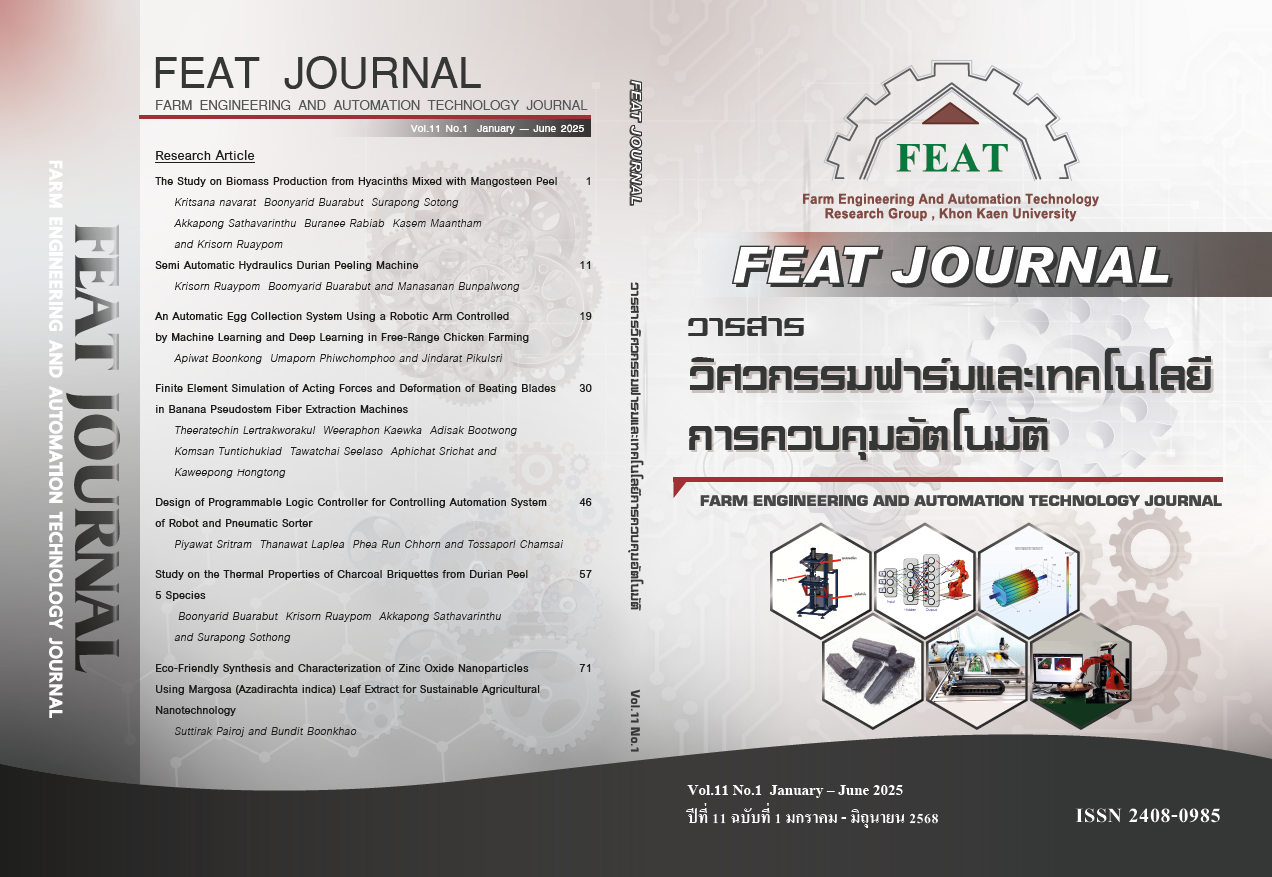
การจำลองแรงกระทำและการเสียรูปของใบตีเครื่องสกัดเส้นใยจากกาบกล้วยด้วย วิธีไฟไนต์เอลิเมนต์
Article Sidebar
Main Article Content
บทคัดย่อ
งานวิจัยนี้มีวัตถุประสงค์เพื่อศึกษาการจำลองแรงกระทำและการเสียรูปของใบตีเครื่องสกัดเส้นใยจากกาบกล้วย โดยใช้วิธีไฟไนต์เอลิเมนต์ (Finite Element Method) เพื่อเปรียบเทียบใบตี 3 แบบ ได้แก่ แบบ 5 ใบ, 13 ใบ และ 32 ใบ ตลอดจนวิเคราะห์ความเค้น Von Mises, การเสียรูป, ความปลอดภัย (FoS) และอายุการใช้งานจากความเมื่อยล้าของใบตีในแต่ละแบบ ผลการทดลองพบว่า ใบตีแบบ 5 ใบมีค่าความเค้นต่ำสุดที่ 6.4 MPa และค่าความปลอดภัยสูงสุด (FoS Goodman = 12.87, FoS Soderberg = 12.42, FoS ทั่วไป = 4.69) พร้อมด้วยอายุการใช้งานจากความเมื่อยล้าสูงถึง 2.80 × 10²¹ รอบ ในขณะที่ใบตีแบบ 13 ใบและ 32 ใบมีค่าความเค้นสูงกว่าแต่กระจายแรงได้ดีกว่าและมีการเสียรูปน้อยกว่า อย่างไรก็ตาม ใบตีทั้งสามแบบยังคงอยู่ในช่วงเชิงยืดหยุ่นของวัสดุ ผลการศึกษานี้ช่วยสนับสนุนการออกแบบใบตีที่มีประสิทธิภาพและความปลอดภัยสูง พร้อมทั้งชี้แนะแนวทางการปรับปรุงรูปทรงเพื่อเพิ่มความแข็งแรงและลดความเค้นสะสมในอนาคต
Article Details

อนุญาตภายใต้เงื่อนไข Creative Commons Attribution-NonCommercial-NoDerivatives 4.0 International License.
วารสารวิศวกรรมฟาร์มและเทคโนโลยีควบคุมอัตโนมัติ (FEAT Journal) มีกําหนดออกเป็นราย 6 เดือน คือ มกราคม - มิถุนายน และ กรกฎาคม - ธันวาคม ของทุกปี จัดพิมพ์โดยกลุ่มวิจัยวิศวกรรมฟาร์มและเทคโนโลยีควบคุมอัตโนมัติ คณะวิศวกรรมศาสตร์มหาวิทยาลัยขอนแก่น เพื่อเป็นการส่งเสริมและเผยแพร่ความรู้ ผลงานทางวิชาการ งานวิจัยทางด้านวิศวกรรมศาสตร์และเทคโนโลยีพร้อมทั้งยังจัดส่ง เผยแพร่ตามสถาบันการศึกษาต่างๆ ในประเทศด้วย บทความที่ตีพิมพ์ลงในวารสาร FEAT ทุกบทความนั้นจะต้องผ่านความเห็นชอบจากผู้ทรงคุณวุฒิในสาขาที่เกี่ยวข้องและสงวนสิทธิ์ ตาม พ.ร.บ. ลิขสิทธิ์ พ.ศ. 2535
เอกสารอ้างอิง
Patil SS, et al. Evaluation of mechanically extracted banana fibers from pseudostems as an alternative raw material for the textile industry. Heliyon. 2024;10(2):e12345.
European Commission. Final Report Summary - BADANA: Development of an automated process to extract fibres from the waste of banana food production for exploitation as a sustainable reinforcement in injection- and rotomoulded products [Internet]. Brussels: CORDIS; 2019 [cited 2025 May 2]. Available from: https://cordis.europa.eu/project/id/232287/reporting
Kusić D, Božič U, Monzón M, Paz R, Bordón P. Thermal and mechanical characterization of banana fiber reinforced composites for its application in injection molding. Materials. 2020;13(16):3581. doi:10.3390/ma13163581
Influence of the extraction location on the physical and mechanical properties of banana pseudo-stem fibers. J Nat Fibers. 2023;20(3):123–35.
Design and simulation of banana pseudo-stem fibre extracting raspador using finite element analysis. J Nat Fibers. 2023;20(4):456–67.
Kim HJ, Cho J-R. Numerical analysis of fatigue life of wind turbine blades reinforced with graphene platelets. Appl Sci. 2025;15(4):1866.
Fatigue analysis of wind turbine composite blade using finite element method. Proc Inst Mech Eng C J Mech Eng Sci. 2023;237(5):789–800.
Belytschko T, Liu WK, Moran B. Nonlinear finite elements for continua and structures. Chichester: John Wiley & Sons; 2014.
COMSOL Inc. Analyze structural fatigue with the Fatigue Module [Internet]. Burlington, MA: COMSOL Inc.; [cited 2025 May 2]. Available from: https://www.comsol.com/fatigue-module
COMSOL Inc. COMSOL Multiphysics® Reference Manual, Version 6.1. Burlington, MA: COMSOL Inc; 2022.
Bathe KJ. Finite element procedures. 2nd ed. Watertown: Klaus-Jurgen Bathe; 2014.
Hibbeler RC. Mechanics of materials. 10th ed. Upper Saddle River: Pearson; 2017.
Shigley JE, Mischke CR, Budynas RG. Mechanical engineering design. 9th ed. New York: McGraw-Hill; 2011.
Juvinall RC, Marshek KM. Fundamentals of machine component design. 6th ed. Hoboken: Wiley; 2016.
Stephens RI, Fatemi A, Stephens RR, Fuchs HO. Metal fatigue in engineering. 2nd ed. New York: Wiley; 2000.
Schijve J. Fatigue of structures and materials. 2nd ed. Dordrecht: Springer; 2009.
Suresh S. Fatigue of materials. 2nd ed. Cambridge: Cambridge University Press; 1998.
Bannantine JA, Comer JJ, Handrock JL. Fundamentals of metal fatigue analysis. New Jersey: Prentice Hall; 1990.
Budynas RG, Nisbett JK. Shigley's mechanical engineering design. 10th ed. New York: McGraw-Hill Education; 2015.
Dowling NE. Mechanical behavior of materials: engineering methods for deformation, fracture, and fatigue. 4th ed. Boston: Pearson; 2013.
Lee YL, Pan J, Hathaway RB, Barkey ME. Fatigue testing and analysis: theory and practice. Oxford: Butterworth-Heinemann; 2005.
Pavelko R, Smith J. Simulation of impact damage in a composite plate and its detection using COMSOL Multiphysics. Int J Struct Integrity. 2020;11(4):459–74. doi:10.1108/IJSI-12-2019-0150.
Garcia M, Lee T. An eXtended Finite Element Method implementation in COMSOL Multiphysics for solid mechanics. Comput Mech. 2022;68(3):905–20. doi:10.1007/s00466-021-02060-7.
Chen W, Zhang H. Mechanical properties and yield strength of carbon steel: experimental and numerical analysis. Mater Sci Eng A. 2019;763:138135. doi:10.1016/j.msea.2019.138135.
Kumar A, Singh R. Mesh independence study for finite element analysis of impact loading on steel plates. J Appl Mech Eng. 2021;10(3):202–10. doi:10.4236/jame.2021.103014.
Poudel S, Chapai S, Subedi RK, Giri TR, Adhikari S. Design, fabrication and testing of banana fibre extraction machine. J Innov Eng Educ. 2019;2(1):1–9.
COMSOL AB. COMSOL Multiphysics® Reference Manual, Fatigue Module. Burlington, MA: COMSOL AB; 2024.
Zienkiewicz OC, Taylor RL, Zhu JZ. The finite element method: its basis and fundamentals. 7th ed. Oxford: Butterworth-Heinemann; 2013.
Roache PJ. Verification and validation in computational science and engineering. Albuquerque: Hermosa Publishers; 1998.
