
Fluoride Reduction in Water Using Cow and Fish Bones
Article Sidebar
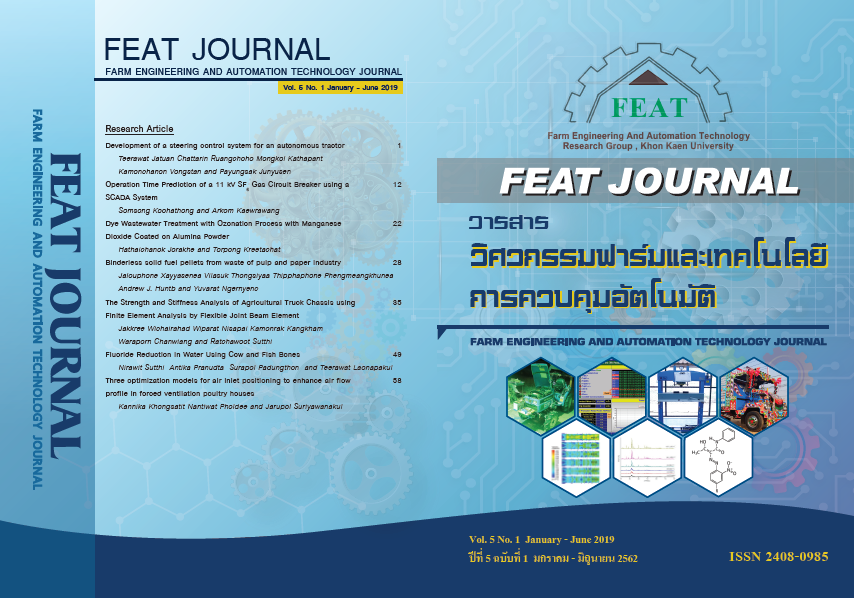
Main Article Content
Abstract
Northern, Northeastern, and Western region of Thailand have high levels of fluoride in groundwater. This effect might harm to the health of consumers. Nowadays, several materials involve bone char and hydroxyapatite were studied for the process of fluoride reduction in water. In this study, animal bones from fish and bovine were used as raw materials for the synthesis of bone char and hydroxyapatite using a thermal decomposition method. The transformation of crystalline phase and microstructure of samples were investigated using X-ray diffractometer (XRD) and scanning electron microscope (SEM). Synthesized bone char and hydroxyapatite washed by deionized water and carbonic acid were then investigated for their ability to reduce fluoride in water by using batch equilibration method with 10 mg/L concentration of fluoride at pH 5. The crystalline phase of cow bone transformed to bone char and hydroxyapatite at 400 and 1,000 degrees Celsius, respectively. The 0.5 gram of hydroxyapatite made from bovine bone washed by carbonic acid could maximum reduced 40% (0.8 mg F -/g) of fluoride in water.
Article Details
วารสารวิศวกรรมฟาร์มและเทคโนโลยีควบคุมอัตโนมัติ (FEAT Journal) มีกําหนดออกเป็นราย 6 เดือน คือ มกราคม - มิถุนายน และกรกฎาคม - ธันวาคม ของทุกปี จัดพิมพ์โดยกลุ่มวิจัยวิศวกรรมฟาร์มและเทคโนโลยีควบคุมอัตโนมัติ คณะวิศวกรรมศาสตร์มหาวิทยาลัยขอนแก่น เพื่อเป็นการส่งเสริมและเผยแพร่ความรู้ ผลงานทางวิชาการ งานวิจัยทางด้านวิศวกรรมศาสตร์และเทคโนโลยีพร้อมทั้งยังจัดส่ง เผยแพร่ตามสถาบันการศึกษาต่างๆ ในประเทศด้วย บทความที่ตีพิมพ์ลงในวารสาร FEAT ทุกบทความนั้นจะต้องผ่านความเห็นชอบจากผู้ทรงคุณวุฒิในสาขาที่เกี่ยวข้องและสงวนสิทธิ์ ตาม พ.ร.บ. ลิขสิทธิ์ พ.ศ. 2535
References
[2] Harrison P T C. Fluoride in water: A UK perspective. J. Fluorine Chem. 2005; 126: 1448-1456.
[3] Bhatnagar A, et al. Fluoride removal from water by adsorption-A review. Chem. Eng. J. 2011; 171: 811-840
[4] Medellin-Castillo NA, et al. Adsorption capacity of bone char for removing fluoride from water solution. Role of hydroxyapatite content, adsorption mechanism and competing anions. J IND ENG CHEM. 2014; 20: 4014-4021.
[5] Yu W, et al. Enhanced adsorption of fluoride from aqueous solution onto nanosized hydroxyapatitev by low-molecular-weight organic acids. Desalination 2011; 276:161-168.
[6] Laonapakul T. Synthesis of hydroxy-apatite from biogenic wastes. KKU ENGINEERING JUORNAL 2015; 42(3):269-275.
[7] Ozawa M, Suzuki S. Microstructural Development of Natural Hydroxyapatite Originated from Fish-Bone Waste through Heat Treatment. J Am Ceram Soc. 2002; 85(5):1351-1317.
[8] Huang YC, et al. Hydroxyapatite extracted from fish scale: Effects on MG63 ostedoblast-like cells. Ceram Int. 2011; 37:1825-1831.
[9] Sobczak A, et al. Evaluation of the biomedical properties of hydroxyapatite obtained from bone waste. Pol. J. Chem. Technol. 2009; 11(1):37-43.
[10] Sangeeta P, et al. Synthesis and characterization of mesoporous bone char obtained by pyrolysis of animal bone, for environmental application. J. Environ. Chem. Eng. 2015; 3:2368-2377.
[11] Asmawi R, et al. Synthesis and characterization of nanocrystalline hydroxyapatite power. lisSopyan.2013
[12] Srimurali M, et al. A study on removal of fluorides from drinking water by adsorption onto low-cost materials. Environ Pollut. 1998; 99: 285-289.
