
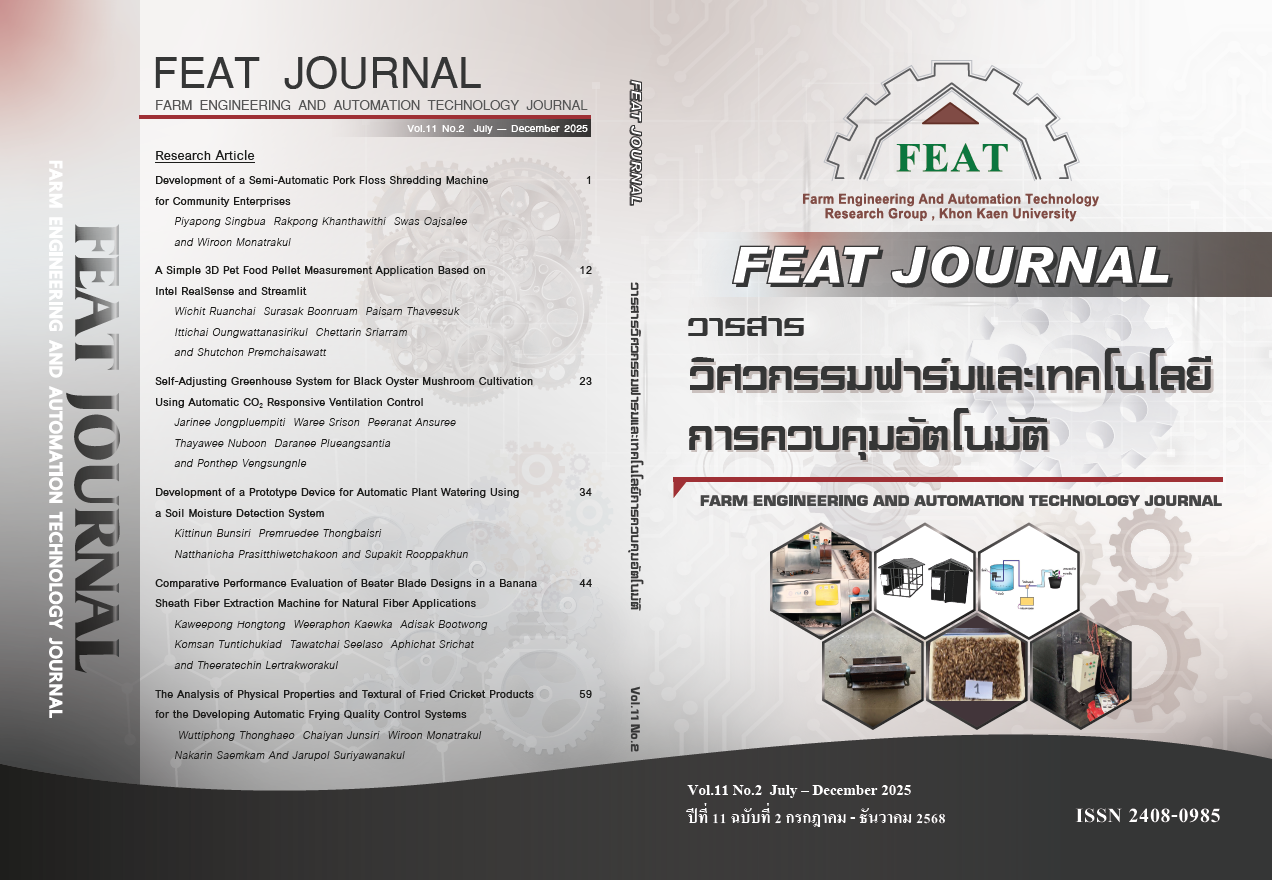
The Analysis of Physical Properties and Textural of Fried Cricket Products for the Developing Automatic Frying Quality Control Systems
Article Sidebar
Main Article Content
Abstract
This study aimed to investigate the physical and texture properties of crispy fried house cricket (Acheta domesticus) obtained from different sources, in order to provide fundamental data for designing an automatic frying control system to achieve consistent product quality. The samples were divided into three groups: Group A (general commercial products), Group B (top-selling online products), and Group C (products certified by the Food and Drug Administration). The results revealed significant physical differences among the three groups. Group A had an average size of 6.02 x 29.03 mm and an average weight of 0.2 g, Group B had 5.78 x 22.16 mm and 0.4 g, and Group C had 5.75 x 19.33 mm and 0.1 g. These results indicated that size is not the main factor determining product quality, which is more influenced by frying methods and oil absorption. The color values (L*) ranged from 28.9–30.7, with Groups A and C exhibiting lighter colors, while Group B was slightly darker. Group C had the highest Red - Green (a*) value (5.7), indicating a uniform reddish-brown color suitable for frying. Texture analysis showed that Group B had the highest hardness (230.980 N) and cohesiveness (0.482), indicating a firm and dense texture, whereas Group C had the lowest gumminess and chewiness (19.275 and 0.737), reflecting a light and crispy texture. In conclusion, Group A represented general products emphasizing value, Group B distinguished by its firmness and dense crispness preferred by consumers, and Group C shows uniform color and texture, making it suitable for industrial production and the development of automatic frying control systems in the future.
Article Details

This work is licensed under a Creative Commons Attribution-NonCommercial-NoDerivatives 4.0 International License.
วารสารวิศวกรรมฟาร์มและเทคโนโลยีควบคุมอัตโนมัติ (FEAT Journal) มีกําหนดออกเป็นราย 6 เดือน คือ มกราคม - มิถุนายน และกรกฎาคม - ธันวาคม ของทุกปี จัดพิมพ์โดยกลุ่มวิจัยวิศวกรรมฟาร์มและเทคโนโลยีควบคุมอัตโนมัติ คณะวิศวกรรมศาสตร์มหาวิทยาลัยขอนแก่น เพื่อเป็นการส่งเสริมและเผยแพร่ความรู้ ผลงานทางวิชาการ งานวิจัยทางด้านวิศวกรรมศาสตร์และเทคโนโลยีพร้อมทั้งยังจัดส่ง เผยแพร่ตามสถาบันการศึกษาต่างๆ ในประเทศด้วย บทความที่ตีพิมพ์ลงในวารสาร FEAT ทุกบทความนั้นจะต้องผ่านความเห็นชอบจากผู้ทรงคุณวุฒิในสาขาที่เกี่ยวข้องและสงวนสิทธิ์ ตาม พ.ร.บ. ลิขสิทธิ์ พ.ศ. 2535
References
Abajue MC, Wogu MN. Sustainable food systems: case studies of successful insect-based enterprises. In: Ogwu MC, Izah SC, editors. Edible insects: nutritional benefits, culinary innovations and sustainability. Cham: Springer; 2025. p. 1–20. doi:10.1007/978-3-031-90087-7_12.
Bourne MC, Kenny JF, Barnard J. Computer-assisted readout of data from texture profile analysis curves. J Texture Stud. 1978;9:481–94. doi:10.1111/j.1745-4603.1978.tb01219.x.
Halloran A, et al. Life cycle assessment of cricket farming in north-eastern Thailand. J Clean Prod. 2017. doi:10.1016/j.jclepro.2017.04.017.
Hanboonsong Y, Jamjanya T, Durst PB. Six-legged livestock: edible insect farming, collection and marketing in Thailand. Rome: Food and Agriculture Organization of the United Nations; 2013. Available from: https://openknowledge.fao.org/handle/20.500.14283/i3246e
Lee H, Kim Y. Color and consumer perception of fried insect foods: a sensory evaluation. Food Sci Biotechnol. 2019;28(3):787–95. doi:10.1007/s10068-019-00570-3.
Oonincx DGAB, et al. An exploration on greenhouse gas and ammonia production by insect species suitable for animal or human consumption. PLoS One. 2010;5(12):e14445. doi:10.1371/journal.pone.0014445.
Rumpold BA, Schlüter OK. Nutritional composition and safety aspects of edible insects. Mol Nutr Food Res. 2013;57(5):802–23. doi:10.1002/mnfr.201200735.
Smith J, Tan H, Wong M. Consumer acceptance of edible insects: effect of product presentation and information. Appetite. 2020;144:104478. doi:10.1016/j.appet.2019.104478.
Tan YL, Tan FA, Chye FY. Nutritional properties of selected edible insects. Biolife Sci Forum. 2024;4:43. doi:10.3390/blsf2024040043.
United Nations, Department of Economic and Social Affairs. World population prospects 2019 [Internet]. New York: United Nations; 2019 [cited 2025 Jul 13]. Available from: https://www.un.org/development/desa/pd/news/world-population-prospects-2019-0
van Huis A, et al. Potential of insects as food and feed in assuring food security. Annu Rev Entomol. 2013;58:563–83. doi:10.1146/annurev-ento-120811-153704.
Yamane T. Elementary sampling theory. Englewood Cliffs (NJ): Prentice-Hall; 1967.
พิมพ์เพ็ญ พรเฉลิมพงศ์, จิราภา วิทยาภิรักษ์. พจนานุกรมวิศวกรรมอาหาร (อังกฤษ–ไทย) [Internet]. ไม่ปรากฏปี [cited 2025 Jul 13]. Available from: https://www.foodnetworksolution.com/wiki/word/0987/texture-profile-analysis
รุจิรา คุ้มทรัพย์, ธนาวรรณ สุขเกษม, รุ่งนภา สนุ่นดี. พฤติกรรมการบริโภคแมลงกินได้ตามวิถีภูมิปัญญาท้องถิ่น: กรณีศึกษาตำบลปากช่อง อำเภอหล่มสัก จังหวัดเพชรบูรณ์. วารสารวิทยาศาสตร์และเทคโนโลยี มหาวิทยาลัยราชภัฏเพชรบูรณ์. 2018;3(2):23–32.
ศิริเลิศ ธ. การประเมินลักษณะเนื้อสัมผัสในอาหาร. J Food Technol Siam Univ. 2015;3(1):6–13. Available from: https://li01.tci-thaijo.org/index.php/JFTSU/article/view/38437
สุปาณี เลี้ยงพรพรรณ. บทความการบริโภคแมลงส่งผลต่อมนุษย์อย่างไร. วารสารวิทยาศาสตร์และเทคโนโลยี มหาวิทยาลัยเทคโนโลยีราชมงคลธัญบุรี. 2012;1(2):1–6. Available from: https://ph02.tcithaijo.org/index.php/tsujournal/article/view/68352/55659
