
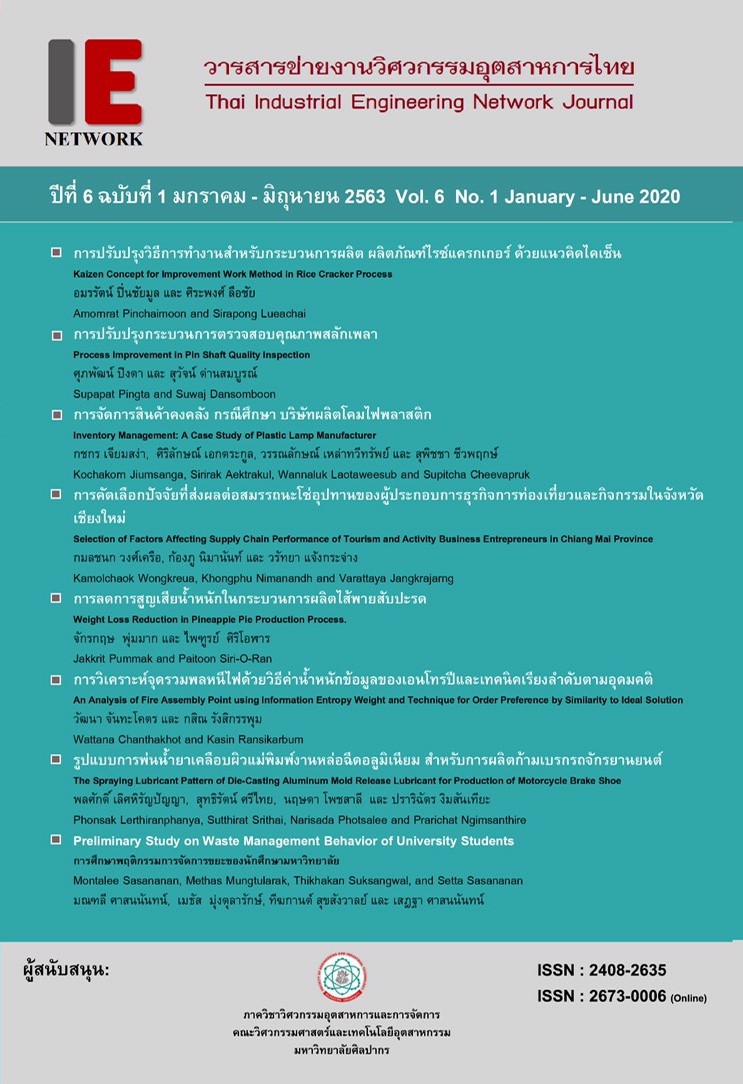
การศึกษาพฤติกรรมการจัดการขยะของนักศึกษามหาวิทยาลัย
Article Sidebar
Main Article Content
บทคัดย่อ
บทความนี้นำเสนอภาพรวมของพฤติกรรมการจัดการขยะและปัจจัยที่มีผลต่อการจัดการขยะของนักศึกษาระดับปริญญาตรีในมหาวิทยาลัยธรรมศาสตร์ การเก็บข้อมูลกระทำโดยใช้แบบสอบถามจำนวน 265 ตัวอย่าง วิธีการวิเคราะห์ใช้ค่าร้อยละ ค่าเฉลี่ย t-test การวิเคราะห์ความแปรปรวน และวิธี Least Significant Different ผลการศึกษาแสดงให้เห็นว่านักศึกษาส่วนมากมีความรู้ในด้านการจัดการขยะโดยรวมอยู่ในระดับที่ดี เมื่อพิจารณาเฉพาะด้านพบว่าผู้ตอบแบบสอบถามมีการคัดแยกขยะ การนำกลับใปใช้ซ้ำ การรีไซเคิล การหลีกเลี่ยงวัสดุอันตราย และการซ่อมแซม อยู่ในระดับปานกลาง แต่มีพฤติกรรมลดการสร้างขยะอยู่ในระดับค่อนข้างดี จากการทดสอบสมมุติฐานพบว่าพฤติกรรมการจัดการขยะของเพศชายและเพศหญิงไม่มีความแตกต่างกันอย่างมีนัยสำคัญยกเว้นในด้านการรีไซเคิล โดยผู้หญิงมีพฤติกรรมการรีไซเคิลมากกว่าผู้ชาย เมื่อพิจารณาตามสาขาที่เรียนพบว่านักศึกษาในสายสังคมศาสตร์มีพฤติกรรมลดการสร้างขยะมากกว่านักศึกษาในสายวิทยาศาสตร์และเทคโนโลยี นักศึกษาชั้นปีที่ 5 หรือสูงกว่ามีพฤติกรรมการจัดการขยะต่ำกว่ากลุ่มอื่นๆอย่างมีนัยสำคัญ นอกจากนี้ชนิดของที่พักอาศัยยังมีผลต่อพฤติกรรมการจัดการขยะ จากการศึกษาพบว่านักศึกษาที่พักอาศัยที่บ้านมีพฤติกรรมการจัดการขยะมากกว่าผู้ที่อาศัยในหอพักของมหาวิทยาลัยและหอพักใกล้เคียงอย่างชัดเจน ในส่วนของอิทธิพลของความรู้การจัดการขยะที่มีต่อพฤติกรรม พบว่าความรู้ไม่มีผลต่อพฤติกรรมด้านการคัดแยก การลด และการรีไซเคิล ดังนั้นจึงสามารถกล่าวได้ว่าพฤติกรรมเหล่านี้สามารถสร้างขึ้นได้ด้วยวิธีการระยะสั้น เช่น การจัดให้มีถังคัดแยก อย่างไรก็ตามพฤติกรรมที่ได้รับอิทธิพลจากความรู้ในการจัดการขยะ คือ การนำไปใช้ใหม่ การซ่อมแซม และการหลีกเลี่ยงวัสดุอันตราย ดังนั้นพฤติกรรมเหล่านี้จึงควรได้รับการกระตุ้นด้วยการรณรงค์และให้ความรู้เป็นสำคัญ
Article Details
บทความ ข้อมูล เนื้อหา รูปภาพ ฯลฯ ที่ได้รับการตีพิมพ์ในวารสารฯ ถือเป็นลิขสิทธิ์ของวารสารฯ หากบุคคลหรือหน่วยงานใดต้องการนำทั้งหมดหรือส่วนหนึ่งส่วนใดไปเผยแพร่ต่อหรือเพื่อกระทำการใดๆ จะได้รับอนุญาต แต่ห้ามนำไปใช้เพื่่อประโยชน์ทางธุรกิจ และห้ามดัดแปลง
เอกสารอ้างอิง
[2] Wheeling K., “The EPA blames six Asian nations that the U.S. exports plastic waste to for ocean pollution”, Pacific Standard, July 15, 2019
[3] Barr S., “Factors influencing environmental attitudes and behaviors: A U.K. case study of household waste management”, Environment and Behavior, 39, 2007, 435-473
[4] Stern P.C., Dietz T., Guagnano GA., “The new ecological paradigm in social psychological context”, Environment and Behavior, 27, 1995, 723-743
[5] Sidique S.F., Lupi F., Joshi S.V., “The effects of behavior and attitudes on drop-off recycling activities”, Resource, Conservation and Recycling, 54, 2010, 163-170
[6] Seunghae L., Paik H.S., “Korean household waste management and recycling behavior”, Building and Environment, 46 (5), 2019, 1159-1166
[7] Barr S., Gilg A.W., Ford N.J., “Differences between household waste reduction, reuse and recycling behavior: A study of reported behaviours, intentions and explanatory variables”, Journal of Environmental and Waste Management, 4, 2001, 1-14
[8] Pettifor H., “Patterns of household practice: An examination into the relationship between housework and waste separation for households in the United Kingdom”, ISER Working Paper Series, 2012, 2012-14
[9] Miafodzyeva S., Brandt N., “Recycling behaviour among householders: synthesizing determinants via a meta-analysis”, Waste and Biomass Valorization, 4, 2013, 221-235
[10] Schwab N., Harton H.C., Cullum J.G., “The effects of emergent norms and attitudes on recycling behavior”, Environment and Behavior, 46, 2014, 403-422
[11] Derksen I., Gartell J., “The social context of recycling”, American Sociological Review, 58, 1993, 434-442
[12] Tonglet M., Phillips P.S., Read A.D., “Using the theory of planned behavior to investigate the determinants of recycling behavior: a case study from Brixworth, UK” Resource, Conservation and Recycling, 41, 2004, 191-214
[13] Loan L.T.T., Takahashi Y., Nomura H., Yabe M. “Modeling home composting behavior toward sustainable municipal organic waste management at the source in developing countries”, Resources, Conservation and Recycling, 140, 2019, 65-71
[14] Baldassare M., Katz C., “The personal threat of environmental problems as predictor of environmental practices”, Environment and Behavior, 24, 1992, 602-616
[15] Steel B.S., “Thinking globally, acting locally? Environmental attitudes, behavior and activism”, Journal of Environmental Management, 47, 1996, 27-36
[16] Segun C., Pelletier L.G., Hunsley J., “Toward a model of environmental activism”, Environment and Behavior, 30, 1998, 628-652
[17] De Young R., “Some psychological aspects of recycling: the structure of conservation satisfactions”, Environment and Behavior, 18, 1986, 435-449
[18] Gamba R.J., Oskamp S., “Factors influencing community residents’ participation in commingled curbside recycling programs”, Environment and Behavior, 26, 1994, 587-612
[19] McKenzie-Mohr D., Oskamp S. , “Psychology and sustainability: An introduction”, Journal of Social Issues, 51(4), 1995, 1-14
[20] Minelgaitė A. and Liobikienė G., “Waste problem in European Union and its influence on waste management behaviours”, Science of the Total Environment, 667, 2019, 86-93
[21] Suntree J., Study of factors relating to environmental conservation behavior of Pathomasoke villagers, Nakhon Pathom Province [Master’s Thesis]. Mahidol University 1988 (In Thai)
[22] Padilla A.J. and Trujillo J.C., “Waste disposal and households’ heterogeneity. Identifying factors shaping attitudes towards source-separated recycling in Bogotá, Colombia”, Waste Management, 74, 2018, 16-33
[23] Yi G., Lee J, Hong W., “A study on the discharge properties and a unit of municipal solid wastes in residential area types: case study of Taegu City”, Proceedings of Annual Conference of the Architecture Institute of Korea 2000. Seoul, Korea
[24] Park J., Park S., Kwon G., “Generation characteristics of residential wastes according to house types by separated collection of food waste – in case of Kyungju City”, Korean Solid Wastes Engineering Society, 17 (2), 2000, 166-76
[25] Schultz P.W., “Strategies for promoting proenvironmental behavior”, European Psychologist, 19, 2014, 107-117.
[26] Mintz K.K., Henn L, Park J., Kurman J., “What predicts household waste management behaviors? Culture and type of behavior as moderators”, Resources, conservation & recycling, 145, 2019, 11-18
[27] Bernstad A. “Household food waste separation behavior and the importance of convenience”, Waste Management, 34(7), 2014, 1317-1323
[28] Kaiser F.G. and Wilson M., “Assessing People’s General Ecological Behavior: A Cross-Cultural Measure”, Journal of Applied Social Psychology, 30 (5), 2006, 952-978
[29] Sidique S.F., Joshi S.V., Lupi F., “Factors influencing the rate of recycling: an analysis of Minnesota countries”, Resource, conservation and recycling, 54, 2010, 242–249
