Development of Microfluidic Paper-Based Analytical Devices for Simultaneous Colorimetric Ammonium and Nitrate Detection
Keywords:
Microfluidic Paper-based Analytical Devices, Colorimetric Detection, Ammonium and Nitrate DetectionAbstract
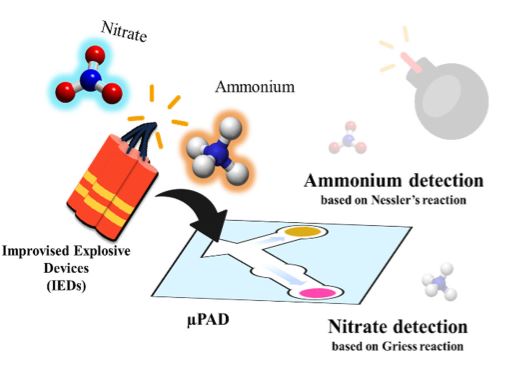
The frequency of terrorist attacks involving Improvised Explosive Devices (IEDs) is expected to continue increasing. Ammonium nitrate fuel oil (ANFO) is the preferred main charge in IEDs due to its low cost and wide availability. Hence, there is a pressing need to develop an ammonium nitrate detection method that is easy to use, cost-efficient, fast, and reliable. This research developed the µPADs as viable devices for detecting ammonium nitrate in the field alongside a mobile phone camera. In this study, a two-lane µPAD was developed to detect both ammonium and nitrate ions in an ammonium nitrate solution. The purpose of this research was to develop a simple and low-cost colorimetric method for simultaneous ammonium and nitrate ion detection using microfluidic paper-based analytical devices (µPADs) fabricated by the wax-screen printing technique. The two-channel µPADs were designed and fabricated. The first channel was used for ammonium detection using Nessler’s reagent coated on the detection at the end of the channel. The second channel was used for nitrate detection using a Griess reagent. By simply dropping the sample at the center of µPADs, the developed µPADs were able to detect both ammonium and nitrate in a short time (only 4 minutes). The colored product on the µPAD (yellowish-brown and pink color for ammonium and nitrate, respectively) was then captured with a camera on a smartphone under a commercial controlled light box and its color intensity was obtained by using ImageJ software. Using the NH4NO3 concentration in the range of 100 – 800 ppm, under optimum conditions, there was a good linear relationship (r2 = 0.9961 for ammonium concentration range of 200-800 ppm and r2 = 0.9894 for nitrate concentration range of 100-800 ppm) and the detection limit was 48.760 and 81.966 ppm for ammonium and nitrate, respectively.
References
Action on Armed Violence, “An Examination on the Precursor Chemicals Used in the Manufacture of Explosive Compositions Found Within Improvised Explosive Devices,” [Online].Available: https://cd-geneve.delegfrance. org/IMG/pdf/precursor-chemicals_ieds-v5.pdf. (Accessed: July. 22, 2024).
National Academies and Department for Homeland Security, “IED Attack: Improvised Explosive Devices,” [Online]. Available: https://www.dhs.gov/xlibrary/assets/prep_ied_ fact_sheet.pdf. (Accessed: July. 22, 2024).
K. G. Balachandar and A. Thangamani, “Studies on Some of the Improvised Energetic Materials (IEMs): Detonation, Blast Impulse and TNT Equivalence Parameters,” Oriental Journal of Chemistry, vol. 35, no. 6, pp. 1813-1823, 2019.
C. Oommen and S. Jain, “Ammonium Nitrate: A Promising Rocket Propellant Oxidizer,” Journal of Hazardous Materials, vol. 67, no. 3, pp. 253-281, 1999.
R. Sharma and S. Kumar, “Rapid Prediction of ANFO Based Explosives through ATR-FTIR Analysis – Use of ATR-FTIR in Explosives,” Brazilian Journal of Analytical Chemistry, vol. 11, no. 43, pp. 92-100, 2024.
I. Corbin and B. McCord, “Detection of the Improvised Explosives Ammonium Nitrate (AN) and Urea Nitrate (UN) Using Non-aqueous Solvents with Electrospray Ionization and MS/MS Detection,” Talanta, vol. 115, pp. 533-539, 2013.
H. Brust, et al., “Isotopic and Elemental Profiling of Ammonium Nitrate in Forensic Explosives Investigations,” Forensic Science International, vol. 248, pp. 101-112, 2015.
A. B. Anushka and P. K. Das, “Paper Based Microfluidic Devices: A Review of Fabrication Techniques and Applications,” The European Physical Journal Special Topics, vol. 232, no. 6, pp. 781-815, 2023.
W. Dungchai, O. Chailapakul and C. S. Henry, “A Low-cost, Simple, and Rapid Fabrication Method for Paper-based Microfluidics Using Wax Screen-printing,” The Analyst, vol. 136, no. 1, pp. 77-82, 2011.
Y. Xia, J. Si and Z. Li, “Fabrication Techniques for Microfluidic Paper-based Analytical Devices and Their Applications for Biological Testing: A Review,” Biosensors and Bioelectronics, vol. 77, pp. 774-789, 2016.
D. M. Cate, J. A. Adkins, J. Mettakoonpitak and C. S. Henry, “Recent Developments in Paper-Based Microfluidic Devices,” Analytical Chemistry, vol. 87, no. 1, pp. 19-41, 2015.
Y. F. Wisang, H. Sulistyarti, U. Andayani and A. Sabarudin, “Microfluidic Paper-based Analytical Devices (µPADs) for Analysis Lead Using Naked Eye and Colorimetric Detections,” Materials Science and Engineering, vol. 546, no. 3, 2019.
H. Bazyar, “On the Application of Microfluidic-Based Technologies in Forensics: A Review,” Sensors, vol. 23, no. 13, 5856, 2023.
G. G. Morbioli, T. Mazzu-Nascimento, A. M. Stockton and E. Carrilho, “Technical Aspects and Challenges of Colorimetric Detection with Microfluidic Paper-based Analytical Devices (µPADs) - A Review,” Analytica Chimica Acta, vol. 970, pp. 1-22, 2017.
W. Zhao and A. van der Berg, “Lab on Paper,” Lab on a Chip, vol. 8, no. 12, pp. 1988-1991, 2008.
K. L. Peters, I. Corbin, L. M. Kaufman, K. Zreibe, L. Blanes and B. R. McCord, “Simultaneous Colorimetric Detection of Improvised Explosive Compounds Using Microfluidic Paper-based Analytical Devices (µPADs),” Analytical Methods, vol. 7, no. 1, pp. 63-70, 2015.
N. L. Nxumalo, L. M. Madikizela, H. G. Kruger, S. C. Onwubu and P. S. Mdluli, “Development of a Paper-based Microfluidic Device for the Quantification of Ammonia in Industrial Wastewater,” Water SA, vol. 46, no. 3, pp. 506-513, 2020.
B. M. Jayawardane, S. Wei, I. D. McKelvie and S. D. Kolev, “Microfluidic Paper-based Analytical Device for the Determination of Nitrite and Nitrate,” Analytical Chemistry, vol. 86, no.15, pp. 7274-7279, 2014.
L. Váradi, M. Breedon, F. F. Chen, A. Trinchi, I. S. Cole and G. Wei, “Evaluation of Novel Griess-reagent Candidates for Nitrite Sensing in Aqueous Media Identified via Molecular Fingerprint Searching,” RSC Advances, vol. 9, no. 7, pp. 3994-4000, 2019.
D. Tsikas, “Analysis of Nitrite and Nitrate in Biological Fluids by Assays Based on the Griess Reaction: Appraisal of the Griess Reaction in the L-arginine/nitric Oxide Area of Research,” Journal of Chromatography B, vol. 851, no. 1-2, pp. 51-70, 2007.
A. Charbaji, H. Heidari-Bafroui, C. Anagnostopoulos and M. Faghri, “A New Paper-based Microfluidic Device for Improved Detection of Nitrate in Water,” Sensors, vol. 21, no. 1, pp. 1-15, 2021.
Department of the Army Technical Manual, TM9-1300-214 Military Explosives, Washington D.C.: US Army, 1984.
J. N. Miller and J. C. Miller, Statistics and Chemometrics for Analytical Chemistry. 6th ed. London: Pearson, 2010.
Downloads
Published
How to Cite
Issue
Section
Categories
License
Copyright (c) 2025 NKRAFA JOURNAL OF SCIENCE AND TECHNOLOGY

This work is licensed under a Creative Commons Attribution-NonCommercial-NoDerivatives 4.0 International License.
- Content and information in articles published in NKRAFA Journal of Science and Technology are comment and responsibility of authors of articles directly. Journal editorial do no need to agree or share any responsibility.
- NKRAFA Journal of Science and Technology Articles holds the copyright of the content, pictures, images etc. which published in it. If any person or agency require to reuse all or some part of articles, the permission must be obtained from the NKRAFA Journal of Science and Technology.