Critical Frequency and Peak Height Variations of the F2 Ionospheric Layer in the Near-Equatorial Region During Low-Solar Activity
Keywords:
Critical Frequency, Peak Height, Ionosphere, Solar MinimumAbstract
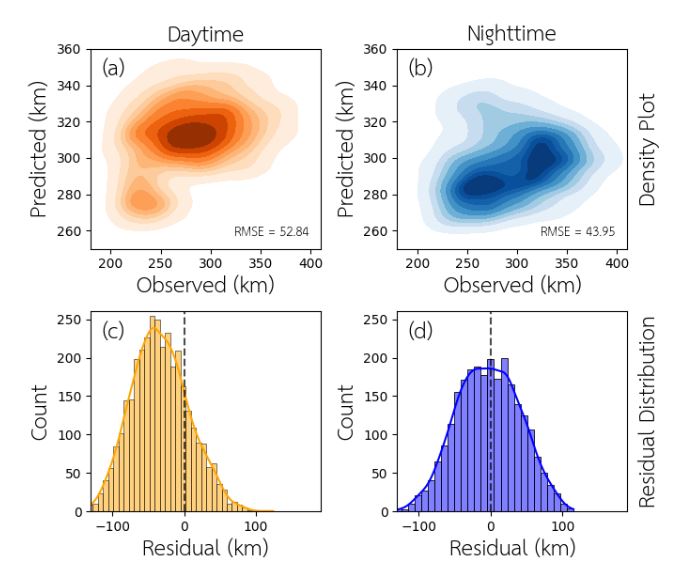
This study investigated the variability of the critical frequency (foF2) and F2 layer peak height (hmF2) in the equatorial magnetic region during low solar activity, utilizing 35,749 data points from the BVJ03 Ionosonde station throughout 2018. Results revealed foF2 median values of 6.85 MHz (IQR: 4.30-8.68 MHz) and hmF2 median values of 282.9 km (IQR: 251.1-316.7 km). Monthly variations exhibited equinox anomaly characteristics, with foF2 declining from 8-9 MHz (January-April) to 5-6 MHz (July-August), while hmF2 demonstrated opposite trends. Seasonal analysis showed maximum foF2 values during autumn (~11 MHz). Diurnal variations indicated minimum foF2 values before dawn (2-3 MHz) and maximum values during afternoon (13:00-15:00 LT), while hmF2 exhibited minimum values in the morning (220-250 km) and maximum values in the evening (320-350 km). Mann-Whitney U tests revealed statistically significant differences, with daytime foF2 (8.16 MHz) nearly doubling nighttime values (4.35 MHz), whereas nighttime hmF2 (291.80 km) slightly exceeded daytime values (275.70 km). Comparison with IRI-2020 models indicated systematic overestimation of hmF2, particularly during daytime hours (RMSE = 52.84 km). This research confirmed that foF2 was primarily influenced by solar radiation, resulting in pronounced day-night variations, while hmF2 was additionally affected by atmospheric dynamics. These findings enhanced understanding of low-latitude ionospheric behavior and can contribute to improving ionospheric parameter prediction models.
References
D. Bilitza, M. Pezzopane, V. Truhlik, D. Altadill, B. W. Reinisch, and A. Pignalberi, “The international reference Ionosphere model: A review and description of an ionospheric benchmark,” Reviews of Geophysics, vol. 60, no. 4, Dec. 2022, Art. no. e2022RG000792, doi: 10.1029/2022RG000792.
D. Ren, J. Lei, W. Wang, A. Burns, X. Luan, and X. Dou, “Does the peak response of the ionospheric F2 region plasma lag the peak of 27-day solar flux variation by multiple days?,” Journal of Geophysical Research: Space Physics, vol. 123, no. 9, pp. 7906–7916, Sep. 2018, doi: 10.1029/2018JA025835.
J. Laštovička and D. Burešová, “Relationships between foF2 and various solar activity proxies,” Space Weather, vol. 21, no. 4, Apr. 2023, Art. no. e2022SW003359, doi: 10.1029/2022SW003359.
L. Gu et al., “Large anomalies in future extreme precipitation sensitivity driven by atmospheric dynamics,” Nature Communications, vol. 14, Jun. 2023, Art. no. 3197, doi: 10.1038/s41467-023-39039-7.
E. A. Kumar and S. Kumar, “Geomagnetic storm effect on F2-region ionosphere during 2012 at low-and mid-latitude stations in the Southern Hemisphere,” Atmosphere, vol. 13, no. 3, Mar. 2022, Art. no. 480, doi: 10.3390/atmos13030480.
H. Lühr et al., “The interhemispheric and F region dynamo currents revisited with the swarm constellation,” Geophysical Research Letters, vol. 42, no. 9, pp. 3069–3075, May 2015, doi: 10.1002/2015GL063662.
M. Freeshah et al., “Analysis of atmospheric and ionospheric variations due to impacts of super typhoon Mangkhut (1822) in the northwest Pacific Ocean,” Remote Sens, vol. 13, no. 4, Feb. 2021, Art. no. 661, doi: 10.3390/rs13040661.
Y. Miyoshi and E. Yiğit, “Impact of gravity wave drag on the thermospheric circulation: Implementation of a nonlinear gravity wave parameterization in a whole-atmosphere model,” Annales Geophysicae, vol. 37, pp. 955–969, 2019, doi: 10.5194/angeo-37-955-2019.
M. Momeni and Y. Migoya-Orué, “Solar activity and ionospheric variation: A comprehensive study using hurst exponent and probability density functions analysis,” Advances in Space Research, vol. 75, no. 10, pp. 7668–7683, May 2025, doi: 10.1016/j.asr.2025.02.060.
T. V. Rao, M. Sridhar, D. V. Ratnam, P. B. S. Harsha, and I. Srivani, “A bidirectional long short-term memory-based ionospheric foF2 and hmF2 models for a single station in the low latitude region,” IEEE Geoscience and Remote Sensing Letters, vol. 19, 2022, Art. no. 8005405, doi: 10.1109/LGRS.2020.3045702.
O. V. Mandrikova, N. V Fetisova, and Y. A. Polozov, “Method for Modeling of Ionospheric Parameters and Detection of Ionospheric Disturbances,” Computational Mathematics and Mathematical Physics, vol. 61, no. 7, pp. 1094–1105, Aug. 2021, doi: 10.1134/S0965542521070137.
H. Kil, L. J. Paxton, W. K. Lee, and G. Jee, “Daytime evolution of equatorial plasma bubbles observed by the first Republic of China satellite,” Geophysical Research Letters, vol. 46, no. 10, pp. 5021–5027, May 2019, doi: 10.1029/2019GL082903.
K. Wang, J. Feng, Z. Zhao, and B. Han, “Analysis of winter anomaly and annual anomaly based on regression approach,” Remote Sensing, vol. 15, no. 20, 2023, Art. no. 4968, doi: 10.3390/rs15204968.
A. G. Wood et al., “Variability of ionospheric plasma: Results from the ESA Swarm mission,” Space Science Reviews, vol. 218, no. 6, 2022, Art. no. 52, doi: 10.1007/s11214-022-00916-0.
Â. M. Santos et al., “Ionospheric variability over the Brazilian equatorial region during the minima solar cycles 1996 and 2009: Comparison between observational data and the IRI model,” Atmosphere (Basel), vol. 14, no. 1, 2022, Art. no. 87, doi: 10.3390/atmos14010087.
K. Venkatesh, D. Pallamraju, K. P. Dalsania, D. Chakrabarty, and T. K. Pant, “Evaluation of the performance of F-layer peak height models used in IRI-2016 over the Indian equatorial and low latitudes,” Advances in Space Research, vol. 73, no. 7, pp. 3797–3807, 2024, doi: 10.1016/j.asr.2023.06.047.
P. Abadi et al., “Roles of thermospheric neutral wind and equatorial electrojet in pre‐reversal enhancement, deduced from observations in Southeast Asia,” Earth and Planetary Physics, vol. 5, no. 5, pp. 387–396, Sep. 2021, doi: 10.26464/epp2021049.
A. G. Elias et al., “Comparative analysis of extreme ultraviolet solar radiation proxies during minimum activity levels,” Earth and Planetary Physics, vol. 7, no. 5, pp. 540–547, 2023, doi: 10.26464/epp2023050.
B. Zhang, Z. Wang, Y. Shen, W. Li, F. Xu, and X. Li, “Evaluation of foF2 and hmF2 parameters of IRI-2016 model in different latitudes over China under high and low solar activity years,” Remote Sens, vol. 14, no. 4, 2022, Art. no. 860, doi: 10.3390/rs14040860.
M. Hegy et al., “Investigation of double geomagnetic storms on 3 and 4 February 2022 using machine learning approach.” NRIAG Journal of Astronomy and Geophysics, vol. 14, no. 1, pp. 1-9, 2025, doi: 10.1080/20909977.2025.2458944.
L. F. McNamara and D. C. Thompson, “Validation of COSMIC values of foF2 and M (3000) F2 using ground-based ionosondes,” Advances in Space Research, vol. 55, no. 1, pp. 163–169, 2015, doi: 10.1016/j.asr.2014.07.015.
J. Wang, Q. Yu, and Y. Shi, “Comparison of observed hmF2 and the IRI-2020 model for six stations in East Asia during the declining phase of the solar cycle 24,” Advances in Space Research, vol. 73, no. 5, pp. 2418–2432, Mar. 2024, doi: 10.1016/j.asr.2023.12.001.
A. Danilov, “Seasonal and diurnal variations in foF2 trends,” Journal of Geophysical Research: Space Physics, vol. 120, no. 5, pp. 3868–3882, May 2015, doi: 10.1002/2014JA020971.
N. Yoshida et al., “Seasonal and dust-related variations in the dayside thermospheric and ionospheric compositions of Mars observed by MAVEN/NGIMS,” Journal of Geophysical Research: Planets, vol. 126, no. 11, 2021, Art. no. e2021JE006926, doi: 10.1029/2021JE006926.
R. Wall Emerson, Mann-Whitney U test and t-test. Los Angeles, CA, USA: SAGE Publications, 2023.
H. Rishbeth and I. C. F. Müller-Wodarg, “Why is there more ionosphere in January than in July? The annual asymmetry in the F2-layer,” Annales Geophysicae, vol. 24, no. 12, pp. 3293–3311, Dec. 2006, doi: 10.5194/angeo-24-3293-2006.
R. He, M. Li, Q. Zhang, and Q. Zhao, “A comparison of a GNSS‐GIM and the IRI‐2020 model over China under different ionospheric conditions,” Space Weather, vol. 21, no. 10, Oct. 2023, Art. no. e2023SW003646, doi: 10.1029/2023SW003646.
Downloads
Published
How to Cite
License
Copyright (c) 2025 NKRAFA JOURNAL OF SCIENCE AND TECHNOLOGY

This work is licensed under a Creative Commons Attribution-NonCommercial-NoDerivatives 4.0 International License.
- Content and information in articles published in NKRAFA Journal of Science and Technology are comment and responsibility of authors of articles directly. Journal editorial do no need to agree or share any responsibility.
- NKRAFA Journal of Science and Technology Articles holds the copyright of the content, pictures, images etc. which published in it. If any person or agency require to reuse all or some part of articles, the permission must be obtained from the NKRAFA Journal of Science and Technology.