Overview of Induction Hot Wire Preheating Techniques in GTAW and GMAW
Keywords:
Arc Welding, GTAW, GMAW, Hot Wire, Induction Heating CoilAbstract
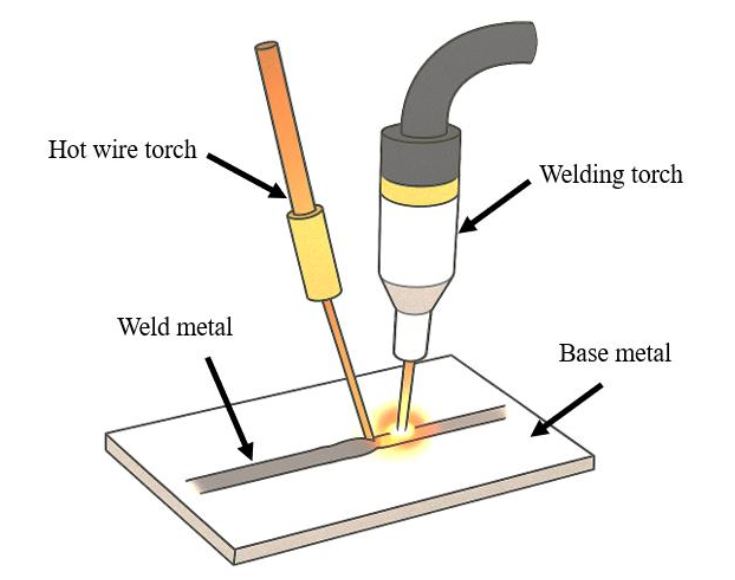
Preheating filler wire before welding using induction heating coils is a technique that has been developed and applied to various welding processes, such as Gas Tungsten Arc Welding (GTAW) and Gas Metal Arc Welding (GMAW), to improve the melting efficiency of the filler wire. This is achieved by reducing the temperature difference between the filler wire and the base material, resulting in a higher deposition rate without increasing the overall heat input to the weld. In addition, this technique benefits the mechanical properties of the weld, such as hardness, toughness, and impact resistance. It also helps to reduce the risk of porosity, as preheating assists in removing moisture on the surface of the filler wire prior to welding. Moreover, it reduces the heat input into the workpiece, leading to finer grain structures and increased hardness in the weld zone. This article presents a study on the effects of preheating filler wire using induction heating coils on deposition rate, microstructure, mechanical properties, and the influence of electromagnetic fields induced by the heating coils on arc stability and weld quality
References
K. V. S. Kumar, S. Gejendhiran, and M. Prasath, “Comparative investigation of mechanical properties in GMAW/GTAW for various shielding gas compositions,” Materials and Manufacturing Processes, vol. 29, no. 8, pp. 996–1003, Jul. 2014, doi: 10.1080/10426914.2014.901527.
T. Chanasavasook, P. Lertvijitpun, and T. Thublaor, “Effect of GTAW and GMAW-STT processes on mechanical properties and microstructure of dissimilar pipe joining between ASTM A106 Gr.B and ASTM A312 TP316/316L in 6G position,” Materials Science Forum, vol. 1141, pp. 3–10, Dec. 2024, doi: 10.4028/p-dS5OcF.
R. Singh, Arc Welding Processes Handbook. Hoboken, NJ: John Wiley & Sons, 2021, pp. 115–296, doi: 10.1002/9781119819080.
Y. Tawfik, Ed. Welding Handbook, Vol. 2: Welding Processes, Part 1. Miami, FL: American Welding Society, 2004, pp. 103–203. [Online]. Available: https://www.scribd.com/document/500941641/Welding-Handbook-Ninth-Edition-Volume-2
C. Magadum, S. Ponnusamy, M. Muthukrishnan, and B. Nair, “Developments and improvements using hot wire gas tungsten arc welding – A review,” Applied Science and Engineering Progress, vol. 16, no. 2, Apr. 2023, Art. no. 5965, doi: 10.14416/j.asep.2022.05.008.
S. Egerland, J. Zimmer, R. Brunmaier, R. Nussbaumer, G. Posch, and B. Rutzinger, “Advanced gas tungsten arc weld surfacing current status and application,” Soldagem & Inspeção, vol. 20, no. 3, pp. 300–314, Oct. 2015, doi: 10.1590/0104-9224/SI2003.05.
A. K. Yadav, M. K. Agrawal, K. K. Saxena, and B. Yelamsetti, “Effect of GTAW process parameters on weld characteristics and microstructural studies of dissimilar welded joints of AA5083 and AA6082: Optimization technique,” International Journal on Interactive Design and Manufacturing, vol. 18, no. 3, pp. 1151–1160, Feb. 2023, doi: 10.1007/s12008-023-01230-x.
P. Kah, R. Suoranta, and J. Martikainen, “Advanced gas metal arc welding processes,” The International Journal of Advanced Manufacturing Technology, vol. 67, no. 1, pp. 655–674, Jul. 2013, doi: 10.1007/s00170-012-4513-5.
I. A. Ibrahim, S. A. Mohamat, A. Amir, and A. Ghalib, “The effect of gas metal arc welding (GMAW) processes on different welding parameters,” Procedia Engineering, vol. 41, pp. 1502–1506, 2012, doi: 10.1016/j.proeng.2012.07.342.
H. Du, J. Li, and Y. Qu, “Mathematical modeling of eddy-current loss for a new induction heating device,” Mathematical Problems in Engineering, vol. 2014, no. 6, pp. 1–7, Jun. 2014, doi: 10.1155/2014/923745.
A. O. Glebov, S. V. Karpov, S. V. Karpushkin, and E. N. Malygin, “Modeling of three-dimensional fields of eddy currents during induction heating of process equipment,” Russian Electrical Engineering, vol. 89, no. 3, pp. 204–209, Jun. 2018, doi: 10.3103/S1068371218030094.
N. P. Cheremisinoff, Electrotechnology: Industrial and Environmental Applications. Westwood, NJ: Noyes Publications, 1996, pp. 1–21. [Online]. Available: https://books.google.co.th/books?id=NRrxX0vz04kC&printsec=copyright#v=onepage&q&f=false
P. Vishnuram, G. Ramachandiran, T. Sudhakar Babu, and B. Nastasi, “Induction heating in domestic cooking and industrial melting applications: A systematic review on modelling, converter topologies and control schemes,” Energies, vol. 14, no. 20, Oct. 2021, Art. no. 6634, doi: 10.3390/en14206634.
V. S. Nemkov and R. C. Goldstein, “Design principle for induction heating and hardening,” in Handbook of Metallurgical Process Design, G. E. Totten, K. Funatani, and L. Xie, Eds., NY: Marcel Dekker, 2004, pp. 591–640. [Online]. Available: https://vdoc.pub/documents/handbook-of-metallurgical-process-design-4a5p7kj0tm90
M. Patil, R. K. Choubey, and P. K. Jain, “Influence of coil shapes on temperature distribution in induction heating process,” Materials Today: Proceedings, vol. 72, pp. 3029–3035, Sep. 2022, doi: 10.1016/j.matpr.2022.08.376.
J. Li, P. Zhang, J. Hu, and Y. Zhang, “Study of the synergistic effect of induction heating parameters on heating efficiency using Taguchi method and response surface method,” Applied Sciences, vol. 13, no. 1, Dec. 2022, Art. no. 555, doi: 10.3390/app13010555.
N. Barka, A. E. Ouafi, P. Bocher, and J. Brousseau, “Effects of material properties for non-equilibrium conditions in induction heating process,” Advanced Materials Research, vol. 664, pp. 496–503, Feb. 2013, doi: 10.4028/www.scientific.net/AMR.664.496.
A. L. Voigt, T. V. da Cunha, and C. E. Niño, “Conception, implementation and evaluation of induction wire heating system applied to hot wire GTAW (IHW-GTAW),” Journal of Materials Processing Technology, vol. 281, Jul. 2020, Art. no. 116615, doi: 10.1016/j.jmatprotec.2020.116615.
N. Suwannatee and M. Yamamoto, “Single-Pass process of square butt joints without edge preparation using hot-wire gas metal arc welding,” Metals, vol. 13, no. 6, May 2023, Art. no. 1014, doi:10.3390/met13061014.
K. Marumoto, A. Fujinaga, T. Takahashi, H. Yamamoto, and M. Yamamoto, “Selection of welding conditions for achieving both a high efficiency and low heat input for hot-wire gas metal arc welding,” Journal of Manufacturing and Materials Processing, vol. 8, no. 2, Apr. 2024, Art. no. 82, doi: 10.3390/jmmp8020082.
A. Padmanaban, B. Neelakandan, and D. Kandasamy, “A study on process characteristics and performance of hot wire gas tungsten arc welding process for high temperature materials,” Materials Research, vol. 20, no. 1, pp. 76–87, Nov. 2016, doi: 10.1590/1980-5373-MR-2016-0321.
B. Silwal, J. Walker, and D. West, “Hot-wire GTAW cladding: Inconel 625 on 347 stainless steel,” The International Journal of Advanced Manufacturing Technology, vol. 102, pp. 3839–3848, Mar. 2019, doi: 10.1007/s00170-019-03448-0.
A. Pai, I. Sogalad, S. Basavarajappa, and P. Kumar “Assessment of impact strength of welds produced by cold wire and hot wire gas tungsten arc welding (GTAW) processes,” Materials Today: Proceedings, vol. 24, pp. 983–994, Jan. 2020, doi: 10.1016/j.matpr.2020.04.411.
Downloads
Published
How to Cite
Issue
Section
Categories
License
Copyright (c) 2025 NKRAFA JOURNAL OF SCIENCE AND TECHNOLOGY

This work is licensed under a Creative Commons Attribution-NonCommercial-NoDerivatives 4.0 International License.
- Content and information in articles published in NKRAFA Journal of Science and Technology are comment and responsibility of authors of articles directly. Journal editorial do no need to agree or share any responsibility.
- NKRAFA Journal of Science and Technology Articles holds the copyright of the content, pictures, images etc. which published in it. If any person or agency require to reuse all or some part of articles, the permission must be obtained from the NKRAFA Journal of Science and Technology.