Mechanical Properties of Pavement Recycling Materials as Base Layer for Quality Improvement with Cement and Asphalt Emulsion
Keywords:
Pavement Recycling, Cement, Asphalt EmulsionAbstract
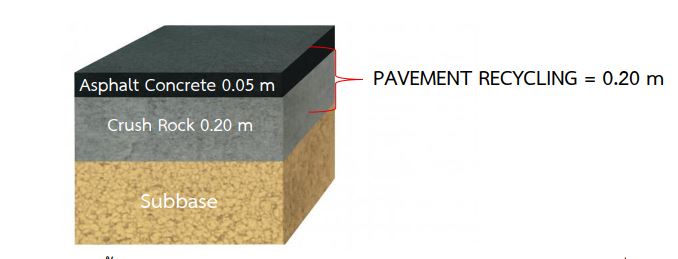
This research was conducted by using pavement recycling materials from rural road structure No.3027 with the reclaimed asphalt pavement thickness of 0.05 m and the reclaimed crushed rock thickness of 0.15 m. Firstly, the basic properties of the materials were tested and then designed on the basic of recycled materials with a cement hydraulic GU type in the ratios of 0, 1, 2, 3, 4, and 5% by total mass weight, Then the material was further improved with an asphalt emulsion of CSS-1 type in the ratio of 0, 1, 2, and 3% by total mass weight, and the results of the curing periods of 7 and 28 days were compared. The test results showed that the aggregate material was distributed close to the standard of crushed rock base layer type A with a maximum dry density of 2.291 g/cm³ and an optimum moisture content of 5.60%. The use of cement was 2.82% by total weight, resulting in an unconfined compressive strength of 17.50 kg/cm². Based on indirect tensile strength, indirect tensile stiffness modulus, and Resilient Modulus, it was found that CSS-1 can improve its mechanical properties of elasticity, permanent deformation resistance, and cracking resistance, where CSS-1 was equal to 1% by total mass weight. It was suitable for use to improve the base course layer material because of the increased amount of CSS-1. As a result, the material has a reduced unconfined compressive strength. In addition, the incubation period at the age of 28 helped to develop the hydration reaction of cement and asphalt emulsions and was also environmentally friendly because it reduced the use of new materials and also the pollution from transportation.
References
สำนักงบประมาณของรัฐสภา, แนวทางการพัฒนาระบบคมนาคมขนส่งของประเทศ, พิมพ์ครั้งที่ 1. กรุงเทพมหานคร: สำนักงานเลขาธิการสภาผู้แทนราษฎร, 2562, หน้า 1–2. [ออนไลน์]. เข้าถึงได้: https://web.parliament.go.th/assets/portals/82/news/452/1_452.pdf
U.S. Department of Transportation, Basic Asphalt Recycling Manual, Glen Ellyn, IL, US: Asphalt Recycling and Reclaiming Association (ARRA), 2001, pp. 1–7. [Online]. Available: https://apps.itd.idaho.gov/apps/manuals/Materials/Materials%20References/BasicAsphaltRecyclingManual.pdf
Standard Terminology Relating to Materials for Roads and Pavements, ASTM D 8-12, ASTM International, West Conshohocken, PA, 2013, pp. 1–3. [Online]. Available: https://store.astm.org/d0008-12.html
Standard Specification for Materials for Aggregate and Soil-Aggregate Subbase, Base, and Surface Courses, AASHTO M 147, American Association of State Highway and Transportation Officials, Washington, D.C., 2017, pp. 1-3. [Online]. Available: https://store.transportation.org/item/publicationdetail/3851
ชิตินทรีย์ โสภณพงษ์, “การศึกษาคุณสมบัติทางวิศวกรรมของวัสดุโครงสร้างทางผสมซีเมนต์ด้วยวิธีทดสอบดินด้านพลศาสตร์,” วศ.ม., มหาวิทยาลัยเกษตรศาสตร์, กรุงเทพฯ, 2560.
B. Dotzycki and P. Jaskuła, “Review and evaluation of cold recycling with bitumen emulsion and cement for rehabilitation of old pavements,” Journal of Traffic and Transportation Engineering (English Edition), vol. 6, no. 4, pp. 311–323, May 2019, doi: 10.1016/j.jtte.2019.02.002.
J. Yan, Z. Leng, F. Li, H. Zhu, and S. Bao, “Early-age strength and long-term performance of asphalt emulsion cold recycled mixes with various cement contents,” Construction and Building Materials, vol. 137, pp. 153–159, Feb. 2017, doi: 10.1016/j.conbuildmat.2017.01.114.
T. Ma, H. Wang, Y. Zhao, X. Huang, and Y. Pi, "Strength mechanism and influence factors for cold recycled asphalt mixture," Advances in Materials Science and Engineering, vol. 2015, pp. 1–10, Sep. 2015, Art. no. 181853, doi: 10.1155/2015/181853.
ธัญรดี ก่อตั้งสัมพันธ์, “การนำวัสดุโครงสร้างทางเดิมกลับมาใช้ใหม่ด้วยแอสฟัลต์อิมัลชันชนิดผสมเย็น,” วศ.ม., มหาวิทยาลัยเกษตรศาสตร์, กรุงเทพฯ, 2552.
L. Kiihnl and A. F. Braham, "Developing a particle size specification for asphalt emulsion," construction and building materials, vol. 293, pp. 1-10, May 2021, Art. no. 123414, doi: 10.1016/j.conbuildmat.2021.123414.
วรุธ เลิศไพชัยยนต์, “การปรับปรุงผิวทางเดิมด้วยบิทูเมนอิมัลชันเพื่อนำมาใช้เป็นวัสดุชั้นพื้นทาง,” วศ.ม., จุฬาลงกรณ์มหาวิทยาลัย, กรุงเทพฯ, 2557. [ออนไลน์]. เข้าถึงได้: https://digiverse.chula.ac.th/Info/item/dc:42433
B. Dotzycki, M. Jaczewski, and C. Szydłowski, "The impact of long-time chemical bonds in mineral-cement-emulsion mixtures on stiffness modulus," The Baltic Journal of Road and Bridge Engineering, vol. 13, no. 2, pp. 121–126, 2018, doi: 10.7250/bjrbe.2018-13.406.
Y. Li, Y. Lyv, L. Fan, and Y. Zhang, "Effects of cement and emulsified asphalt on properties of mastics and 100% cold recycled asphalt mixtures," Materials, vol. 12, no. 5, Mar. 2019, Art. no. 754, doi: 10.3390/ma12050754.
P. Nanthavisit, “Development of cement-asphalt emulsion mixture for Thailand road rehabilitation,” Ph.D. dissertation, D.Eng. (Civil Engineering), Chiang Mai University, Chiang Mai, Thailand, 2020.
จักรพงษ์ วงค์คำจันทร์ และคณะ, “คุณสมบัติเชิงกลของวัสดุชั้นพื้นทางเดิมปรับปรุงคุณภาพด้วยปูนซีเมนต์ร่วมกับยางอิมัลชัน,” ใน การประชุมวิชาการวิศวกรรมโยธาแห่งชาติ ครั้งที่ 28, จังหวัดภูเก็ต, 24–26 พฤษภาคม 2566, หน้า 1–6. [ออนไลน์]. เข้าถึงได้: https://www.conference.thaince.org/index.php/ncce28/article/download/2287/1430
เมธากุล มีธรรม และ วชรภูมิ เบญจโอฬาร, “การเปรียบเทียบปริมาณการปล่อยก๊าซเรือนกระจกจากงานก่อสร้างถนนโดยการเลือกเทคนิคการก่อสร้างที่ต่างกัน,” วารสารวิชาการครุศาสตร์อุตสาหกรรม พระจอมเกล้าพระนครเหนือ, ปีที่ 7, ฉบับที่ 2, หน้า 1–9, ก.ค. – ธ.ค. 2559.
Y. Yang, Y. Yang, and B. Qian, "Performance and microstructure of cold recycled mixes using asphalt emulsion with different contents of cement," Materials, vol. 12, no. 16, Aug. 2019, Art. no. 2548, doi: 10.3390/ma12162548.
G. Flores, J. Gallego, L. Miranda and J. R. Marcobal. “Cold asphalt mix with emulsion and 100% RAP: Compaction energy and influence of emulsion and cement content.” Construction and Building Materials, Vol. 250, Mar. 2020, Art. no. 118804, doi:10.1016/j.conbuildmat.2020.118804.
มทช.223-2545 มาตรฐานงานชั้นพื้นทาง (Base), สำนักวิเคราะห์ วิจัย และพัฒนา กรมทางหลวงชนบท, ปทุมธานี: โรงพิมพ์มหาวิทยาลัยธรรมศาสตร์, 2559, หน้า 94–95.
มทช.(ท) 303-2545 วิธีการทดสอบเพื่อหาค่าแรงอัดแกนเดียว (UNCONFINED COMPRESSION TEST), สำนักวิเคราะห์ วิจัย และพัฒนา กรมทางหลวงชนบท, ปทุมธานี: โรงพิมพ์มหาวิทยาลัยธรรมศาสตร์, 2559, หน้า 272–280.
Standard Method of Test Unconfined Compressive Strength of Cohesive Soil, AASHTO T 208- 15, American Association of State Highway and Transportation Officials, Washington, D.C., 2015, pp. 1–6. [Online]. Available: https://store.transportation.org/Item/PublicationDetail?ID=5493
Standard Test Method for Indirect Tensile (IDT) Strength of Asphalt Mixtures, ASTM D6931-17, West Conshohocken, PA, 2017, pp. 1–5. [Online]. Available: https://store.astm.org/d6931-17.html
Standard Method of Test for Resilient Modulus of Asphalt Mixtures, AASHTO TP 31-96, American Association of State Highway and Transportation Officials, Washington, D.C., 1996, pp. 380–409. [Online]. Available: https://www.scribd.com/document/475728404/AASHTO-TP31-Resilient-modulus-of-bituminous-mixtures-by-indirect-tension-pdf
Determining the Resilient Modulus of Soils and Aggregate Materials, AASHTO T 307-99 (2007), American Association of State Highway and Transportation Officials, Washington, D.C, 2007, pp. 1–42. [Online]. Available: https://www.scribd.com/document/733275991/AASHTO-T307-99-Determination-of-Resilient-Modulus
Wirtgen GmbH, Wirtgen Cold Recycling Technology, 1st ed. Windhagen: Wirtgen GmbH, 2012, pp. 73–98. [Online]. Available: https://www.researchgate.net/profile/Kim-Jenkins-4/publication/327738860_Recommendation_of_RILEM_TC237-SIB_on_cohesion_test_of_recycled_asphalt/links/5bab48b445851574f7e65b40/Recommendation-of-RILEM-TC237-SIB-on-cohesion-test-of-recycled-asphalt.pdf
สมาคมอุตสาหกรรมปูนซีเมนต์ไทย (TCMA), ปูนซีเมนต์ไฮดรอลิก หนึ่งในมาตรการลดก๊าสเรือนกระจกของประเทศไทยตามข้อตกลงปารีส, ฉบับปรับปรุง. กรุงเทพฯ: สมาคมอุตสาหกรรมปูนซีเมนต์ไทย (TCMA), 2565, หน้า 1–20. [ออนไลน์]. เข้าถึงได้: https://shorturl.at/oHE7U
วัชรินทร์ วิทยกุล, ยางมะตอยน้ำสำหรับงานถนน, พิมพ์ครั้งที่ 1. กรุงเทพ: สำนักพิมพ์มหาวิทยาลัยเกษตรศาสตร์, 2548, หน้า 1–33.
แคตอิออนิกแอสฟัลต์อิมัลชั่นสำหรับถนน, มอก. 371-2530, สำนักงานมาตรฐานผลิตภัณฑ์อุตสาหกรรม, กรุงเทพฯ, 2530, หน้า 1–16.
ปูนซีเมนต์ไฮดรอลิก, มอก. 2594-2556, สำนักงานมาตรฐานผลิตภัณฑ์อุตสาหกรรม, กรุงเทพฯ, 2556, หน้า 1–10. [ออนไลน์]. เข้าถึงได้: https://a.tisi.go.th/t/?n=8133
วิธีการทดสอบหาขนาดเม็ดของวัสดุ (Sieve Analysis), มทช. (ท) 501.8-2545, สำนักวิเคราะห์ วิจัย และพัฒนา กรมทางหลวงชนบท, กรุงเทพ, 2559, หน้า 57-62.
วิธีการทดสอบความแน่น แบบสูงกว่ามาตรฐาน (Modified Compaction Test), มทช. (ท) 501.2-2545, สำนักวิเคราะห์ วิจัย และพัฒนา กรมทางหลวงชนบท, กรุงเทพฯ, 2559, หน้า 10–17.
Downloads
Published
How to Cite
License
Copyright (c) 2026 NKRAFA JOURNAL OF SCIENCE AND TECHNOLOGY

This work is licensed under a Creative Commons Attribution-NonCommercial-NoDerivatives 4.0 International License.
- Content and information in articles published in NKRAFA Journal of Science and Technology are comment and responsibility of authors of articles directly. Journal editorial do no need to agree or share any responsibility.
- NKRAFA Journal of Science and Technology Articles holds the copyright of the content, pictures, images etc. which published in it. If any person or agency require to reuse all or some part of articles, the permission must be obtained from the NKRAFA Journal of Science and Technology.