Development of An Intelligent Classification of Plastic Waste System
Keywords:
Waste Sorting, Plastic, IntelligentAbstract
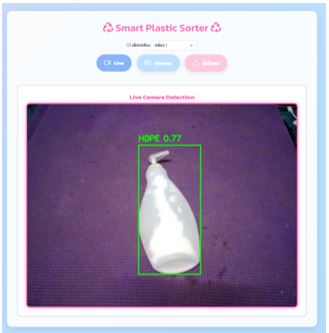
Plastic waste is a severe environmental issue in Thailand, accounting for 12% of total waste, yet only 25% is recycled. Manual classification is therefore limited and prone to errors. This study applied YOLOv11, a real-time object detection model with higher accuracy and speed than its predecessors, to the classification of four major types of plastic waste: HDPE, PET, PP, and PS. A web application was developed using Flask to enable users to detect and classify plastic waste conveniently, rapidly, and accurately. The experimental results indicated that the YOLOv11 model can effectively classify four types of plastic waste (HDPE, PET, PP, and PS), achieving an average latency of 22 ms per image and a processing speed of 55 FPS. Evaluating the classification performance by plastic type, PET achieved the highest accuracy of 0.994 and precision of 0.999, followed by HDPE with an accuracy of 0.983 and precision of 0.958. PP and PS recorded accuracies of 0.958 and 0.976, and precisions of 0.943 and 0.971, respectively. In terms of recall, HDPE reached 1.0, PET 0.97, PP 0.898, and PS 0.918. The F1-scores of PET and HDPE were the highest at 0.984 and 0.978, while PS and PP achieved 0.944 and 0.92, respectively. These results demonstrated that the model can reliably and accurately classify PET and HDPE waste. The system was suitable for practical deployment in waste sorting facilities or recycling centers, integrated with IoT devices such as robotic arms or conveyor belts, enabling real-time waste separation, reducing reliance on manual labor, and enhancing overall waste management efficiency.
References
Thai PBS, "ขยะล้นเมือง คนไทยสร้างขยะเฉลี่ย 7.3 หมื่นตัน/วัน,” Thai PBS, 5 มิ.ย. 67. [ออนไลน์]. เข้าถึงได้: https://www.thaipbs.or.th/news/content/340722
สำนักงานนโยบายและแผนทรัพยากรธรรมชาติและสิ่งแวดล้อม, “ขยะพลาสติก,” สำนักงานนโยบายและแผนทรัพยากรธรรมชาติและสิ่งแวดล้อม. เข้าถึงเมื่อ: 1 ส.ค. 68. [ออนไลน์]. เข้าถึงได้: https://www.onep.go.th/ขยะพลาสติก
ธนโชติ ภาชะนัย, จักรกริช ปานเงิน, กรรณิการ์ คนงาม, วรชัย ศรีสมุดคำ และ วาสนา วงศ์ษา, “เครื่องคัดแยกขยะรีไซเคิลด้วยการประมวลผลภาพ,” วารสารวิชาการเทคโนโลยีอุตสาหกรรม และวิศวกรรม มหาวิทยาลัยราชภัฏพิบูลสงคราม, ปีที่ 4, ฉบับที่ 2, หน้า 242–253, พ.ค.–ส.ค. 65. [ออนไลน์]. เข้าถึงได้: https://ph02.tci-thaijo.org/index.php/psru-jite/article/view/247342
S. Promboonruang, T. Boonrod, and R. Yongyut, “Efficient waste detection and classification based on YOLOv5 models,” Engineering Access, vol. 10, no. 1, pp. 51–58, Jan.–Jun. 2024, doi: 10.14456/mijet.2024.7.
ปาณิสรา หาดขุนทด, ภัครพล อาจอาษา และ ธนากร แสงกุดเลาะ, “การพัฒนาระบบคัดแยกมะขามหวานด้วยเทคนิคการประมวลผลภาพ,” วารสารวิทยสารสนเทศและเทคโนโลยี, ปีที่ 4, ฉบับที่ 2, หน้า 47–61, ก.ค.–ธ.ค. 66. [ออนไลน์]. เข้าถึงได้: https://so09.tci-thaijo.org/index.php/jait_ssru/article/view/3036
Ultralytics, “Ultralytics YOLO11,” Ultralytics. Accessed: Jul. 10, 2025. [Online]. Available: https://docs.ultralytics.com/models/yolo11/
J. Redmon, S. Divvala, R. Girshick and A. Farhadi, "You only look once: Unified, real-time object detection," 2016 IEEE Conference on Computer Vision and Pattern Recognition (CVPR), Las Vegas, NV, USA, 2016, pp. 779–788, doi: 10.1109/CVPR.2016.91.
K. M. Ting, “Confusion matrix,” in Encyclopedia of Machine Learning, C. Sammut, and G. I. Webb, Eds., Boston, MA, USA: Springer, 2011, doi: 10.1007/978-0-387-30164-8_157.
R. Khanam and M. Hussain, “YOLOv11: An overview of the key architectural enhancements,” ARXIV. Accessed: Jul. 10, 2024. [Online]. Available: https://arxiv.org/abs/2410.17725
J. Brownlee, “Generative adversarial networks with python,” Machine Learning Mastery. Accessed: Jul. 10, 2024. [Online]. Available: https://machinelearningmastery.com/generative_adversarial_networks/
K. Soumya, K. Kushala, K. Y. Varshini, K. B. Jahnavi, and K. L. Swetha, “Plastic waste detection using YOLOv5 deep learning object detection algorithm”, International Journal of Novel Research and Development (IJNRD), vol.8, no. 3, pp. 226–238, Dec. 2024. [Online]. Available: https://www.ijnrd.org/papers/IJNRD2303103.pdf
J. R. Yasiri, R. Prathivi, and Susanto. “Detection of plastic bottle waste using YOLO version 5 algorithm”, Sinkron: Jurnal dan Penelitian Teknik Informatika, vol. 9, no. 1, pp. 20–30, Jan. 2025, doi: 10.33395/sinkron.v9i1.14242.
A. P. Unni, N. A. Alimon, M. Gowri, S. N. A. Krishna, and S. Livera, “Waste segregation using YOLO v8 based object detection and robotics,” Journal of emerging technologies and innovative research (JETIR), vol. 11, no. 4, pp. 591–595, Apr. 2024. [Online]. Available: https://www.jetir.org/papers/JETIR2404F83.pdf
Downloads
Published
How to Cite
License
Copyright (c) 2026 NKRAFA JOURNAL OF SCIENCE AND TECHNOLOGY

This work is licensed under a Creative Commons Attribution-NonCommercial-NoDerivatives 4.0 International License.
- Content and information in articles published in NKRAFA Journal of Science and Technology are comment and responsibility of authors of articles directly. Journal editorial do no need to agree or share any responsibility.
- NKRAFA Journal of Science and Technology Articles holds the copyright of the content, pictures, images etc. which published in it. If any person or agency require to reuse all or some part of articles, the permission must be obtained from the NKRAFA Journal of Science and Technology.