Quantitative Risk Assessment of Hourly Solar Radiation Forecasting using Monte Carlo Method: A Comparative Stability Study of CPR Model in Thailand
Keywords:
Monte Carlo Simulation, Hourly Solar Radiation, CPR Model, Risk AnalysisAbstract
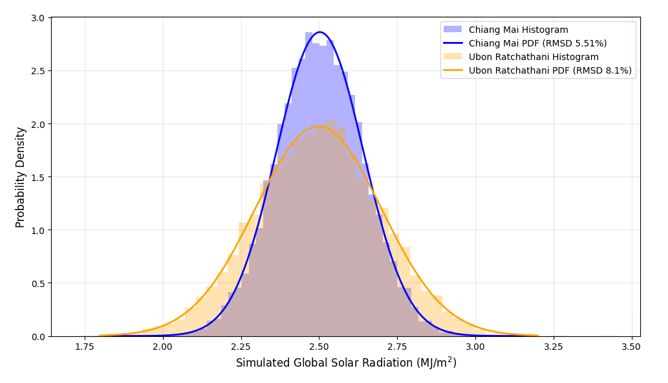
Efficient management of solar energy systems requires accurate hourly global solar radiation data. This study aimed to analyze quantitative risk and establish confidence intervals for solar radiation forecasting using the Collares-Pereira and Rabl (CPR) model. The study applied Monte Carlo Simulation with 10,000 iterations, based on the Normal Distribution Assumption, utilizing Root Mean Square Difference (RMSD) and Mean Bias Difference (MBD) statistics from standard measurement stations in Chiang Mai and Ubon Ratchathani. The results indicated that while the mean forecast values for both stations were similar, the 95% confidence interval width for Ubon Ratchathani was 49.8% wider than that of Chiang Mai. Furthermore, the probability of error exceeding 10% in Ubon Ratchathani was three times higher. These findings suggested that solar system design in the Northeastern region required a higher safety margin compared to the Northern region to accommodate significantly higher uncertainty fluctuations. However, these results relied on the error distribution assumption, which should be further investigated in future research.
References
J. Widén and J. Munkhammar, Solar Radiation Theory. Uppsala, Sweden: Uppsala University, 2019, doi: 10.33063/diva-381852.
H. Khorasanizadeh, A. Aghaei, H. Ehteram, R. Dehghani Yazdeli, and N. Hataminasar, “Attaining optimum tilts of flat solar surfaces utilizing measured solar data: Case study for Ilam, Iran,” Iranica Journal of Energy and Environment, vol. 5, no. 3, pp. 224–232, 2014, doi: 10.5829/idosi.ijee.2014.05.03.01.
W. B. Wan Nik, M. Z. Ibrahim, K. B. Samo, and A. M. Muzathik, “Monthly mean hourly global solar radiation estimation,” Solar Energy, vol. 86, no. 1, pp. 379–387, Jan. 2012, doi: 10.1016/j.solener.2011.10.008.
A. Madhlopa, “Solar radiation climate in Malawi,” Solar Energy, vol. 80, no. 8, pp. 1055–1057, Aug. 2006, doi: 10.1016/j.solener.2005.08.007.
M. J. Ahmad and G. N. Tiwari, “Solar radiation models–A review,” International Journal of Energy Research, vol. 35, no. 4, pp. 271–290, Mar. 2011, doi: 10.1002/er.1690.
M. Iqbal, An Introduction to Solar Radiation. NY, USA: Academic Press, 1983, doi: 10.1016/B978-0-12-373750-2.X5001-0.
เสริม จันทร์ฉาย, รังสีอาทิตย์. นครปฐม: เพชรเกษมการพิมพ์, 2557. [ออนไลน์]. เข้าถึงได้: https://phy.sc.su.ac.th/book/solar_book.pdf
B. Y. Liu and R. C. Jordan, “The interrelationship and characteristic distribution of direct, diffuse and total solar radiation,” Solar Energy, vol. 4, no. 3, pp. 1–19, Jul. 1960, doi: 10.1016/0038-092X(60)90062-1.
M. Collares-Pereira and A. Rabl, “The average distribution of solar radiation-correlations between diffuse and hemispherical and between daily and hourly insolation values,” Solar Energy, vol. 22, no. 2, pp. 155–164, 1979, doi: 10.1016/0038-092X(79)90100-2.
K. Runghathaithum, K. Tohsing and S. Janjai, "Simplified models for obtaining monthly average hourly global solar radiation from daily radiation data at four main regions in Thailand," KKU Science Journal, vol. 53, no. 3, pp. 390–400, Oct. 2025, doi: 10.14456/kkuscij.2025.31.
N. Metropolis and S. Ulam, “The Monte Carlo method,” Journal of the American Statistical Association, vol. 44, no. 247, pp. 335–341, Sep. 1949, doi: 10.2307/2280232.
Thai Meteorological Department, Climatological Data of Thailand (30-Year Period: 1981-2010). Bangkok: Thai Meteorological Department, 2012. [Online]. Available: https://www.tmd.go.th/weather/province/last30years-1981-2010/
P. Lauret, M. David, and H. T. Pedro, “Probabilistic solar forecasting using quantile regression models,” Energies, vol. 10, no. 10, 2017, Art. no.1591, doi: 10.3390/en10101591.
Downloads
Published
How to Cite
Issue
Section
Categories
License
Copyright (c) 2026 NKRAFA JOURNAL OF SCIENCE AND TECHNOLOGY

This work is licensed under a Creative Commons Attribution-NonCommercial-NoDerivatives 4.0 International License.
- Content and information in articles published in NKRAFA Journal of Science and Technology are comment and responsibility of authors of articles directly. Journal editorial do no need to agree or share any responsibility.
- NKRAFA Journal of Science and Technology Articles holds the copyright of the content, pictures, images etc. which published in it. If any person or agency require to reuse all or some part of articles, the permission must be obtained from the NKRAFA Journal of Science and Technology.