Submissions Process
Submissions Process
As part of the submission process, authors are required to verify their manuscript’s compliance with the following items. Submissions that do not adhere to these guidelines may be returned to the authors.
- Originality: The manuscript is original, has not been previously published, and is not currently under consideration by another journal (or a full explanation has been provided in the ‘Comments to the Editor’).
- File Format: The submission file is in Microsoft Word format (.doc or .docx). The text adheres to the formatting requirements outlined in the [Author Guidelines] and the [Manuscript Template].
- Cover Letter : A formal cover letter must be included with the submission. This letter should explicitly address the following:
- Scientific Novelty: A clear statement describing the originality of the work and how it advances the current state of knowledge in its field.
- Suggested Reviewers: The names and contact information of at least three potential reviewers. These individuals must be recognized experts in the manuscript’s specific field, must not be from the same institution as the authors, and must have no conflict of interest.
- Graphical Abstract: A graphical abstract has been prepared and included with the submission.
- Key Highlights: A summary of the most significant new findings or breakthroughs presented in the manuscript.
- Conflict of Interest: A formal Declaration of Conflict of Interest has been completed using the official [Template] and is included with the submission files.
- Authorship Policy: The author list is final. Please note that no additional authors will be permitted once the manuscript has been accepted for publication.
"The peer-review process"
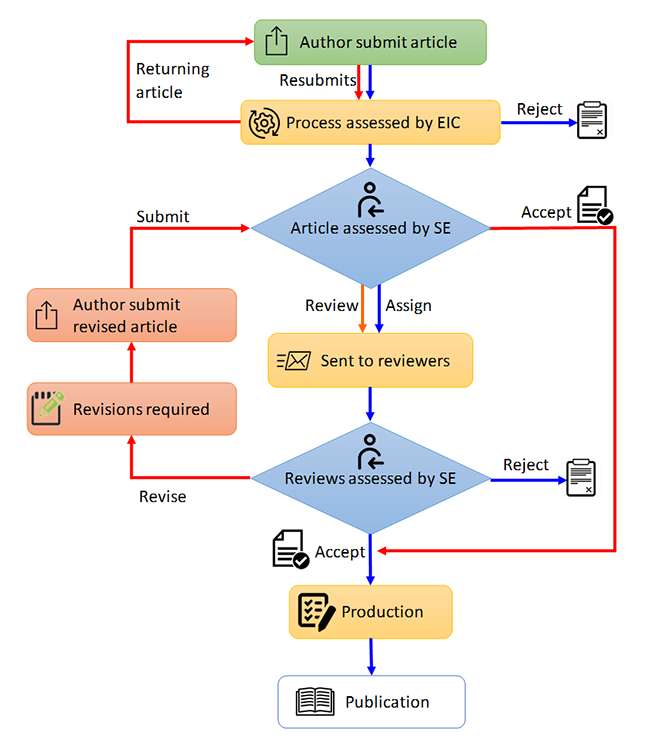
The peer-review process can be broadly summarized into 5 steps, although these steps can vary slightly between journals.
- Submission of Paper
The corresponding or submitting author submits the article to the journal via an online system.
- Evaluation by the Editor-in-Chief (EIC)
The EIC checks that the paper is appropriate for the journal and is sufficiently original and interesting. If not, the paper may be rejected without being reviewed any further. The EIC assigned the appropriate section editor (SE), who handled the peer review if the article met the journal requirement.
- Invitation to Reviewers
The SE sends invitations to appropriate reviewers. As responses are received, further invitations are made, if needed, until the necessary number of acceptances is obtained – commonly, at least 3.
- Review is Conducted
The reviewer sets a time to read the article. The review has then submitted a recommendation to accept or reject it or a request for revision before it is reconsidered.
- Journal Evaluates the Reviews
The SE considers all the returned reviews before making an overall decision. If the reviews differ widely, SE may invite another reviewer to get a different opinion before deciding.
After the decision, the possible steps will be processed as a following.
If accepted, the paper is sent to production.
If the article is rejected or sent back for major or minor revision, the SE should include constructive comments from the reviewers to help the author improve the article. Moreover, reviewers should also be sent an email or letter to let them know the outcome of their review. The reviewers should receive a new version of the paper sent back for revision. However, the SE might do this follow-up review where only minor changes were requested.