
Development of Sweetened Condensed Creamer made of Thai Pathumthani Rice (Hom-Pathum) Milk
Article Sidebar
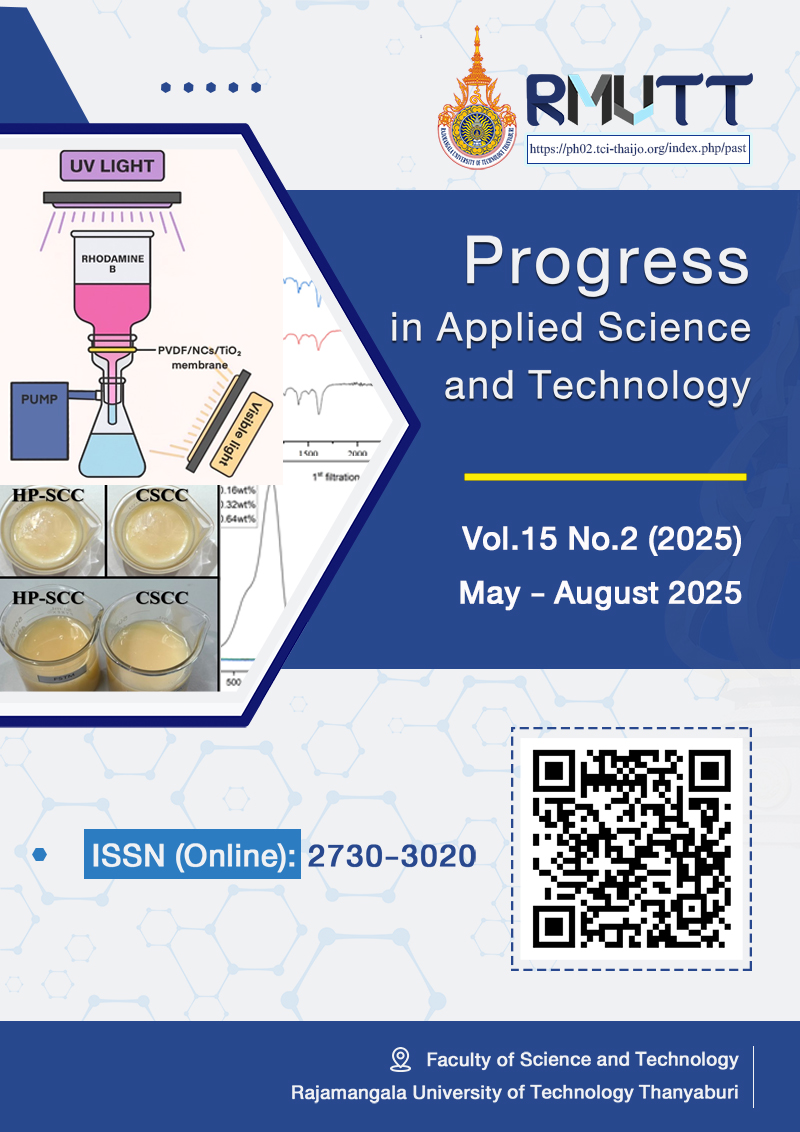
Main Article Content
Abstract
Thai Pathumthani Rice (Hom-Pathum) is a Geographic Indication (GI) product cultivated in Thailand. Plant-based milk production has gained popularity due to its lower greenhouse gas emissions, water use, and land utilization than dairy milk. Sweetened condensed cream is a concentrated dairy product made by eliminating a lot of water from cream and adding sugar for stability, texture, and shelf life. Its creamy texture, high fat content, and sweetness make it popular in confectionery, bakery, and desserts. This study was aimed to utilize the whole Hom-Pathum rice for Hom-Pathum rice milk (HPRM) production and formulate a sweetened condensed creamer (SCC) product. The acquired SCC was assessed for its physical, physico-chemical, biological activity, chemical composition, and microbiological properties. The results showed that the ratio of rice to water 1:10 (%w/v) was suitable for HPRM production and processes to SCC product. The color of obtained SCC made of HPRM (HP-SCC) was significantly different in L* value (76.31±2.43) when compared to commercial sweetened condensed cream (CSCC), 72.83±3.01, (p<0.05). No difference was observed in pH, water activity (Aw) and total acidity value of final product compared with CSCC (p>0.05). The viscosity of HP-SCC showed the consistency (7,642.63±29.78cP) with commercial product. The HP-SCC enhanced antioxidant activity and eliminated hazards from pathogenic bacteria, resulting in a safe product. These findings may serve as preliminary results for the creation of HPRM and HP-SCC products that fulfill consumer quality standards.
Article Details

This work is licensed under a Creative Commons Attribution-NonCommercial-NoDerivatives 4.0 International License.




References
Butovskaya E, Caprai E, Peloso M, Gasparini M, Borgia M, Abdul ME, et al. Plant-based milk alternatives: Assessing the occurrence of chemical and microbiological contaminants in soy, oat, rice and almond beverages from Italian market. Food Control. 2025;169:111005.
Ang WS, Kee PE, Lan JCW, Chen W-H, Chang J-S, Khoo KS. Unveiling the rise of microalgae-based foods in the global market: Perspective views and way forward. Food Biosci. 2025;66:105390.
Andreani G, Banovic M, Dagevos H, Sogari G. Consumer perceptions and market analysis of plant-based foods: A global perspective. In: Boukid F, Rosell CM, Gasparre DD, editors. Handbook of Plant-Based Food and Dairies. 1st ed. Academic Press; 2024. p. 393–408.
Moshtaghian H, Hallström E, Bianchi M, Bryngelsson S. Nutritional profile of plant-based dairy alternatives in the Swedish market. Curr Res Food Sci. 2024;8:100712.
Kupkanchanakul W, Kadowaki M, Kubota M, Naivikul O. Effect of pre-germination at varying stages of embryonic growth length on chemical composition and protein profile of Thai rice (Oryza sativa L.). Agr Nat Resour. 2018;52(1):59–65.
Dokduang H, Katenak A, Kittirat Y, Tomacha J, Promraksa B, Taing L, et al. Chemical composition and anticancer potential of water extracts derived from ground powder of Thai germinated brown rice (Oryza sativa L.). Nat Prod Res. 2025;1–8.
Nieuwenhuijse H. Sweetened Condensed Milk. In: McSweeney PLH, McNamara JP, editors. Encyclopedia of Dairy Sciences. 3rd ed. Academic Press; 2022. p. 549–54.
Palatzidi A, Nikoloudaki O, Tlais AZA, Zannini E, O’Mahony JA, Tsakalidou E, et al. Fermented plant-based cream cheese analogues formulated using legume flours and avocado pulp. Future Foods. 2025;11:100580.
Grossi M, Rao J, Chen B. Tuning the properties of plant-based whipped cream through zein nanoparticles-sodium stearate complex. Food Hydrocoll. 2024;155:110219.
Rawal K, Annamalai PK, Bhandari B, Prakash S. Engineering plant-based Pickering emulsions as highly stable dairy cream alternatives using a binary mixture of particle stabilisers. Food Hydrocoll. 2025;159:110604.
Oh J, Lee K-G. Analysis of physicochemical properties of nut-based milk and sweetened condensed milk alternatives. Food Chem. 2024;455:139991.
McNamara JP. Imitation, Alternative and ‘Plant-based’ Dairy Products. In: McSweeney PLH, McNamara JP, editors. Encyclopedia of Dairy Sciences. 3rd ed. Academic Press; 2022. p. 418–22.
Vashisht P, Sharma A, Awasti N, Wason S, Singh L, Sharma S, et al. Comparative review of nutri-functional and sensorial properties, health benefits and environmental impact of dairy (bovine milk) and plant-based milk (soy, almond, and oat milk). Food Hum. 2024;2:100301.
Boukid F, Mefleh M, Mameri H, Rosell CM. Plant protein innovations in snacks and bakery: Synergy of market trends and scientific advances. Food Biosci. 2024;62:105580.
Faccin GL, Miotto LA, Vieira LN, Barreto PLM, Amante ER. Chemical, sensorial and rheological properties of a new organic rice bran beverage. Rice Sci. 2009;16(3):226–34.
AOAC. Official methods of analysis of AOAC International. 17th ed. Gaithersburg, MD: Association of Analytical Communities; 2000.
Issara U, Rawdkuen S. Instant organic rice bran milk – A nutritional quality aspect. Int Food Res J. 2016;25(4):1600–5.
Issara U, Rawdkuen S. Organic rice bran milk: Production and its natural quality attributes. In: Proceedings of 1st Joint ACS AGFD-ACS ICSCT Symposium on Agricultural and Food Chemistry; 2014. p. 82–8. Montien Riverside Hotel, Bangkok, Thailand.
Kukusamude C, Puripunyavanich V, Kongsri S. Combination of light stable isotopic and elemental signatures in Thai Hom Mali rice with chemometric analysis. Food Chem X. 2023;17:100613.
Siripattanakulkajorn C, Sombutsuwan P, Nakornsadet A, Chumsantea S, Lilitchan S, Krisnangkura K, et al. Policosanol and other bioactive compounds in different Thai rice varieties. J Food Compos Anal. 2024;126:105891.
Puerari C, Magalhães-Guedes KT, Schwan RF. Physicochemical and microbiological characterization of chicha, a rice-based fermented beverage produced by Umutina Brazilian Amerindians. Food Microbiol. 2015;46:210–7.
Ramos CL, de Almeida EG, Pereira GVM, Cardoso PG, Dias ES, Schwan RF. Determination of dynamic characteristics of microbiota in a fermented beverage produced by Brazilian Amerindians using culture-dependent and culture-independent methods. Int J Food Microbiol. 2010;140(2):225–31.
Ramos CL, de Almeida EG, Freire AL, Schwan RF. Diversity of bacteria and yeast in the naturally fermented cotton seed and rice beverage produced by Brazilian Amerindians. Food Microbiol. 2011;28(7):1380–6.
Fabian CB, Huynh LH, Ju YH. Precipitation of rice bran protein using carrageenan and alginate. LWT-Food Sci Technol. 2010;43(2):375–9.
