
Structural and Biological Enhancement of Cu-Incorporated Biphasic Calcium Phosphate Synthesized via a Sol–Gel Combustion Method
Article Sidebar
Main Article Content
Abstract
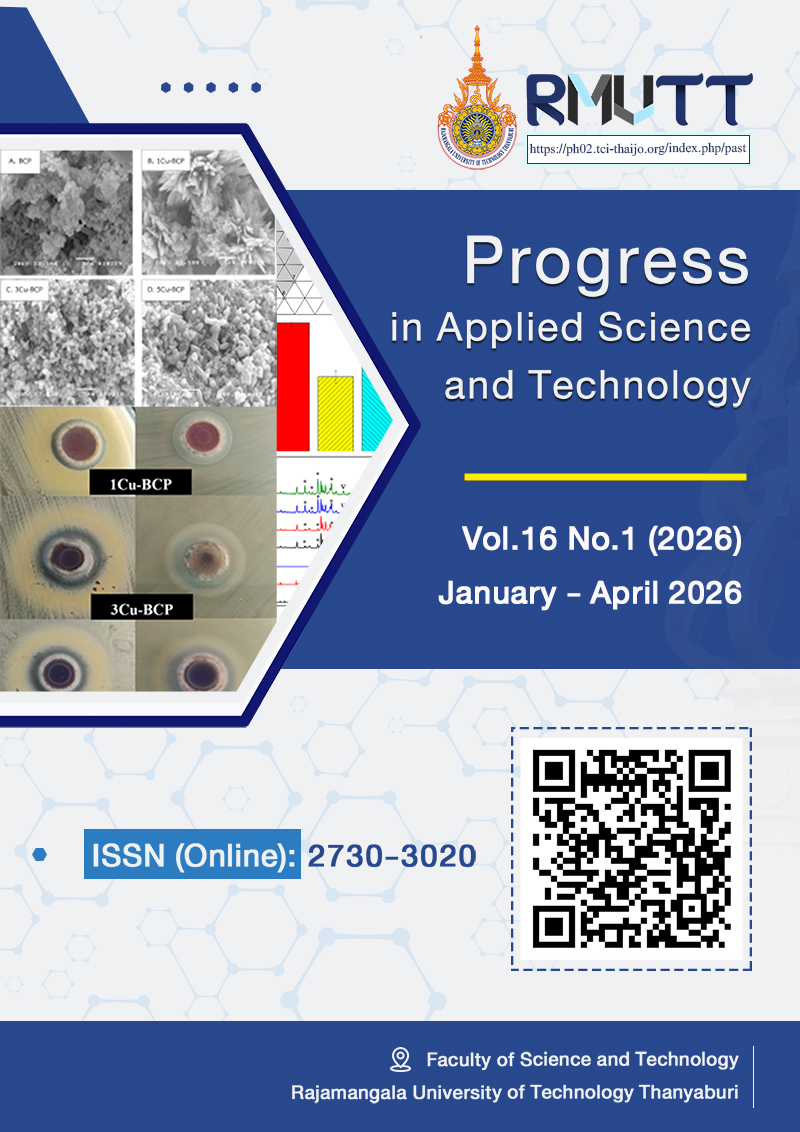
Biphasic Calcium Phosphate (BCP) is a critical bioceramic for bone regeneration due to its biocompatibility and osteoconductivity. This study investigates the enhancement of BCP through the incorporation of copper (Cu) ions using a sol–gel combustion method at concentrations of 0, 1, 3, and 5 mol%. XRD analysis revealed that while hydroxyapatite (HAp) remained the primary phase, Cu incorporation promoted the formation of secondary β-Tricalcium Phosphate (β-TCP) and Calcium Oxide (CaO) phases. XANES spectra confirmed that Cu exists in a +2 oxidation state and forms a separate CuO phase rather than substituting for Ca sites. Bioactivity assessments via 7-day immersion in Simulated Body Fluid (SBF) demonstrated that the 5Cu–BCP sample most effectively promoted the formation of a bone-like apatite layer with a Ca/P ratio of 1.63. Antibacterial tests showed that Cu-doped samples inhibited S. aureus growth, but only 5Cu–BCP was effective against the Gram-negative P. aeruginosa. Furthermore, while the 1Cu–BCP sample showed significant cytotoxicity, higher Cu concentrations (3Cu and 5Cu) exhibited better cell viability, likely due to more effective structural incorporation of CuO. These findings suggest that 5Cu–BCP is a promising material for biomedical applications, offering a superior balance of bioactivity, antibacterial performance, and biocompatibility.
Article Details

This work is licensed under a Creative Commons Attribution-NonCommercial-NoDerivatives 4.0 International License.




References
Ebrahimi M, Botelho MG, Dorozhkin SV. Biphasic calcium phosphates bioceramics (HA/TCP): Concept, physicochemical properties and the impact of standardization of study protocols in biomaterials research. Mater Sci Eng C Mater Biol Appl. 2017 Feb;71:1293–312.
Bouler JM, Pilet P, Gauthier O, Verron E. Biphasic calcium phosphate ceramics for bone reconstruction: A review of biological response. Acta Biomater. 2017 Apr;53:1–12.
Ebrahimi M, Pripatnanont P, Suttapreyasri S, Monmaturapoj N. In vitro biocompatibility analysis of novel nano‐biphasic calcium phosphate scaffolds in different composition ratios. J Biomed Mater Res Part B. 2014 Jan;102(1):52–61.
Jin P, Liu L, Cheng L, Chen X, Xi S, Jiang T. Calcium-to-phosphorus releasing ratio affects osteoinductivity and osteoconductivity of calcium phosphate bioceramics in bone tissue engineering. BioMed Eng OnLine. 2023 Feb 9;22(1):12.
Rittidach T, Tithito T, Suntornsaratoon P, Charoenphandhu N, Thongbunchoo J, Krishnamra N, et al. Effect of zirconia-mullite incorporated biphasic calcium phosphate/biopolymer composite scaffolds for bone tissue engineering. Biomed Phys Eng Express. 2020 Sep 1;6(5):055004.
Li X, Song T, Chen X, Wang M, Yang X, Xiao Y, et al. Osteoinductivity of Porous Biphasic Calcium Phosphate Ceramic Spheres with Nanocrystalline and Their Efficacy in Guiding Bone Regeneration. ACS Appl Mater Interfaces. 2019 Jan 30;11(4):3722–36.
Xu A, Zhuang C, Xu S, He F, Xie L, Yang X, et al. Optimized Bone Regeneration in Calvarial Bone Defect Based on Biodegradation-Tailoring Dual-shell Biphasic Bioactive Ceramic Microspheres. Sci Rep. 2018 Feb 21;8(1):3385.
Kucko SK, Raeman SM, Keenan TJ. Current Advances in Hydroxyapatite- and β-Tricalcium Phosphate-Based Composites for Biomedical Applications: A Review. Biomed Mater Devices. 2023 Mar;1(1):49–65.
Al-Sanabani JS, Madfa AA, Al-Sanabani FA. Application of Calcium Phosphate Materials in Dentistry. Int J Biomater. 2013;2013:1–12.
Kang HJ, Makkar P, Padalhin AR, Lee GH, Im SB, Lee BT. Comparative study on biodegradation and biocompatibility of multichannel calcium phosphate based bone substitutes. Mater Sci Eng C Mater Biol Appl. 2020 May;110:110694.
Kim B, Ventura R, Lee B. Functionalization of porous BCP scaffold by generating cell‐derived extracellular matrix from rat bone marrow stem cells culture for bone tissue engineering. J Tissue Eng Regen Med. 2018 Feb;12(2).
Basu S, Basu B. Doped biphasic calcium phosphate: synthesis and structure. J Asian Ceram Soc. 2019 Jul 3;7(3):265–83.
Ressler A, Žužić A, Ivanišević I, Kamboj N, Ivanković H. Ionic substituted hydroxyapatite for bone regeneration applications: A review. Open Ceram. 2021 Jun;6:100122.
Šupová M. Substituted hydroxyapatites for biomedical applications: A review. Ceram Int. 2015 Sep;41(8):9203–31.
Jiang Y, Yuan Z, Huang J. Substituted hydroxyapatite: a recent development. Mater Technol. 2020 Oct 14;35(11–12):785–96.
Fan J, Yuan X, Lu T, Ye J. Biphasic Calcium Phosphate Ceramic Scaffold Composed of Zinc Doped β-Tricalcium Phosphate and Silicon Doped Hydroxyapatite for Bone Tissue Engineering. ACS Appl Bio Mater. 2024 Nov 18;7(11):7758–69.
Lin Z, Cao Y, Zou J, Zhu F, Gao Y, Zheng X, et al. Improved osteogenesis and angiogenesis of a novel copper ions doped calcium phosphate cement. Mater Sci Eng C Mater Biol Appl. 2020 Sep;114:111032.
Huang SM, Chen WC, Liu SM, Ko CL, Chen JC, Shih CJ. Insights into the Various Cellular Antimicrobial Responses, Biocompatibility, Osteogenesis, Wound Healing, and Angiogenesis of Copper-Doped Nano-Hydroxyapatite Composite Calcium Phosphate Bone Cement In Vitro. J Compos Sci. 2024 Oct 14;8(10):424.
Shen Q, Qi Y, Kong Y, Bao H, Wang Y, Dong A, et al. Advances in Copper-Based Biomaterials With Antibacterial and Osteogenic Properties for Bone Tissue Engineering. Front Bioeng Biotechnol. 2022 Jan 20;9:795425.
Rahimi MJS, Kianvash A, Rezvani M, Memar MY. Biological properties of copper: Antibacterial, osteogenesis of biomaterials. Biochem Biophys Rep. 2025 Dec;44:102251.
Zhang J, Wu H, He F, Wu T, Zhou L, Ye J. Concentration-dependent osteogenic and angiogenic biological performances of calcium phosphate cement modified with copper ions. Mater Sci Eng C Mater Biol Appl. 2019 Jun;99:1199–212.
Bejarano J, Detsch R, Boccaccini AR, Palza H. PDLLA scaffolds with Cu‐ and Zn‐doped bioactive glasses having multifunctional properties for bone regeneration. J Biomed Mater Res Part A. 2017 Mar;105(3):746–56.
Giri PS, Pandey S, Athmuri DN, Dobbidi P, Rath SN, Roopavath UK. Copper-Substituted Calcium-Deficient Apatite: Enhancing Osteogenic and Angiogenic Synergy for Bioengineered Bone Regeneration. ACS Biomater Sci Eng. 2025 Nov 10;11(11):6633–44.
Ruttakorn A, Tocho S, Yimnirun R, Saisopa T, Eknapakul T, Chirawatkul P, et al. The effects of Zn and Sr Co-doping on local structure, dielectric properties, and bioactivity of hydroxyapatite porous materials. Radiat Phys Chem. 2025 Nov;236:112928.
Bootchanont A, Wechprasit T, Isran N, Theangsunthorn J, Chaosuan N, Chanlek N, et al. Correlation of the antibacterial activity and local structure in Zn- and Mn-doped hydroxyapatites by Rietveld refinement and the first-principles method. Materialia. 2022 Dec;26:101586.
Bootchanont A, Chaosuan N, Promdee S, Teeka J, Kidkhunthod P, Yimnirun R, et al. Correlation between biomedical and structural properties of Zn/Sr modified calcium phosphates. Biometals. 2024 Oct;37(5):1177–89.
Kokubo T, Takadama H. How useful is SBF in predicting in vivo bone bioactivity? Biomaterials. 2006 May;27(15):2907–15.
Jorgensen JH, Ferraro MJ. Antimicrobial Susceptibility Testing: A Review of General Principles and Contemporary Practices. Clin Infect Dis. 2009 Dec;49(11):1749–55.
