A study of angular momentum change in the orbit of an eclipsing binary systemV1851 Orionis
Keywords:
วี 1851 โอไรโอนิส, ระบบดาวคู่, ทฤษฎีการสูญเสียโมเมนตัมเชิงมุมAbstract
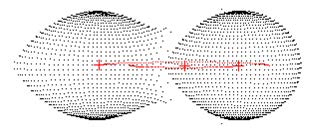
The aim of this research was to study the orbital periods and physical characteristics of binary star V 1851 Orionis, a type W Uma eclipsing binary star system. It is changing the physical characteristics of a contact binary star system to a semidetacted binary star system. The researchers therefore carried out a step-by-step research to analyze the new physical data using photometry techniques. by collecting data with reflecting telescope 0.7 m in diameter, connected to the CCD photometer system through the filters light in the blue (B), visible (V) and red (R) wavelengths according to the UVB standard system at the Nakhon Ratchasima Regional observatory for the public, collecting data between 18 - 21 November 2020 and during 22 - 23 December 2020. The result showed that the new linear ephemeris equation was HJD = 2452617.7356 + 0.27695E. The orbital period of the binary star system V 1851 Orionis increases at the rate of 5.02294198 × 10⁻¹⁷ seconds per year, when analyzing its physical characteristics using the PHOEBE program. It was found that the mass ratio was 0.64694, the angle of inclination of the orbital plane was 87.78448 degrees, the temperature of the primary star and the secondary star were 5,711 Kelvin and 6,000 Kelvin, respectively. The primary stars and secondary stars have the same mass 18.761285 and 12.137425 times the sun, respectively. From the analysis of the data, it can be concluded that the binary star V 1851 Orionis is an eclipsing binary system of type W Uma, both of which are dwarf stars. It has spectral types exist in the G0 constellation and has an increased orbital period. It shows that the two stars of this binary system are moving apart. This is not in line with angualar momentum loss theory (AML) stellar evolution hypothesis.
References
Blattler, E. and Diethelm, R. (2007). Observations of Variables. Commissions of 27 and 42 of The IAU information bullentin on variablestars, IBVS No. 5799. pp 1 – 4.
Bob Nelson. (2020). Bob Nelson's Database of Eclipsing Binary O-C Files. Retrieved June, 2, 2020. From https://www.aavso.org/bob-nelsons-o-c- files.
Essam, A., Nakhlawy, A. & Rassem, M.A. (2013). The first photometric analyses and classification of the W-UMa eclipsing binary systems GSC 1283-53 and GSC 702-1892. NRIAG Journal of Astronomy and Geophysics.
Kopal Zdenek. (1959). Close binary systems Vol.5. U.S.A : Springer.
Pancharoen, W. and Maithong, W. (2021). The First study of a Period change of the V1851 Orion Eclipsing Binary System. ASEAN J. Sci. Tech report. 2021, 24(3) 9-14.
Prsa, A. (2011). PHOEBE Scientific Reference version 0.30. Pennsylvania: Villanova University.
Prša, A. and Harmanec, P., (2010). PHOEBE manual. Pennsylvania: Villanova University.
Thanawat Rangsungnoen. (2012). Physical Structure of W Uma Binary System LO Andromeda. KKU Sci. J. 41(1), 203-212. (in Thai).
University de Strasbourg. (2020). Basic data of V* V1851 Ori – Eclipsing Binary. Retrieved June, 12, 2020. From
Downloads
Published
How to Cite
Issue
Section
License
Copyright (c) 2023 SCIENCE AND TECHNOLOGY RESEARCH JOURNAL NAKHON RATCHASIMA RAJABHAT UNIVERSITY

This work is licensed under a Creative Commons Attribution-NonCommercial-NoDerivatives 4.0 International License.
เนื้อหาและข้อมูลในบทความที่ลงตีพิมพ์ในวารสารวิจัย วิทยาศาสตร์และเทคโนโลยี มหาวิทยาลัยราชภัฏนครราชสีมา ถือเป็นข้อคิดเห็นและความรับผิดชอบของผู้เขียนบทความโดยตรงซึ่งกองบรรณาธิการวารสาร ไม่จำเป็นต้องเห็นด้วย หรือร่วมรับผิดชอบใด ๆ
บทความ ข้อมูล เนื้อหา รูปภาพ ฯลฯ ที่ได้รับการตีพิมพ์ในวารสารวิจัย วิทยาศาสตร์และเทคโนโลยี มหาวิทยาลัยราชภัฏนครราชสีมา ถือเป็นลิขสิทธิ์ของวารสารวิจัย วิทยาศาสตร์และเทคโนโลยี มหาวิทยาลัยราชภัฏนครราชสีมา หากบุคคลหรือหน่วยงานใดต้องการนำทั้งหมดหรือส่วนหนึ่งส่วนใดไปเผยแพร่ต่อหรือเพื่อกระทำการใด ๆ จะต้องได้รับอนุญาตเป็นลายลักอักษรจากวารสารวิจัย วิทยาศาสตร์และเทคโนโลยี มหาวิทยาลัยราชภัฏนครราชสีมา ก่อนเท่านั้น