
Risk Assessment and Geospatial Mapping of Ammonia Transportation Hazards: A Case Study of Thungsong, Thailand
Article Sidebar
Main Article Content
Abstract
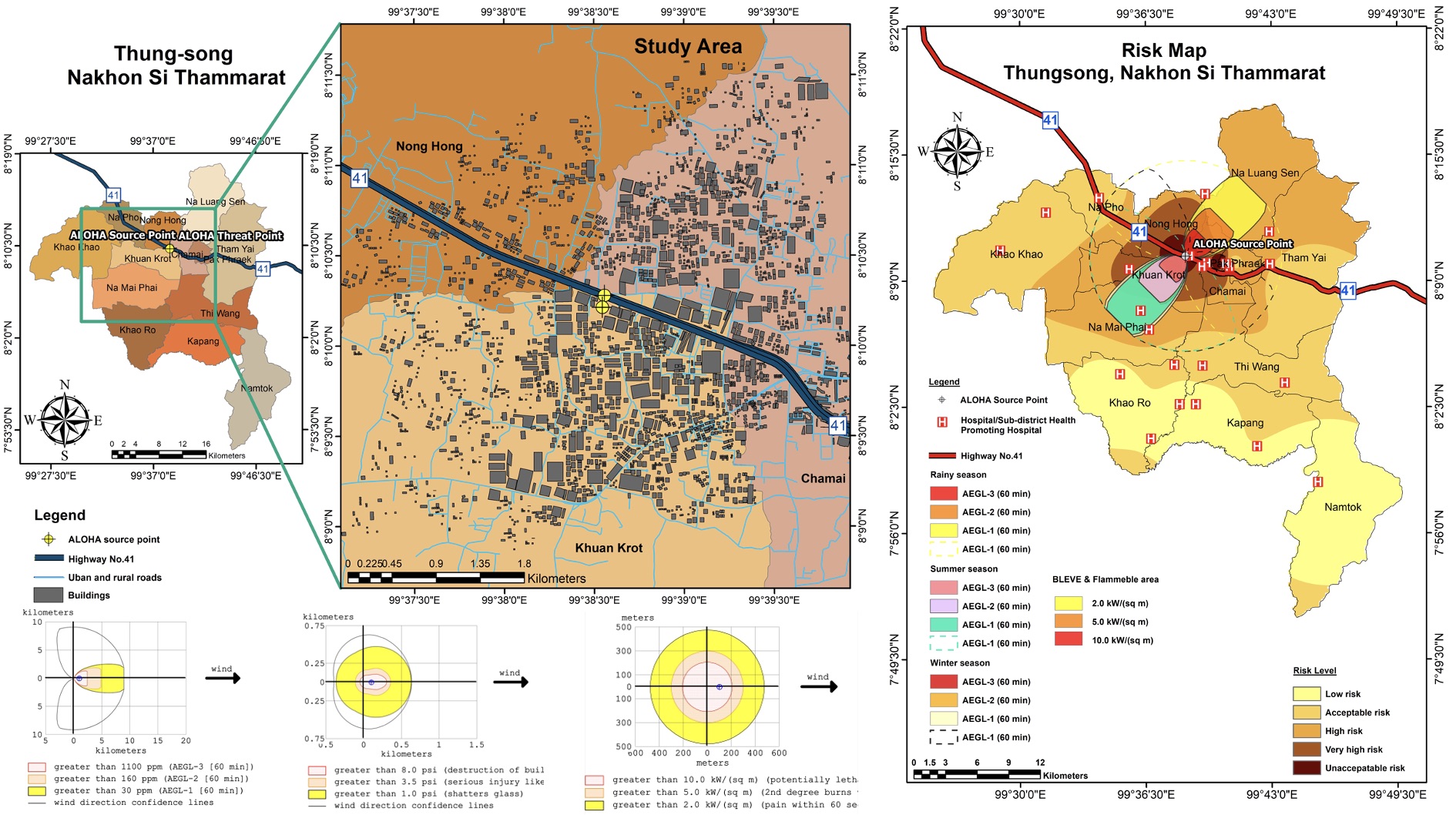
The transportation of ammonia—a widely used industrial chemical—presents significant risks, including leaks, fires, and explosions. This study aimed to assess the risks of transporting ammonia in the southern part of Thailand and to create a detailed risk evaluation using geospatial methods. We used the Areal Locations of Hazardous Atmospheres (ALOHA) to comprehensively simulate five ammonia accident scenarios: toxic vapor cloud, flammable areas (flash fire and jet fire), boiling liquid expanding vapor explosion (BLEVE), and vapor cloud explosion while risk, severity, and evacuation routes were mapped using ArcGIS software. The simulation results reveal that variations in wind direction influence ammonia spread across different seasons. In summer and winter, the wind direction is northeast, and in the rainy season, it shifts to southwest. In scenario 1, the red zone extends 2,400 meters from the source, with ammonia levels reaching up to 505,000 ppm, while in scenario 2, the red zone spans 368 meters. Explosive hazards (BLEVE and VCE) have ranges of 207 and 310 meters, respectively. While our study provides detailed mapping of ammonia hazard zones, future studies are needed to incorporate socio-economic factors into geospatial analyses to improve evacuation strategies and risk mitigation. Consequently, the maps produced can be utilized as essential decision-making tools in emergency response planning and management, which may reduce the death toll during a disaster in the future.
Article Details

This work is licensed under a Creative Commons Attribution-NonCommercial-NoDerivatives 4.0 International License.
References
Jabbari, M.; Atabi, F.; Ghorbani, R., Key airborne concentrations of chemicals for emergency response planning in HAZMAT road transportation- margin of safety or survival. Journal of Loss Prevention in The Process Industries 2020, 65, 104139.
Bondžić, J.; Sremački, M.; Popov, S.; Mihajlović, I.; Vujić, B.; Petrović, M., Exposure to hazmat road accidents - Toxic release simulation and GIS-based assessment method. J Environ Manage 2021, 293, 112941.
Fan, T.; Chiang, W.-C.; Russell, R., Modeling urban hazmat transportation with road closure consideration. Transportation Research Part D: Transport and Environment 2015, 35, 104-115.
Brzozowska, L., Computer simulation of impacts of a chlorine tanker truck accident. Transportation research part D: transport and environment 2016, 43, 107-122.
Inanloo, B.; Tansel, B., Explosion impacts during transport of hazardous cargo: GIS-based characterization of overpressure impacts and delineation of flammable zones for ammonia. Journal of Environmental Management 2015, 156, 1-9.
Ghaleh, S.; Omidvari, M.; Nassiri, P.; Momeni, M.; Lavasani, S., Pattern of safety risk assessment in road fleet transportation of hazardous materials (oil materials). Safety Science 2019, 116, 1-12.
Vianello, C.; Maschio, G., Quantitative risk assessment of the Italian gas distribution network. Journal of Loss Prevention in the Process Industries 2014, 32, 5-17.
Bubbico, R.; Maschio, G.; Mazzarotta, B.; Milazzo, M. F.; Parisi, E., Risk management of road and rail transport of hazardous materials in Sicily. Journal of Loss Prevention in the Process Industries 2006, 19(1), 32-38.
Fabiano, B.; Currò, F.; Palazzi, E.; Pastorino, R., A framework for risk assessment and decision-making strategies in dangerous good transportation. Journal of Hazardous Materials 2002, 93(1), 1-15.
Egidi, D.; Foraboschi, F. P.; Spadoni, G.; Amendola, A., The ARIPAR project: analysis of the major accident risks connected with industrial and transportation activities in the Ravenna area. Reliability Engineering & System Safety 1995, 49(1), 75-89.
Bouet, R.; Duplantier, S.; Salvi, O., Ammonia large scale atmospheric dispersion experiments in industrial configurations. Journal of Loss Prevention in the Process Industries 2005, 18(4), 512-519.
Junior, M. M.; e Santos, M. S.; Vidal, M. C. R.; de Carvalho, P. V. R., Overcoming the blame game to learn from major accidents: A systemic analysis of an Anhydrous Ammonia leakage accident. Journal of loss prevention in the process industries 2012, 25(1), 33-39.
Tan, W.; Du, H.; Liu, L.; Su, T.; Liu, X., Experimental and numerical study of ammonia leakage and dispersion in a food factory. Journal of Loss Prevention in the Process Industries 2017, 47, 129-139.
Yarandi, M. S.; Mahdinia, M.; Barazandeh, J.; Soltanzadeh, A., Evaluation of the toxic effects of ammonia dispersion: consequence analysis of ammonia leakage in an industrial slaughterhouse. Medical gas research 2021, 11(1), 24.
Gangopadhyay, R.; Das, S., Ammonia leakage from refrigeration plant and the management practice. Process Safety Progress 2008, 27(1), 15-20.
Sanchez, E. Y.; Represa, S.; Mellado, D.; Balbi, K. B.; Acquesta, A. D.; Colman Lerner, J. E.; Porta, A. A., Risk analysis of technological hazards: Simulation of scenarios and application of a local vulnerability index. Journal of Hazardous Materials 2018, 352, 101-110.
Roney, N.; Llados, F., Toxicological profile for ammonia. 2004.
Sekizawa, S.-i.; Tsubone, H., Nasal receptors responding to noxious chemical irritants. Respiration physiology 1994, 96(1), 37-48.
Bai, Z.; Dong, Y.; Wang, Z.; Zhu, T., Emission of ammonia from indoor concrete wall and assessment of human exposure. Environment international 2006, 32(3), 303-311.
Cheng, J.; Shen, J.; Jia, L.; Hu, K. In Simulation analysis of the influence of leakage location and flow rate on the leakage of liquid ammonia tank, International Conference on Computational Modeling, Simulation, and Data Analysis (CMSDA 2021), SPIE: 2022, 232-236.
Inanloo, B.; Tansel, B.; Jin, X.; Bernardo-Bricker, A., Cargo-specific accidental release impact zones for hazardous materials: risk and consequence comparison for ammonia and hydrogen fluoride. Environment Systems and Decisions 2016, 36(1), 20-33.
NIOSH, Ammonia: Exposure Routes and Symptoms. 2019.
Orozco, J. L.; Caneghem, J. V.; Hens, L.; González, L.; Lugo, R.; Díaz, S.; Pedroso, I., Assessment of an ammonia incident in the industrial area of Matanzas. Journal of Cleaner Production 2019, 222, 934-941.
Tan, W.; Lv, D.; Guo, X.; Du, H.; Liu, L.; Wang, Y., Accident consequence calculation of ammonia dispersion in factory area. Journal of Loss Prevention in the Process Industries 2020, 67, 104271.
Tepper, A.; Comstock, G. W.; Levine, M., A longitudinal study of pulmonary function in fire fighters. American journal of industrial medicine 1991, 20(3), 307-316.
George, A.; Bang, R. L.; Lari, A.-R.; Gang, R. K.; Kanjoor, J. R., Liquid ammonia injury. Burns 2000, 26(4), 409-413.
Montague, T. J.; Macneil, A. R., Mass ammonia inhalation. Chest 1980, 77(4), 496-498.
Rahman, N.; Ansary, M. A.; Islam, I., GIS based mapping of vulnerability to earthquake and fire hazard in Dhaka city, Bangladesh. International Journal of Disaster Risk Reduction 2015, 13, 291-300.
Bariha, N.; Mishra, I. M.; Srivastava, V. C., Fire and explosion hazard analysis during surface transport of liquefied petroleum gas (LPG): a case study of LPG truck tanker accident in Kannur, Kerala, India. Journal of loss prevention in the process industries 2016, 40, 449-460.
Chakrabarti, U. K.; Parikh, J. K., Route risk evaluation on class-2 hazmat transportation. Process Safety and Environmental Protection 2011, 89(4), 248-260.
Anjana, N.; Amarnath, A.; Nair, M. H., Toxic hazards of ammonia release and population vulnerability assessment using geographical information system. Journal of environmental management 2018, 210, 201-209.
Li, F.; Bi, J.; Huang, L.; Qu, C.; Yang, J.; Bu, Q., Mapping human vulnerability to chemical accidents in the vicinity of chemical industry parks. Journal of Hazardous Materials 2010, 179(1), 500-506.
NOAA, E., ALOHA: USER'S MANUAL 2007.
Han, Z. Y.; Weng, W. G., Comparison study on qualitative and quantitative risk assessment methods for urban natural gas pipeline network. Journal of Hazardous Materials 2011, 189(1), 509-518.
Patal, P.; Sohani, N., Hazard evaluation using ALOHA tool in storage area of an oil refinery. International Journal of Research in Engineering and Technology 2015, 4(12), 204-209.
Khan, F. I.; Abbasi, S. A., An assessment of the likelihood of occurrence, and the damage potential of domino effect (chain of accidents) in a typical cluster of industries. Journal of Loss Prevention in the Process Industries 2001, 14(4), 283-306.
AlRukaibi, F.; Alrukaibi, D.; Alkheder, S.; Alojaiman, S.; Sayed, T., Optimal route risk-based algorithm for hazardous material transport in Kuwait. Journal of Loss Prevention in the Process Industries 2018, 52, 40-53.
Anjana, N.; Amarnath, A.; Chithra, S.; Harindranathan Nair, M.; Jose, S. K., Population vulnerability assessment around a LPG storage and distribution facility near Cochin using ALOHA and GIS. International Journal of Engineering Science Invention 2015, 4(6), 23-31.
Meysami, H.; Ebadi, T.; Zohdirad, H.; Minepur, M., Worst-case identification of gas dispersion for gas detector mapping using dispersion modeling. Journal of Loss Prevention in the Process Industries 2013, 26(6), 1407-1414.
Hu, T.; Xiong, J.; Zhou, J.; Xia, Q., Nitrogen removal performance of bioretention cells under freeze-thaw cycles: Effects of filler structure and microbial community. Journal of Environmental Management 2024, 369, 122380.
Zhou, J.; Xiong, J.; Zhu, J.; Xie, X.; Ni, J.; Liu, Y.; Wang, X., Effects of freeze-thaw cycles on nutrient removal from bioretention cells. Journal of Environmental Management 2023, 325, 116556.
Khanmohamadi, M.; Bagheri, M.; Khademi, N.; Ghannadpour, S. F., A security vulnerability analysis model for dangerous goods transportation by rail – Case study: Chlorine transportation in Texas-Illinois. Safety Science 2018, 110, 230-241.
Rajeev, K.; Soman, S.; Renjith, V. R.; George, P., Human vulnerability mapping of chemical accidents in major industrial units in Kerala, India for better disaster mitigation. International journal of disaster risk reduction 2019, 39, 101247.
Besiktas, R.; Baltaci, H.; Akkoyunlu, B. O., Simulation of the Jet Fire Using Atmospheric Dispersion Modeling (ALOHA): A Case Study of Natural Gas Pipeline in Istanbul, Türkiye. Atmosphere 2024, 15(4), 456.
Jirsa, P., An Analysis of the Cumulative Uncertainty Associated with a Quantitative Consequence Assessment of a Major Accident. Process Safety and Environmental Protection 2007, 85 (3), 256-259.
Griffiths, R. F., The use of probit expressions in the assessment of acute population impact of toxic releases. Journal of Loss Prevention in the Process Industries 1991, 4(1), 49-57.
Zhou, Y.; Hu, G.; Li, J.; Diao, C., Risk assessment along the gas pipelines and its application in urban planning. Land Use Policy 2014, 38, 233-238.
Duijm, N. J.; Markert, F.; Paulsen, J. L., Safety assessment of ammonia as a transport fuel. Risø National Laboratory: 2005.
Gyenes, Z.; Wood, M. H.; Struckl, M., Handbook of scenarios for assessing major chemical accident risks. Publications Office of the European Union: 2017.
Zhang, D.; Mao, Z.; Gong, M.; Ren, J.; Zuo, S.; Chen, X., Study on optimization of shelter locations and evacuation routes of gas leakage accidents in chemical industrial park. Process Safety and Environmental Protection 2023, 177, 556-567.
Lee, H. E.; Sohn, J.-R.; Byeon, S.-H.; Yoon, S. J.; Moon, K. W., Alternative risk assessment for dangerous chemicals in South Korea regulation: Comparing three modeling programs. International journal of environmental research and public health 2018, 15(8), 1600.
Tahmid, M.; Dey, S.; Syeda, S. R., Mapping human vulnerability and risk due to chemical accidents. Journal of Loss Prevention in the Process Industries 2020, 68, 104289.
Sengupta, A.; Bandyopadhyay, D.; Roy, S.; van Westen, C. J.; van der Veen, A., Challenges for introducing risk assessment into land use planning decisions in an Indian context. Journal of Loss Prevention in the Process Industries 2016, 42, 14-26.
Chau, K.; Djire, A.; Vaddiraju, S.; Khan, F., Process Risk Index (PRI) – A methodology to analyze the design and operational hazards in the processing facility. Process Safety and Environmental Protection 2022, 165, 623-632.
Li, X.; Zhu, Y.; Abbassi, R.; Chen, G., A probabilistic framework for risk management and emergency decision-making of marine oil spill accidents. Process Safety and Environmental Protection 2022, 162, 932-943.
