Clove Position on the Induction of Single-Clove Garlic, Yield, and Bioactive Compounds
Article Sidebar
Main Article Content
Abstract
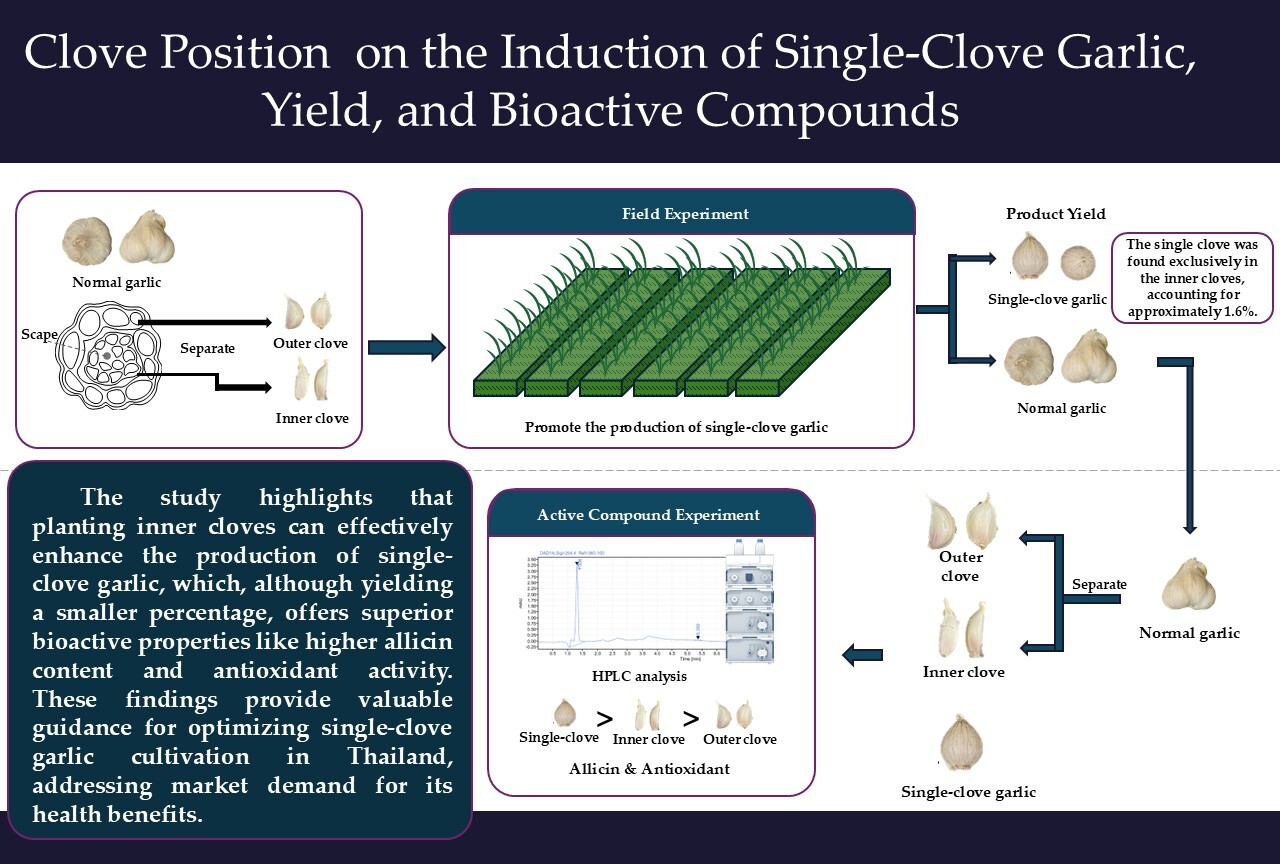
Garlic is a valuable crop renowned for its medicinal properties and nutritional value, widely consumed in raw and processed. In Thailand’s garlic production system, common garlic predominates, while single-clove garlic represents a smaller portion but commands higher prices due to its elevated levels of bioactive compounds and associated health benefits, leading to increased market demand. Research indicates that planting smaller cloves may enhance single-clove garlic production. Garlic cultivation in Thailand is primarily concentrated in the northern and northeastern regions, with only 1-2% of the production area dedicated to single-clove garlic. This study aimed to increase single-clove garlic yields by comparing different clove positions to optimize production and bioactive compound content, providing practical guidance for farmers. The experiment involved two treatments: inner cloves (0.5-0.8 g) and outer cloves (0.8-1.1 g). Yield components and bioactive compounds were analyzed. Results showed that outer cloves produced 100% common garlic bulbs, while inner cloves yielded 98.4% common bulbs and 1.6% single-clove garlic. Despite higher fresh yields of common bulbs from outer cloves, inner cloves produced 40.56 kg/ha of single-clove garlic. Weight loss after 30 days was 41–42% for common bulbs and 54.73% for single-clove garlic. Single-clove garlic showed more significant reductions in bulb and neck diameter. Notably, single-clove garlic contained the highest allicin content (35.79 mg/g FW) and DPPH inhibition (30.51%), indicating superior antioxidant properties. These findings suggest that planting inner cloves effectively promotes single-clove garlic production with enhanced bioactive properties, offering valuable insights for farmers.
Article Details

This work is licensed under a Creative Commons Attribution-NonCommercial-NoDerivatives 4.0 International License.
References
Diretto, G.; Rubio-Moraga, A.; Argandona, J.; Castillo, P.; Gomez-Gomez, L.; Ahrazem, O. Tissue-specific accumulation of sulfur compounds and saponins in different parts of garlic cloves from purple and white ecotypes. Molecules. 2017, 22, 1359.
Szychowski, K.A.; Rybczynska-Tkaczyk, K.; Gawel-Beben, K.; Swieca, M.; Karas, M.; Jakubczyk, A.; Matysiak, M.; Binduga, U.E.; Gminski, J. Characterization of active compounds of different garlic (Allium sativum L.) cultivars. Polish Journal of Food and Nutrition Sciences. 2018, 68, 73-81.
Jones, M.G.; Collin, H.A.; Tregova, A.; Trueman; Trueman, L.; Brown, L.; Cosstick, R.; Hughes, J.; Milne, J.; Wilkinson, M.C.; Tomsett A.B.; Thomas, B. The biochemical and physiological genesis of alliin in garlic. Medicinal and Aromatic Plant Science and Biotechnolology. 2007, 1, 21-24.
Yang, X.; Su, Y.; Wu, J.; Wan, W.; Chen, H.; Cao, X.; Wang, J.; Zhang, Z.; Wang, Y.; Ma, D.; Loake, G.J.; Jiang, J. Parallel analysis of global garlic gene expression and alliin content following leaf wounding. BMC Plant Biology. 2021, 21, 1-10.
Batiha, E.G.; Beshbishy, A.M.; Wasef, L.G.; Elewa, Y.H.A.; Al–Sagan, A.A.; Abd-Elhack, M.E.; Taha, A.E.; Abd–Elhakim, Y.M.; Devkota, H.P. Chemical constituents and pharmacological activities of garlic (Allium sativum L.): A Review. Nutrients. 2020, 12, 1-21.
Pakakaew, P.; Taesuwan, S.; Phimolsiripol, Y.; Utama-ang N. Comparison between the physicochemical properties, bioactive compounds and antioxidant activities of Thai and Chinese garlics. Current Applied Science and Technology. 2021, 22, 1-11.
Susanti, Y.; Adriani, M.; Adi, A.C. Effect of single clove garlic extract (Allium Sativum Linn) on blood sugar levels, malondialdehyde, insulin levels and insulin resistance (experiments in rats (Rattus novergicus) induced by streptozotocin. STRADA: Jurnal Ilmiah Kesehatan. 2020, 9, 954-963.
Horticultural Research Institute. Current garlic production situation. Available online: https://www.doa.go.th/hort/?p=19232 (accessed 26 April 2023). (In Thai)
Austin, J.; Rattanakosol, P.; Chokpachuen, J.; Siriyan, R.; Sakuanrungsirikul, S.; Ketsakul, S.; Rukkaphan, A. and Nimkingrat, T. Verification the identity of garlic from different growing area. Thai Agricultural Research Journal. 2016, 34, 253-269. (In Thai)
Innoi, A. Optimum rate of nitrogen fertilizer for garlic production in northern Thailand. Master thesis. Chiang Mai University, Chiang Mai, Thailand. 2018. (In Thai)
Thailand Agricultural Research Repository. Single-clove garlic, adding value through processing. Available online: https://blog.arda.or.th/1559/vegetables/กระเทียมโทน/ (accessed 16 August 2024). (In Thai)
Arifah, S.N.; Atho’illah, M.F.; Lukiati, B.; Lestari, S.R. Herbal medicine from single clove garlic oil extract ameliorates hepatic steatosis and oxidative status in high fat diet mice. The Malaysian Journal of Medical Sciences. 2020, 27, 46-56.
Gofur, A.; Wulandari, I.; Arifah, S.N.; Athoillah, M.F.; Witjoro, A.; Lestari, S.R. Single clove garlic (Allium sativum) essential oil as an inhibitor of Staphylococcus aureus bacteria. Biosaintifika: Journal of Biology and Biology Education. 2019, 11, 77-83.
Samritluan, K. Garlic; Nanmeebooks: Bangkok, Thailand, 52 p. (In Thai)
Kaewpiboon, C.; Boonnak, N. Evaluation of the antioxidant activities of black single bulb form of elephant garlic (Allium ampeloprasum var. ampeloprasum). Thai Science and Technology Journal. 2020, 29, 111-118. (In Thai)
Meredith, T.J. The complete book of garlic: a guide for gardeners, growers, and serious cook; Timber Press: Oregon, US., 2008, 330.
Atif, M.J.; Amin, B.; Ghani, M.I.; Ali, M.; Cheng, Z. Variation in morphological and quality parameters in garlic (Allium sativum L.) bulb influenced by different photoperiod, temperature, sowing and harvesting time. Plants. 2020, 155, 1-15.
Atif, M.J.; Amin, B.; Ghani, M.I.; Ali, M.; Liu, X.; Zhang, Y.; Cheng, Z. Allium sativum L. (Garlic) bulb enlargement as influenced by differential combinations of photoperiod and temperature. Food Chemistry. 2021, 338, 1-9.
Wu, C.; Wang, M.; Dong, Y.; Cheng, Z.; Meng, H. Growth, bolting and yield of garlic (Allium sativum L.) in response to clove chilling treatment. Scientia Horticulturae. 2015, 194, 43-52.
Desta, B.; Tena, N.; Amare, G. Growth and Bulb Yield of Garlic as Influenced by clove size. The Scientific World Journal. 2021, 2021, 1-7.
Anikoh, P. O.; Ozivave, Z. O.; Ogbaje, H.; Metiboba, C. T.; Egbunu, M. M. Effect of bulb size, Dept of bulb storage and bulb orientation on storage loss of onion (Allium cepa L.). FUDMA Journal of Agriculture and Agricultural Technology. 2023, 9, 41-49.
Zhu, Q.; Kakino, K.; Nogami, C.; Ohnuki, K.; Shimizu, K. An LC-MS/MS-SRM method for simultaneous quantification of four representative organosulfur compounds in garlic products. Food Analytical Methods. 2016, 9, 3378-3384.
Bocchini, P., C. Andalò, R. Pozzi, G.C. Galletti and A. Antonelli. Determination of diallyl thiosulfinate (allicin) in garlic (Allium sativum L.) by high-performance liquid chromatography with a post-column photochemical reactor. Analytica Chimica Acta. 2001, 441(1), 37-43.
Wongsa, P.; Spreer, W.; Sruamsiri, P.; Müller, J. Allicin and total phenolic content and antioxidant activity in conventional and organic garlic. Acta Horticulturae. 2016, 1125, 129-136.
Qin, F.F.; Xu, H.L.; Xu, Q.C.; Li, F.; Fujimiya, S. The single-clove garlic used as seed for high yield. In Proceedings of the 233rd Crop Science Society of Japan, Kanto, Japan, 27 March 2012; 286.
Rungcharoen, J.; Mitharn, S.; Suriyawong, N. Selection of garlic cultivars and technology of garlic cultivation in highland areas. Available online: https://research.hrdi.or.th/research/detail/359/. (accessed 26 April 2023). (In Thai)
Shiferaw, D.; Nigussie-Dechassa, R.; Woldetsadik, K.; Shama, J.; Getachew, T. Bulb quality of garlic (Allium sativum L.) as influenced by the application of inorganic fertilizers. African Journal of Agricultural Research. 2014, 9, 784-796.
Innoi, A.; Kunasakdakul, K.; Santasup, C. Optimum rate of nitrogen fertilizer for garlic production in Khun Yuam district, Mae Hong Son province. Journal of Agriculture. 2019, 35, 215-226. (In Thai)
Calimpang, I.; Bane-Eng, M.; Sagun, A. Classification of clove sizes as planting material to the bulb yield of garlic var. Ilocos white. Journal of Biodiversity and Environmental Sciences. 2023, 22, 62-69.
Malashri; Shashidhar, Tr. Impact of planting methods and clove size on growth, yield and economics of garlic (Allium sativum L.). International Journal of Chemical Studies. 2020, 6, 1853-1856.
Feng, J.; Hussain, H.A.; Hussain, S.; Shi, C.; Cholidah, L.; Men, S.; Ke, J.; Wang, L. Optimum water and fertilizer management for better growth and resource use efficiency of rapeseed in rainy and drought seasons. Sustainability. 2020, 12, 703. https://doi.org/10.3390/su12020703
Ammarellou, A. Bulb production of 38 Iranian garlic (Allium sativum L.) cultivars in greenhouse conditions. Journal of Medicinal plants and By-product. 2017, 6, 105-110.
Lopez-Bellido, F.J.; Lopez-Bellido, R.J.; Muñoz-Romero, V.; Fernandez-Garcia, P.; Lopez-Bellido, L. New phenological growth stages of garlic (Allium sativum). Annals of Applied Biology. 2016, 169, 423-439.
Mathew, D.; Forerb, Y.; Rabinowitchc, H.D.; Kamenetsky, R. Effect of long photoperiod on the reproductive and bulbing processes in garlic (Allium sativum L.) genotypes. Environmental and Experimental Botany. 2011, 71, 166-173.
Westerfield, R.; Adams, D.; Eaker, T. Homegarden series: garlic production for the gardener. Full review. Available online: https://secure.caes.uga.edu/extension/publications/files/pdf/C%20854_8.PDF. (accessed 14 Jun 2023).
Kunasakdakul, K.; Panyakorn, W.; Panya, K.; Chaichana, I.; Buranapanichpan, S.; Santasup, C.; Yaiprasarn, K., Chantaracha, A.; Rattanaplome, N.; Samana, M., Tajumpa, E.; Kongmee, W.; Prayoonsaengrasamee, S.; Panse, W.; Suwan-apa, W.; Angkaen; Inthraprasit, T.; Wongpanya, S. Promoting farmers' potential for producing garlic and shallots using organic farming systems. Available online: https://digital.library.tu.ac.th/tu_dc/frontend/Info/item/dc:172148. (accessed 26 April 2023). (In Thai)
Tresina, P.S.; Santhiya Selvam, M.; Doss, A.; Mohan. V.R. Chapter 3 - Antidiabetic bioactive natural products from medicinal plants studies. In Natural Products Chemistry; Editor Rahman, A.; Elsevier: California, US. 2022, 75, pp. 75-118.
Arzanlou, M.; Bohlooli, S. Introducing of green garlic plant as a new source of allicin. Food Chemistry. 2010, 120, 179-183.
Bloem, E.; Haneklaus, S.; Schnug, E. Influence of fertilizer practices on S-containing metabolites in garlic (Allium sativum L.) under field conditions. Journal of Agricultural and Food Chemistry. 2010, 58, 10690-10696.
Nasim S.A.; Dhir, B.; Samar, F.; Rashmi, K.; Mahmooduzzafar; Mujib, A. Sulphur treatment alters the therapeutic potency of alliin obtained from garlic leaf extract. Food and Chemical Toxicology. 2009, 47, 888-892.
Office of Agricultural Economics. Agricultural production index. Available online: https://translate.google.com/?sl=th&tl=en&text=ดัชนีผลผลิตสินค้าเกษตร&op=translate (accessed 26 October 2024). (In Thai)
Ministry of Commerce. Garlic price (2023-2024). Available online: https://regional.moc.go.th/th/file/get/file/20240227555fe7b149358dfbad39d3e2cc2a3d19091016.pdf (accessed 26 October 2024). (In Thai)
Thai News Agency MCOT Pcl. Pricing of Nam Pad single clove garlic. Available online: https://tna.mcot.net/agriculture-905044#google_vignette (accessed 26 October 2024). (In Thai)
