
Biochar from sewage sludge on soil and plant characteristics of Arugula (Eruca sativa)
Article Sidebar
Main Article Content
Abstract
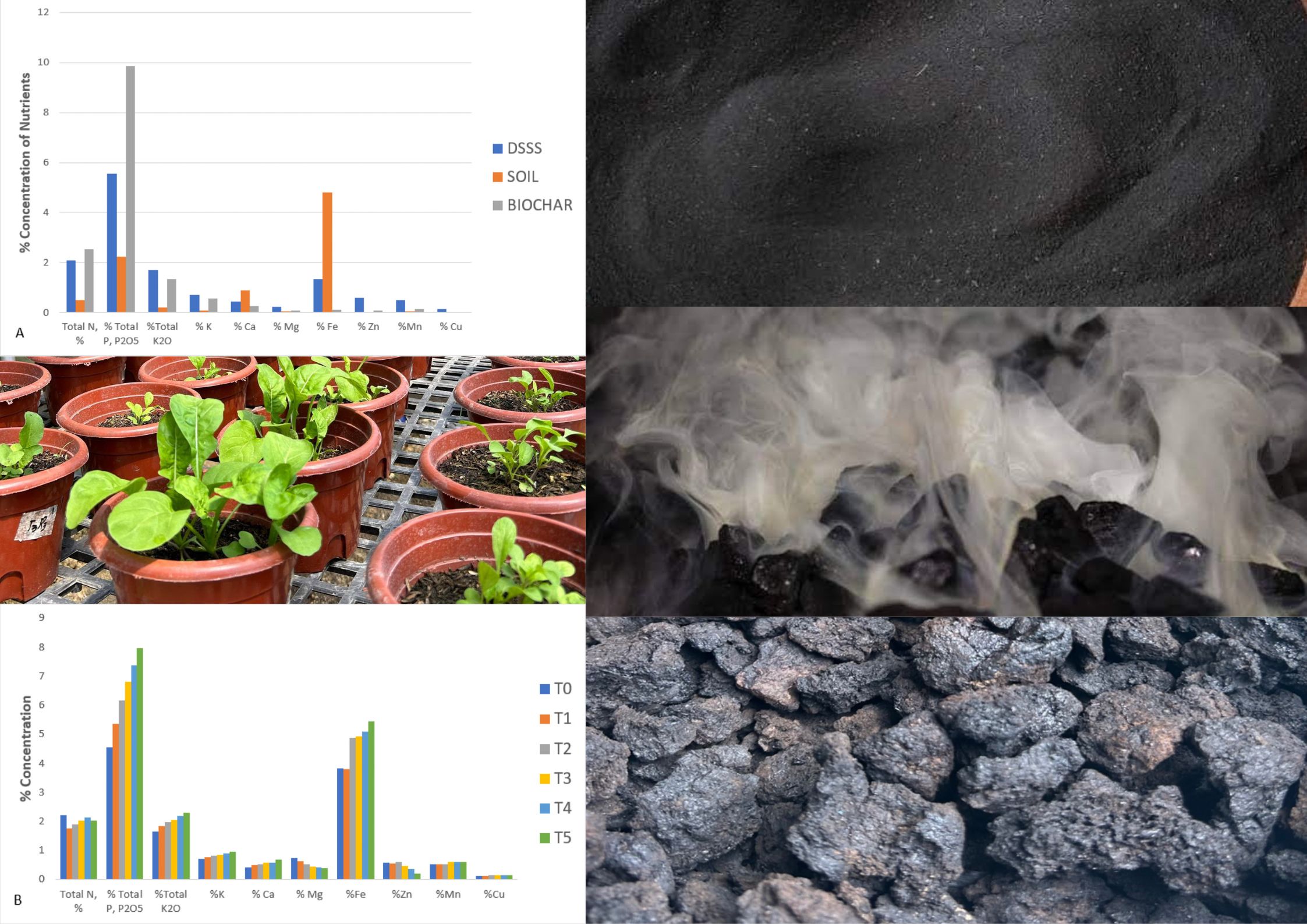
Swine sewage sludge is challenging to manage due to the large volumes produced and its high pathogen content. Recently, thermal treatments such as pyrolysis have gained interest as a means to convert dried swine sewage sludge into biochar, which is increasingly applied to soils to enhance plant growth. This study evaluated the effects of biochar produced from dried swine sewage sludge on the growth of Arugula (Eruca sativa) in a greenhouse. Biochar was created through fast pyrolysis at 500°C. This was applied to the test plants with a Completely Randomized Design (CRD) involving six treatments (T0: Dried Swine Sewage Sludge 100g; T1: biochar 20g; T2: biochar 40g; T3: biochar 60g; T4: biochar 80g; T5: biochar 100g) in four replications. Results indicated that biochar is high in nitrogen (2.52%) and phosphorus (9.85%), while Dried Swine Sewage Sludge is rich in potassium (0.7057%). Increasing biochar to certain levels improved nutrient availability in the soil, leading to significant gains in chlorophyll content (0.1144 µg/mL), total soluble solids (4.50 °Brix), leaf count (7.6 number of leaves per plant at 4th week), and plant height (37.75mm during the 2nd week). Biochar application above 40g had a negative impact on horticultural characteristics, specifically the plant height, plant mass (fresh weight) and number of leaves, suggesting that excessive biochar may inhibit development. Despite this, higher biochar levels still enriched soil nutrients (N, 2.52%; Cu, 0.1448%; Fe, 5.44895%; Mn, 0.61375%; Ca, 0.69275%; P2O5, 7.964%; K2O, 2.303%), highlighting the importance of balancing biochar rates for optimal plant performance.
Downloads
Article Details

This work is licensed under a Creative Commons Attribution-NonCommercial-NoDerivatives 4.0 International License.
References
Pillai, B. B. K.; Meghvansi, M. K.; Sudha, M. C.; Sreenivasulu, M. Recent Trends in Performance Assessment of Anaerobic Biodigestion for Sewage Waste Management: A Critical Review. Environmental and Microbial Biotechnology 2022, 113-136.
Cairone, S.; Hasan, S. W.; Choo, K. H.; Lekkas, D. F.; Fortunato, L.; Zorpas, A. A.; Korshin, G.; Zarra, T.; Belgiorno, V.; Naddeo, V. Revolutionizing wastewater treatment toward circular economy and carbon neutrality goals: Pioneering sustainable and efficient solutions for automation and advanced process control with smart and cutting-edge technologies. J. Water Process Eng. 2024, 63, 105486. https://doi.org/10.1016/j.jwpe.2024.105486.
Masse, D. I.; Saady, N. M. C. Current state and future challenges of manure management technologies for livestock operations. Agric. Biosyst. Eng. 2015.
Pathak, A.; Dastidar, M. G.; Sreekrishnan, T. R. Bioleaching of heavy metals from sewage sludge: A review. J. Environ. Manage. 2009, 90, 2343-2353.
Franca, A. S.; Oliveira, L. S.; Nunes, A. A.; Alves, C. C. O. Microwave-assisted thermal treatment of defective coffee beans press cake for the production of adsorbents. Bioresour. Technol. 2010, 101, 1068-1074.
Senthilkumar, M., Amaresan, N., Sankaranarayanan, A. Estimation of Phosphate Solubilizing Capacity of Microorganisms. In: Plant-Microbe Interactions. Springer Protocols Handbooks. Humana, New York, NY. 2021. https://doi.org/10.1007/978-1-0716-1080-0_10
Sadasivan, S.; Manickam, A. Biochemical Methods, New Age International Publishers, New Delhi, 1997, 256.
Instituto A. L. Conservasvegetais, frutas e produtos de frutas. In: Instituto Adolfo Lutz, Ed., Cap. XV Métodosfísico-químicosparaanálise de alimentos, 4th Edition, Anvisa, Brasília, 2005, 571-591.
Mu, H. Y.; Zhuang, Z.; Li, Y. M.; et al. Heavy metal contents in animal manure in China and the related soil accumulation risks. Huanjing Kexue. 2020, 41 (2), 986–996..
Laird, D.; Fleming, P.; Wang, B.; Horton, R.; Karlen, D. Biochar impact on nutrient leaching from a Midwestern agricultural soil. Geoderma. 2010, 158(3-4), 436-442. https://doi.org/10.1016/j.geoderma.2010.05.012.
Bird, M. I.; Ascough, P. L.; Young, I. M.; Wood, C. V.; Scott, A. C. X-ray microtomographic imaging of charcoal. J. Archaeol. Sci. 2008, 35(10), 2698-2706. https://doi.org/10.1016/j.jas.2008.04.017.
Cheng, C.-H.; Lehmann, J.; Engelhard, M. H. Natural oxidation of black carbon in soils: Changes in molecular form and surface charge along a climosequence. Geochim. Cosmochim. Acta. 2008, 72(6), 1598-1610. https://doi.org/10.1016/j.gca.2008.01.010.
Downie, A.; Crosky, A.; Munroe, P. Physical properties of biochar. In Biochar for Environmental Management; Lehman, J., Joseph, S., Eds.; Earthrscan: London, 2009, pp 13-29
Novak, J. M.; Lima, I.; Xing, B.; Gaskin, J. W.; Steiner, C.; Das, K. C.; Ahmedna, M.; Rehrah, D.; Watts, D. W.; Busscher, W. J.; Schomberg, H. Characterization of Designer Biochar Produced at Different Temperatures and Their Effects on a Loamy Sand. Ann. Environ. Sci. 2009, 3(1), 195-206.
Beck, D. A.; Johnson, G. R.; Spolek, G. A. Amending green roof soil with biochar to affect runoff water quantity and quality. Environ. Pollut. 2011, 159(8-9), 2111-2118. https://doi.org/10.1016/j.envpol.2011.03.015
Bai, X.; Zhang, S.; Shao, J.; Chen, A.; Jiang, J.; Chen, A.; Luo, S. Exploring the negative effects of biochars on the germination, growth, and antioxidant system of rice and corn. J. Environ. Chem. Eng. 2022, 10(3), 107398
Ali, L.; Xiukang, W.; Naveed, M.; Ashraf, S.; Nadeem, S.M.; Haider, F.U.; Mustafa, A. Impact of Biochar Application on Germination Behavior and Early Growth of Maize Seedlings: Insights from a Growth Room Experiment. Appl. Sci. 2021, 11(24), 11666. https://doi.org/10.3390/app112411666
Carril, P.; Ghorbani, M.; Loppi, S.; Celletti, S. Effect of Biochar Type, Concentration and Washing Conditions on the Germination Parameters of Three Model Crops. Plants. 2023, https://doi.org/10.3390/plants12122235
Yu, P.; Gu, M. (2024, January). Biochar Basics 2. Biochar’s Effects on Plant Growth. UGA Cooperative Extension Circular 1292. extension.uga.edu/publications/detail.html?number=C1292-02.
Jabborova, D.; Wirth, S.; Halwani, M.; Ibrahim, M.F.M.; El Azab, I.H.; El-Mogy, M.M.; Elkelish, A. Growth Response of Ginger (Zingiber officinale), Its Physiological Properties and Soil Enzyme Activities after Biochar Application under Greenhouse Conditions. Horticulturae. 2021.
Wang, J.; Shi, D.; Huang, C.; Zhai, B.; Feng, S. Effects of Common Biochar and Acid-Modified Biochar on Growth and Quality of Spinach in Coastal Saline Soils. Plants. 2023, 12, 3232. https://doi.org/10.3390/plants12183232
Schulz, H.; Dunst, G.; Glaser, B. No effect level of co-composted biochar on plant growth and soil properties in a greenhouse experiment. Agron. 2014, 4(1), 34-51. https://doi.org/10.3390/agronomy4010034
Baker, D. P., & Nunez, M. Early Growth Stages and Their Impact on the Performance of Plants. Plant Growth Regul. 2009, 59(2), 105-118
Shamim, M.; Saha, N.; Hye, F.B. Effect of biochar on seed germination, early growth of Oryza sativa L. and soil nutrients. Trop. Plant Res. 2018, 5(3), 336-342. https://doi.org/10.22271/tpr.2018.v5.i3.042
Uslu, O.S.; Babur, E.; Alma, M.H., Solaiman, Z.M. Walnut Shell Biochar Increases Seed Germination and Early Growth of Seedlings of Fodder Crops. Agric. 2020, 10(10), 427. https://doi.org/10.3390/agriculture10100427
Liu, M.; Lin, Z.; Ke, X.; Fan, X.; Joseph, S.; Taherymoosavi, S.; Liu, X.; Bian, R.; Solaiman, Z.M.; Li, L.; Pan, G. Rice Seedling Growth Promotion by Biochar Varies With Genotypes and Application Dosages. Front. Plant Sci. 2021, 12. https://doi.org/10.3389/fpls.2021.580462
Murtaza, G.; Rizwan, M.; Usman, M. et al. Biochar enhances the growth and physiological characteristics of Medicago sativa, Amaranthus caudatus and Zea mays in saline soils. BMC Plant Biol. 2024, 24, 304. https://doi.org/10.1186/s12870-024-04957-1
Hafeez, Y.; Iqbal, S.; Jabeen, K.; Shahzad, S. Effect of biochar application on seed germination and seedling growth of Glycine max (L.) Merr. under drought stress. Pak. J. Bot. 2017.
Yousaf, M. T. B.; Nawaz, M. F.; Zia ur Rehman, M.; Gul, S.; Yasin, G.; Rizwan, M.; Ali, S. Effect of three different types of biochars on eco-physiological response of important agroforestry tree species under salt stress. Int. J. Phytoremediation 2021, 23(13), 1412-1422. https://doi.org/10.1080/15226514.2021.1901849
Zhang, C.; Lin, Y.; Tian, X.; Xu, Q.; Chen, Z.; Lin, W. Tobacco bacterial wilt suppression with biochar soil addition associates to improved soil physiochemical properties and increased rhizosphere bacteria abundance. Appl. Soil Ecol. 2017, 112, 90-96.
Ikram, M.; Minhas, A.; Ghoneim, A.M.; Mahmoud, E.; Mehran, M.; Rauf, A.; Ali, W. Promoting Tomato Resilience: Effects of Ascorbic Acid and Sulphur-Treated Biochar in Saline and Non-Saline Cultivation Environments. Res. Sq. 2024. https://doi.org/10.21203/rs.3.rs-4922115/v1.
