
Archaeoastronomical Analysis of Sri Suphan Temple
Article Sidebar
Main Article Content
Abstract
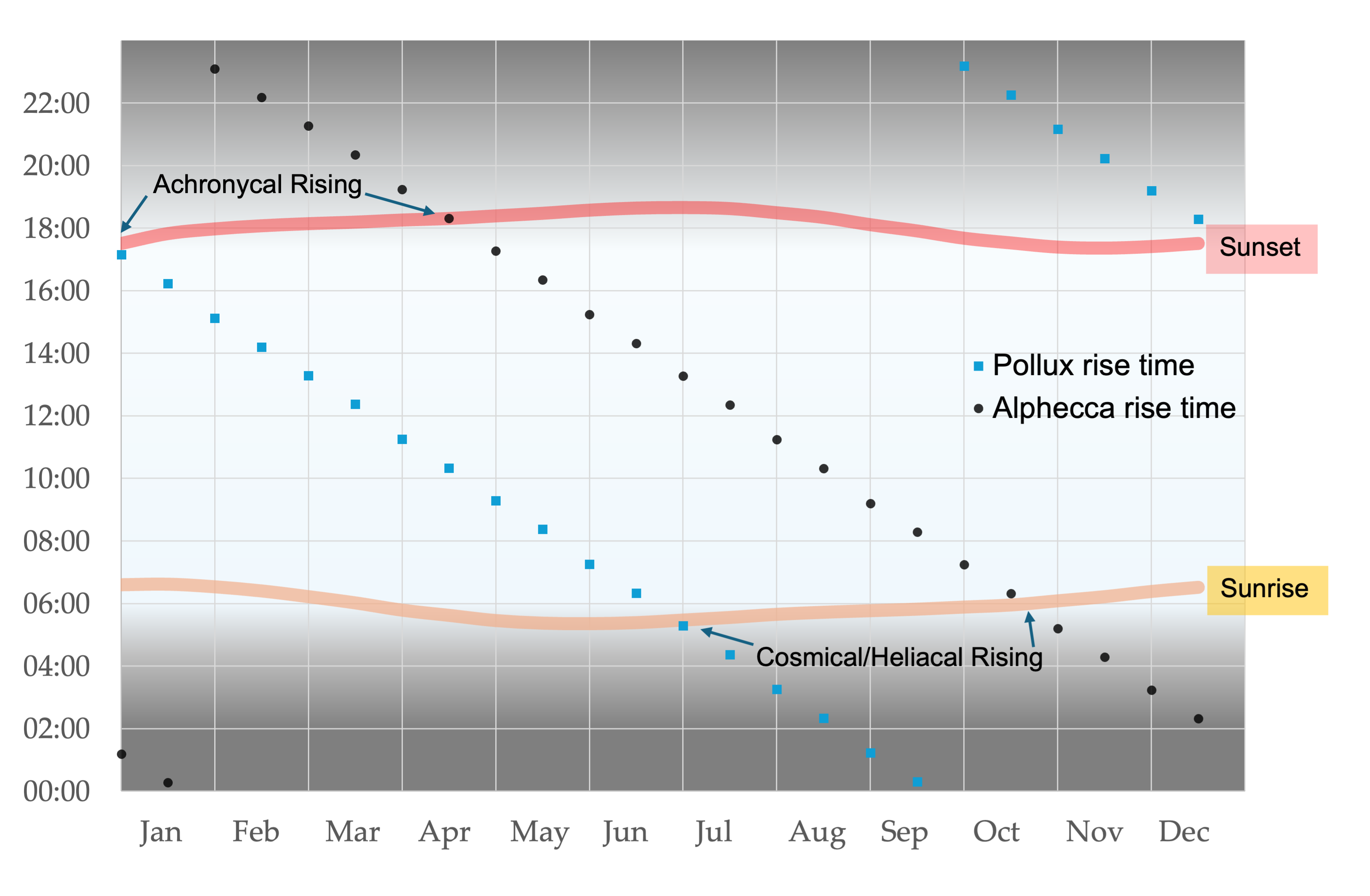
Archaeoastronomical studies in the ancient Lanna Kingdom, centered in Chiang Mai Province in northern Thailand, have revealed the influence of Vastu Shastra principles, an ancient Indian treatise of architecture, on the alignments of cities and temples with auspicious stars. This paper investigates the orientation of Sri Suphan Temple, a royal Buddhist temple built in King Mueng Kaew’s reign in 1503 during the Vaisakha lunar month, that has a similar orientation to the renowned Phra That Doi Suthep Temple, which was previously studied to be aligned with a star marking Vaisakha Nakshatra around 1537. We surveyed the site using a theodolite, a GPS device, and Stellarium astronomy software to yield the orientation of the temple with an azimuth angle of 58.94 ± 0.08°. Using precession-corrected Stellarium computation to trace stars’ azimuths back in time and reveal their annual path behavior, we find Alphecca, with an azimuth of 59.45 degrees, rising on the eastern horizon during Vaisakha month as indicated in the inscription, to be the most probable star of alignment. Alphecca is a bright star in the Corona Borealis Constellation reported to be the same star used in the Doi Suthep Temple, which suggests that the Sri Suphan Temple may have been a prototype for aligning later Buddhist temples.
Article Details

This work is licensed under a Creative Commons Attribution-NonCommercial-NoDerivatives 4.0 International License.
References
Magli, G. Archaeoastronomy and the chronology of the Temple of Jupiter at Baalbek. Archaeoastronomy Introduction to the Science of Stars and Stones 2016. https://doi.org/10.10007/978-3-319-22882-2.
Baratta, N.C.; Magli, G. The Role of Astronomy and Feng Shui in the Planning of Ming Beijing. Nexus Network Journal 2021, 23, 767-787. https://doi.org/10.1007/978-981-19-6274-5_10.
Goto, A. Archaeoastronomy and ethnoastronomy in the Ryukyu Islands: a preliminary report. Proceedings of the International Astronomical Union, 2011, 7(S278), 315-324.
Ruggles, C.L.N, ed. Handbook of archaeoastronomy and ethnoastronomy. Springer New York: NY; 2015. https://doi.org/10.1007/978-1-4614-6141-8.
Zotti, G.; Hoffmann, S.M.; Wolf, A.; Chéreau, F.; Chéreau, G. The Simulated Sky: Stellarium for Cultural Astronomy Research. Journal of Skyscape Archaeology 2021, 6(2), 221-258. https://doi.org/10.1558/jsa.17822.
Riyaprao, O., et al. Bhumpanya Darasastr Lanna (Lanna astronomical wisdom), Chiang Mai: Publishing Unit, Faculty of Science, Chiang Mai University; 2021.
Saelee, C.; Riyaprao, O.; Komonjinda, S.; Sriboonrueang, K. An archaeoastronomical investigation of Vaastu Shastra Principles (Vedic Architecture) implemented in the city planning of ancient Chiang Mai. In: Orchiston, W.; Vahia, M.N., editors. Exploring the History of Southeast Asian Astronomy. Historical & Cultural Astronomy. Cham: Springer 2021, 461-485. https://doi.org/10.1007/978-3-030-62777-5_13
Kramrisch, S. The hindu temple: volume one. Delhi: Motilal Banarsidass Publ. 1976.
Lemsonth, C.; Lorwilai, S.; Sankaokam, P.; Riyaprao, O.; Saelee, C. The off-cardinal alignment of Chiang Mai’s City Plan in Relation to the Orion’s Belt. ASEAN Journal of Scientific and Technological Reports 2023, 26(4), 29-37. https://doi.org/10.55164/ajstr.v26i4.249720
Riyaprao, O.; Sriboonrueang, K.; Komonjinda, S; Saelee, C. Astronomical Orientation of Phra That Doi Suthep Temple in Relation to Acronychal Rising of Corona Borealis and Visakha Bucha Day. Journal of Astronomical History and Heritage, 2023, 26(3), 701-721. https://doi.org/10.3724/SP.J.1440-2807.2023.09.68
Lertpipatworakul, T.; Chaeyklin, N. Wat Sri Suphan Rong Roy Jaruek (Sri Suphan Temple’s historical traces). https://www.sac.or.th/portal/th/article/detail/379 (Accessed 10 May 2024)
Princess Maha Chakri Sirindhorn Anthropology Centre. Wat Sri Suphan Inscription https://db.sac.or.th/inscriptions/inscribe/detail/16441 (Accessed: 16 February 2024).
Saelee, C.; Riyaprao, O. Sobtieb Wan Duen Pee Nai Jaruk Lanna (Date Calibration of Lanna inscriptions). Chiang Mai: Publishing Unit, Faculty of Science, Chiang Mai University, 2023.
Komonjinda, S.; Riyaprao, O.; Sriboonrueang, K.; Saelee, C. Relative orientation of Prasat Hin Phanom Rung Temple to Spica on New Year’s Day: the chief indicator for the intercalary year of the luni-solar calendar. Proceedings of the International Astronomical Union, 2019, 15(S367), 260-264. https://doi.org/10.1017/S1743921321001034
