
Total Flavonoid Content, Antioxidant Properties, and COX Inhibition of a Dual-Extract Herbal Blend: Formulation of a Gel for Anti-Inflammatory and Wound-Healing Applications
Article Sidebar
Main Article Content
Abstract
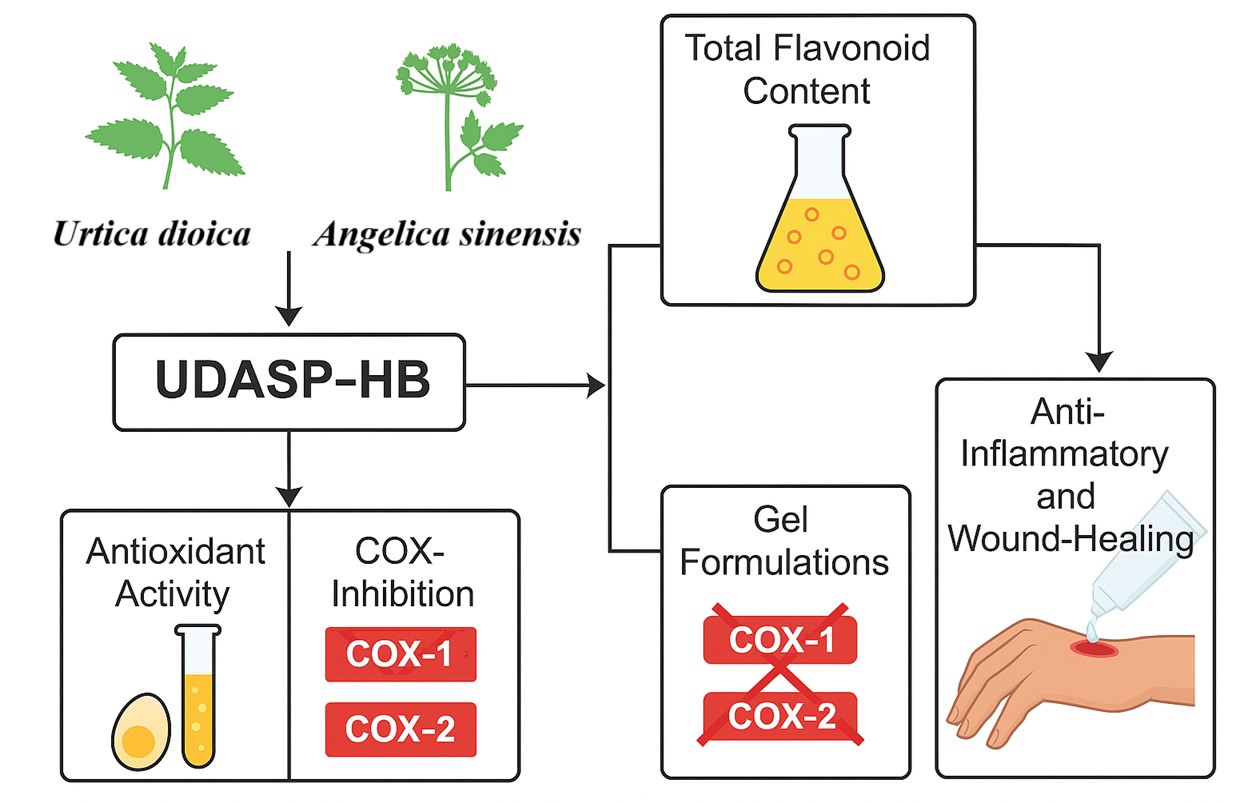
The current work examined UDASP-HB, a novel herbal formulation comprising Urtica dioica methanol leaf extract and Angelica sinensis polysaccharide, for its pharmacological activity. It examined the total flavonoid content and its antioxidant and anti-inflammatory activity. UDASP-HB exhibited high concentrations of flavonoids, with considerable inhibition of lipid peroxidation in egg yolk and liver homogenate model compared with controls. UDASP-HB inhibited COX-1 and COX-2 enzymes and, therefore, can exhibit anti-inflammatory activity. Additionally, six new topical gel formulations and preparations were developed and examined for their physicochemical properties and in vitro drug delivery studies. All six preparations facilitated sustained delivery and effective dermal delivery.
Downloads
Article Details

This work is licensed under a Creative Commons Attribution-NonCommercial-NoDerivatives 4.0 International License.
References
Hendrix, J.; Nijs, J.; Ickmans, K.; Godderis, L.; Ghosh, M.; Polli, A. The Interplay between Oxidative Stress, Exercise, and Pain in Health and Disease: Potential Role of Autonomic Regulation and Epigenetic Mechanisms. Antioxidants (Basel). 2020, 9(11), 1166. https://doi.org/10.3390/antiox9111166
. Kakoti, B. B.; Hernandez-Ontiveros, D. G.; Kataki, M. S.; Shah, K.; Pathak, Y.; Panguluri, S. K. J. F. i. c. m. Resveratrol and omega-3 fatty acid: its implications in cardiovascular diseases. 2015, 2, 38. https://doi.org/10.3389/fcvm.2015.00038
Sreejayan, N.; Rao, M. N. A. Nitric oxide scavenging by curcuminoids. J Pharm Pharmacol. 1997, 49, 105-107. https://doi.org/10.1111/j.2042-7158.1997.tb06761.x
Li, C.; Huang, Q.; Fu, X.; Yue, X. J.; Liu, R. H.; You, L. J. Characterization, antioxidant and immunomodulatory activities of polysaccharides from Prunella vulgaris Linn. International journal of biological macromolecules. 2015, 75, 298-305. https://doi.org/10.1016/j.ijbiomac.2015.01.010
Li, H.-L.; Liu, D.-P.; Liang, C.-C. Paraoxonase gene polymorphisms, oxidative stress, and diseases. Journal of Molecular Medicine. 2003, 81(12), 766-779. https://doi.org/10.1007/s00109-003-0481-4
Wu, Y.; Li, L.; Wen, T.; Li, Y.-Q. Protective effects of echinacoside on carbon tetrachloride-induced hepatotoxicity in rats. Toxicology. 2007, 232(1–2), 50-56. https://doi.org/10.1016/j.tox.2006.12.013
Soga, M.; Matsuzawa, A.; Ichijo, H. Oxidative Stress-Induced Diseases via the ASK1 Signaling Pathway. International Journal of Cell Biology. 2012, 2012, 439587. https://doi.org/10.1155/2012/439587
Re, R.; Pellegrini, N.; Proteggente, A.; Pannala, A.; Yang, M.; Rice-Evans, C. Antioxidant activity applying an improved ABTS radical cation decolorization assay. Free Radical Biology and Medicine. 1998, 72, 1231-1237. https://doi.org/10.1016/S0891-5849(98)00315-3
Packer, L., Handbook of Antioxidants. Taylor & Francis: 2001. https://doi.org/10.1201/9780203904046
Kataki, M. S.; Murugamani, V.; Rajkumari, A.; Mehra, P.; Awasthi, D.; Yadav, R. S. Antioxidant, Hepatoprotective, and Anthelmintic Activities of Methanol Extract of Urtica dioica L. Leaves. Pharmaceutical Crops. 2012, 3(1), 38-46. https://doi.org/10.2174/2210290601203010038
Ruch, R. J.; Cheng, S. J.; Klaunig, J. E. Prevention of cytotoxicity and inhibition of intracellular communication by antioxidant catechins isolated from Chinese green tea. Carcinogenesis. 1989, 10, 1003-1008. https://doi.org/10.1093/carcin/10.6.1003
Ahmad, S.; Ullah, F.; Zeb, A.; Ayaz, M.; Ullah, F.; Sadiq, A. Evaluation of Rumex hastatus D. Don for cytotoxic potential against HeLa and NIH/3T3 cell lines: chemical characterization of chloroform fraction and identification of bioactive compounds. BMC complementary and alternative medicine. 2016, 16(1), 308. https://doi.org/10.1038/s41598-019-41372-1
D'Abrosca, B.; Ciaramella, V.; Graziani, V.; Papaccio, F.; Della Corte, C. M.; Potenza, N.; Fiorentino, A.; Ciardiello, F.; Morgillo, F. Urtica dioica L. inhibits proliferation and enhances cisplatin cytotoxicity in NSCLC cells via Endoplasmic Reticulum-stress mediated apoptosis. Scientific reports. 2019, 9(1), 4986. https://doi.org/10.1201/9781315153711-18
Kataki, M. S.; Rajkumari, A.; Mazumder, B. J. N.; Relevance, N. C.; Prevention, D. Nutrition and Healthy Aging. 2017, 451.
Khare, C. P., Indian medicinal plants: an illustrated dictionary. Springer Science & Business Media: 2008. https://doi.org/10.1007/978-0-387-70638-2
Kataki, M. S.; Murugamani, V.; Rajkumari, A.; Mehra, P. S.; Awasthi, D.; Yadav, R. S. Antioxidant, hepatoprotective, and anthelmintic activities of methanol extract of Urtica dioica L. leaves. Pharmaceutical Crops. 2012, 3(1), 38-46. https://doi.org/10.2174/2210290601203010038
Huq, A.; Jamal, J. A.; Stanslas, J. J. E.-B. C.; Medicine, A. Ethnobotanical, phytochemical, pharmacological, and toxicological aspects of Persicaria hydropiper (L.) Delarbre. 2014, 2014. https://doi.org/10.1155/2014/782830
Mandal, V.; Mohan, Y.; Hemalatha, S. Microwave assisted extraction—an innovative and promising extraction tool for medicinal plant research. Pharmacognosy reviews. 2007, 1(1), 7-18.
Ghasemi, K.; Ghasemi, Y.; Ebrahimzadeh, M. A. Antioxidant activity, phenol and flavonoid contents of 13 citrus species peels and tissues. Pakistan journal of pharmaceutical sciences. 2009, 22(3), 277-81.
Badmus, J. A.; Adedosu, T. O.; Fatoki, J. O.; Adegbite, V. A.; Adaramoye, O. A.; Odunola, O. A. Lipid Peroxidation Inhibition and Antiradical Activities of Some Leaf Fractions of Mangifera Indica. Acta Poloniae Pharmaceutica - Drug Research. 2011, 68(1), 23-29.
Redl, K.; Breu, W.; Davis, B.; Bauer, R. Anti-inflammatory active polyacetylenes from Bidens campylotheca [J]. Planta Medica. 1994, 60(58-62). https://doi.org/10.1055/s-2006-959409
Aguilar, J. L.; Rojas, P.; Marcelo, A.; Plaza, A.; Bauer, R.; Reininger, E.; Klaas, C. A.; Merfort, I. Anti-inflammatory activity of two different extracts of Uncaria tomentosa (Rubiaceae) [J]. Journal of Ethnopharmacology. 2002, 81, 271-276. https://doi.org/10.1016/S0378-8741(02)00093-4
Aiyalu, R.; Govindarjan, A.; Ramasamy, A. Formulation and evaluation of topical herbal gel for the treatment of arthritis in animal model. Brazilian Journal of Pharmaceutical Sciences. 2016, 52. https://doi.org/10.1590/s1984-82502016000300015
Kohli, D. P. S.; Shah, D. H., Drug Formulations Manual. Eastern Publishers: 1998.
Nandgude, T.; Thube, R.; Jaiswal, N.; Deshmukh, P.; Chatap, V.; Hire, N. Formulation and evaluation of pH induced in-situ nasal gel of salbutamol sulphate. International Journal of Pharmaceutical Sciences and Nanotechnology (IJPSN). 2008, 1(2), 177-183. https://doi.org/10.37285/ijpsn.2008.1.2.9
Aiyalu, R.; Govindarjan, A.; Ramasamy, A. Formulation and evaluation of topical herbal gel for the treatment of arthritis in animal model. Brazilian Journal of Pharmaceutical Sciences. 2016, 52, 493-507. https://doi.org/10.1590/s1984-82502016000300015
Queiroz, M. B. R.; Marcelino, N. B.; Ribeiro, M. V.; Espindola, L. S.; Cunha, F. R.; Silva, M. V. d. Development of gel with Matricaria recutita L. extract for topic application and evaluation of physical-chemical stability and toxicity. Lat. Am. J. Pharm. 2009, 28(4), 574-579.
Nayak, S. H.; Nakhat, P. D.; Yeole, P. G. Development and evaluation of cosmeceutical hair styling gels of ketoconazole. Indian journal of pharmaceutical sciences. 2005, 67(2), 231.
Jain, B. D. Formulation Development And Evaluation Of Fluconazole Gel In Various Polymer Basesformulation Development And Evaluation Of Fluconazole Gel In Various Polymer BaseS. Asian Journal of Pharmaceutics (AJP). 2007, 1(1).
Martin, A. N.; Sinko, P. J.; Singh, Y., Martin's Physical Pharmacy and Pharmaceutical Sciences: Physical Chemical and Biopharmaceutical Principles in the Pharmaceutical Sciences. Lippincott Williams & Wilkins: 2011.
Loganathan, V.; Manimaran, S.; Jaswanth, A.; Sulaiman, A.; Reddy, M. V. S.; Kumar, B. S.; Rajaseskaran, A. The effects of polymers and permeation enhancers on releases of flurbiprofen from gel formulations. Indian Journal of Pharmaceutical Sciences. 2001, 63(3), 200.
Oktay, A. N.; Ilbasmis-Tamer, S.; Han, S.; Uludag, O.; Celebi, N. Preparation and in vitro/in vivo evaluation of flurbiprofen nanosuspension-based gel for dermal application. European Journal of Pharmaceutical Sciences. 2020, 155, 105548. https://doi.org/10.1016/j.ejps.2020.105548
Panigrahi, L.; Ghosal, S. K.; Pattnaik, S.; Maharana, L.; Barik, B. B. Effect of permeation enhancers on the release and permeation kinetics of lincomycin hydrochloride gel formulations through mouse skin. Indian journal of pharmaceutical sciences. 2006, 68(2). https://doi.org/10.4103/0250-474X.25716
Ghasemzadeh, A.; Ghasemzadeh, N. Flavonoids and phenolic acids: Role and biochemical activity in plants and human. J. Med. Plants Res. 2011, 5(31), 6697-6703. https://doi.org/10.5897/JMPR11.1404
Ratz‐Łyko, A.; Arct, J.; Majewski, S.; Pytkowska, K. Influence of polyphenols on the physiological processes in the skin. Phytotherapy Research. 2015, 29(4), 509-517. https://doi.org/10.1002/ptr.5289
Stelmakienė, A.; Ramanauskienė, K.; Briedis, V. Release of rosmarinic acid from semisolid formulations, and its penetration through the human skin ex vivo. Acta Pharmaceutica. 2015, 65(2), 199-205. https://doi.org/10.1515/acph-2015-0012
Seelinger, G.; Merfort, I.; Wölfle, U.; Schempp, C. M. Anti-carcinogenic effects of the flavonoid luteolin. Molecules. 2008, 13(10), 2628-2651. https://doi.org/10.3390/molecules13102628
Blanco-Fuente, H.; Anguiano-Igea, S.; Otero-Espinar, F. J.; Blanco-Méndez, J. In-vitro bioadhesion of carbopol hydrogels. International journal of pharmaceutics. 1996, 142(2), 169-174. https://doi.org/10.1016/0378-5173(96)04665-0
Walker, R. B.; Smith, E. W. The role of percutaneous penetration enhancers. Advanced Drug Delivery Reviews. 1996, 18(3), 295-301. https://doi.org/10.1016/0169-409X(95)00078-L
Murthy, S. N.; Shivakumar, H. N., Topical and transdermal drug delivery. In Handbook of non-invasive drug delivery systems, Elsevier: 2010; pp 1-36. https://doi.org/10.1016/B978-0-8155-2025-2.10001-0
