Development of Khlu (Pluchea indica (L.) Less.) leaves drying technology for Khlu leaves tea production in the Palian River Basin Community, Trang Province
Article Sidebar
Main Article Content
Abstract
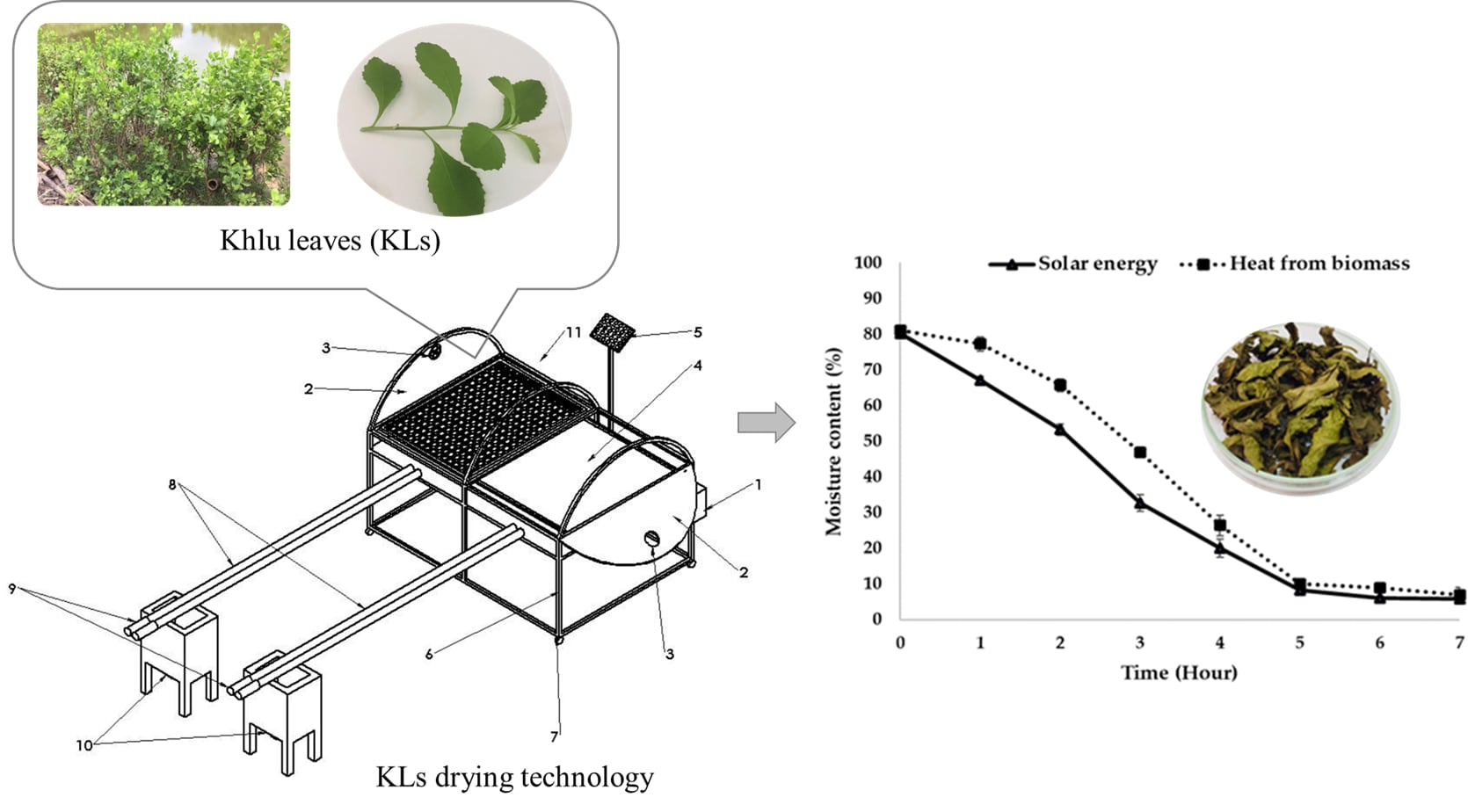
This research aims to investigate the optimal temperature conditions for drying Khlu (Pluchea indica (L.) Less.) leaves (KLs) in a laboratory, develop KLs drying technology, and transfer the technology to the Palian River Basin Community in Trang Province. The results showed that after drying KLs at different temperatures for 7 hours, the optimal choice was 45°C, which resulted in a moisture content of 10.95 ± 0.54%, a lightness (L) value of 48.87 ± 1.58, and the lowest effective concentration (EC50) of 0.200 ± 0.024 mg/mL. Drying at 55°C produced results similar to drying at 45°C, with a moisture content of 10.16 ± 1.27%, a lightness (L) value of 35.33 ± 1.75, and an EC50 of 0.370 ± 0.003 mg/mL. Drying at 65°C wasn't as effective. At the same time, the KLs had a low moisture content of 9.40 ± 1.24%, they turned out very dark (L value = 34.33 ± 0.38), and they also had the highest EC50 of 0.730 ± 0.007 mg/mL, indicating the weakest antioxidant ability. The KLs drying technology can utilize sunlight and heat from biomass to reduce the moisture content to just 5.80 ± 0.61% and 7.02 ± 1.97%, respectively, and has an EC50 of 0.240 ± 0.011 mg/mL and 0.290 ± 0.010 mg/mL, respectively. Finally, the researchers transferred the KLs drying technology to the community for drying KLs to produce Khlu leaves tea. This technology can dry about 10 kg of fresh KLs per period. Upon drying, the technology is expected to yield approximately 2 kg of dried KLs for the production of Khlu leaves tea.
Downloads
Article Details

This work is licensed under a Creative Commons Attribution-NonCommercial-NoDerivatives 4.0 International License.
References
Noitubtim, M.; Wattanayon, W.; Chooprajong, S.; Somwong, T.; Srichuay, W. Effect of temperature on antioxidant activity in mulberry leaf tea and mulberry leat tea powder production. Maejo Journal of Agricultural Production 2023, 5(2), 1-9. (In Thai)
Musika, J.: Musika, T. Development of Healthy shallot herbal tea (Allium ascalonicum L.) with antioxidant activities. Journal of Food Technology Siam University 2021, 16(2), 148-159. (In Thai)
Junsi, M.; Dangkhaw, N.; Klamklomjit, S. Development of antioxidant herbal tea product from Sang-Ko-Ra-Nee and Tree-Sha-Waas functional drink. Journal of Science Technology, Ubon Ratchatani University 2024, 26(1), 93-103. (In Thai)
Wongyai, W. Safflower tea. RMUTSB Academic Journal, 2013, 1(1), 10-15. (In Thai)
Novelina, N.; Wellyalina, W.; Faramida, S. Characteristics of Herbal Tea Bags From a Mixture of Pandan Leaf Powder (Pandanus amaryfolius Roxb.) and Red Ginger (Zingiber officinale var. Rubrum). Asian Journal of Applied Research for Community Development and Empowerment 2024, 8(2), 230-234. https://doi.org/10.29165/ajarcde.v8i2.431
Chunwijitra, K.; Phunthupan, P.; Phesatcha, B.; Thiwato, S.; Phesatcha, K. Effects of the production process on quality of Gymnema inodorum (Lour.) Decne. powder and enhancing their quality of herbal tea mixtures of the Phu Phan development study center community enterprise, Pla Pak District, Nakhon Phanom Province. YRU Journal of Science and Technology 2024, 9(2), 23-33. (In Thai)
Suriyaphan, O. Nutrition, Health Benefits and Applications of Pluchea indica (L.) Less Leaves. Pharmaceutical Sciences Asia 2014, 41(4), 1-10.
Chiangnoon, R.; Samee, W.; Uttayarat, P.; Jittachai, W.; Ruksiriwanich, W.; Rose Sommano, S.; Athikomkulchai, S.; Chittasupho, C. Phytochemical analysis, antioxidant, and wound healing activity of Pluchea indica L. (Less) branch extract nanoparticles. Molecule 2022, 27(3), 635. https://doi.org/10.3390/molecules27030635
Ruan, J.; Li, Z.; Yan, J.; Huang, P.; Yu, H.; Han, L.; Zhang, Y.; Wang, T. Bioactive constituents from the aerial parts of Pluchea indica Less. Molecules, 2018, 23(9), 2104. https://doi.org/10.3390/molecules23092104
Ibrahim, S.R.M.; Bagalagel, A.A.; Diri, R.M.; Noor, A.O.; Bakhsh, H.T.; Mohamed, G.A. Phytoconstituents and pharmacological activities of indian camphorweed (Pluchea indica): a multi-potential medicinal plant of nutritional and ethnomedicinal importance. Molecules 2022, 27(8), 2383. https://doi.org/10.3390/molecules27082383
Nopparat, J.;INualla-ong, A.; Phongdara, A. Ethanolic extracts of Pluchea indica (L.) leaf pretreatment attenuates cytokine-induced β-cell apoptosis in mulyiple low-dose streptozotocin-induced diabetic mice. PLoS ONE 2019, 14(2), e0212133. https://doi.org/10.1371/journal.pone.0212133
AOAC. Official method of analysis. 18th Edition. 2005, Assosiation of Officating Analytical Chemists, Washington D.C.
Polyium, U.; Sakulyunyongsuk, N. Biologolgical activities and optimal conditions for making Klu tea. Applied Mechanics and Materials 2020, 901, 11-15. https://doi.org/10.4028/www.scientific.net/AMM.901.11
Podkumnerd, N.; Wunsri, S.; Khairin, S. Production process development of Nipa bowl from Nipa palm (Nypa fruticans Wurmb.) waste by using solar dryer cabinet for sustainability of Palian river basin community. Malaysian Journal of Fundamental and Applied Sciences 2019, 15(4), 593-596. https://doi.org/10.11113/mjfas.v15n4.1334
Sawaengkhot, W.; Prommakool, A.; Savedboworn, W.; Pattayakorn, K. Determination of phenolic compound and antioxidant activity in leaves of 2 mulberry (Morus alba L.) cultivar. Khon Kaen Agriculture Journal 2018, 46(Suppl.1), 359-362. (In Thai)
Dincer, I.; Sahin, A.Z. A new model for thermodynamic analysis of drying process. International Journal of Heat and Mass Transfer 2004, 47, 645-652. https://doi.org/10.1016/j.ijheatmasstransfer.2003.08.013
Punchuklang, K.; Bunkrongcheap, R.; Petlamul, W.; Punchuklang, A. Antioxidant activity, total phenolic and tannin contents in Crotalatia juncea Tea. Thai Science and Technology Journal 2021, 29(4), 653-665. (In Thai)
Pokony, J. Addition of antioxidant for food stabilization to control oxidative rancidity. Czech Journal of Food Science 1986, 4, 299-307.
Yanishlieva, N.V. Inhibiting oxidation. J. Pokorny´; N. V. Yanishlieva; M. H. Gordon (Eds)., Antioxidants in Food – Practical Applications (pp. 22–70), Woodhead Publishing, Cambridge (UK). 2001.
Suriyatem, R.; Auras, R.A.; Intipunya, P.; Rachtanapun, P. Predictive mathematical modeling for EC50 calculation of antioxidant activity and antibacterial ability of Thai bee products. Journal of Applied Pharmaceutical Science 2017, 7(9), 122-133. https://doi.org/10.7324/JAPS.2017.70917
Widyawati, P.S. Determination of antioxidant capacity in Pluchea indica Less leaves extract and its fractions. International Journal of Pharmacy and Pharmaceutical Sciences 2016, 8(9), 32-36. http://dx.doi.org/10.22159/ijpps.2016v8i9.11410
Thai Industrail Standards Institute (TISI). Thai community product standard 1466/2556; Dried gymnema for infusion. 2013, Ministry of Industry.
