
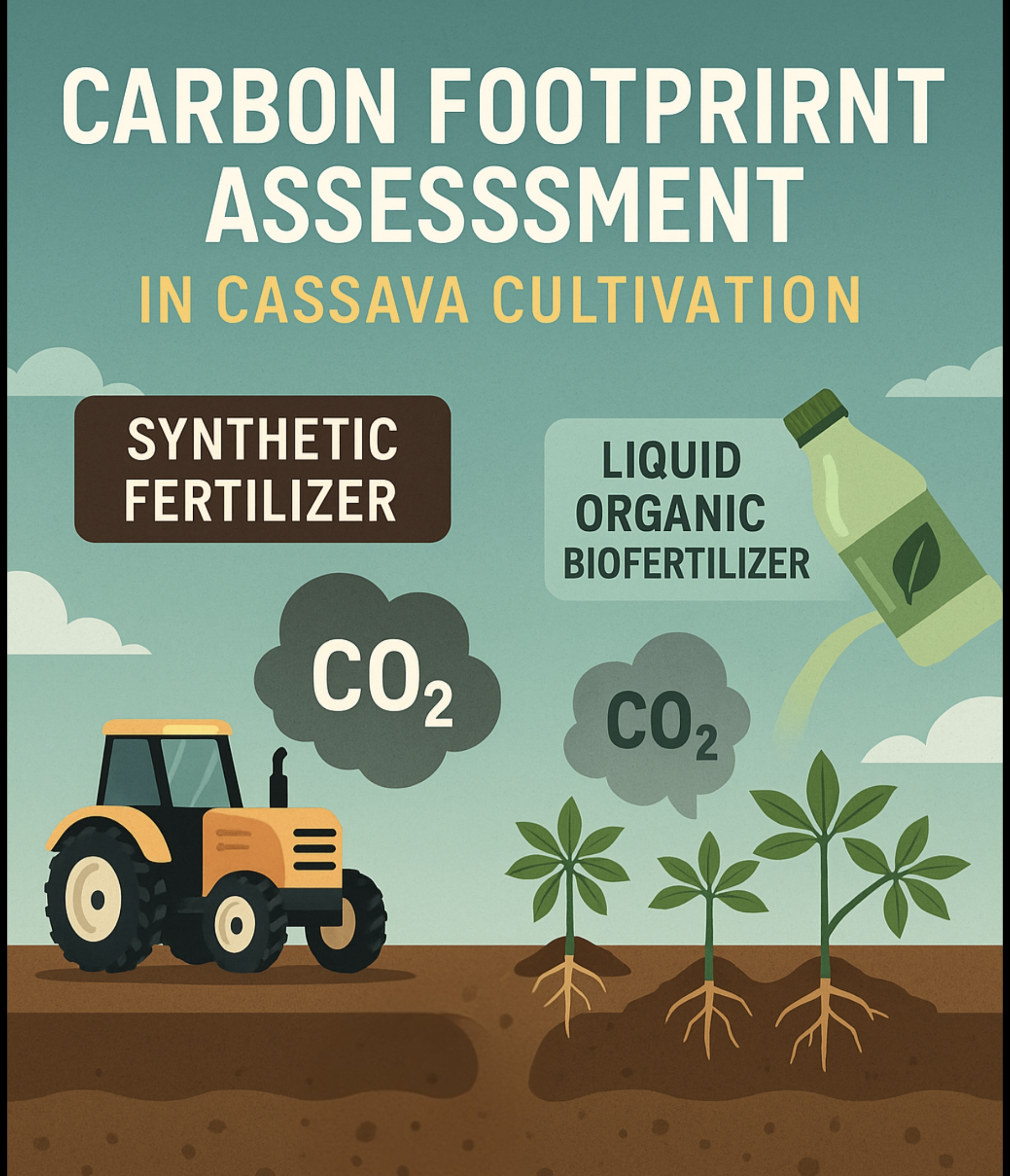
Carbon footprint assessment using synthetic fertilizer and liquid organic biofertilizer in cassava cultivation to promote good cultivation practices and prevent greenhouse gas emissions from agricultural cultivation in Thailand.
Article Sidebar
Main Article Content
Abstract
Typically, agricultural crop production contributes to greenhouse gas (GHG) emissions, especially the use of synthetic fertilizers and, less frequently, the application of organic fertilizers. Synthetic fertilizers not only have positive effects but also have many deleterious effects on the natural ecosystem. The primary purpose of this study was to evaluate cassava root yields harvested using two different cultivation methods: synthetic fertilizers and liquid organic biofertilizers. We investigated the amount of raw material fertilizers required for each cultivation method to evaluate the effects of global warming potential (GWP) on cassava cultivation methods in northeastern Thailand. The system boundary was defined from cradle to farm gate, starting with cultivation and progressing until harvest, using life cycle assessment (LCA). The input and output data were analyzed to determine the potential impacts of global warming over 100 years. The experiments found that 1000 kg of cassava root product harvested with synthetic fertilizer released the most GHGs, 51.83 kg CO2eq/1000 kg. This was 10 times that of the experimental plot using a liquid organic biofertilizer at 2.74 kg CO2eq/1000 kg. Therefore, as farmers are challenged with everything from drought to low yields and as agriculture becomes less predictable in the face of a changing climate, it is essential to help farmers transition to practices that increase resilience and dramatically decrease reliance on fossil-fuel-based chemicals. To develop guidelines for reducing GHG emissions in cultivation, the focus should be on farmers’ cultivation activities, especially fertilizer application.
Downloads
Article Details

This work is licensed under a Creative Commons Attribution-NonCommercial-NoDerivatives 4.0 International License.
References
Penuelas, J.; Coello, F.; Sardans, J. A better use of fertilizers is needed for global food security and environmental sustainability. Agriculture & Food Security 2023. 12(1), 5. https://doi.org/10.1186/s40066-023-00409-5
Walling, E.; Vaneeckhaute, C. Greenhouse gas emissions from inorganic and organic fertilizer production and use: A review of emission factors and their variability. Journal of Environmental Management, 2020. 276, 111211. https://doi.org/10.1016/j.jenvman.2020.111211.
Blonk, H.; van Paassen, M.; Draijer, N.; Tyszler, M.; Braconi, N.; van Rijn, J. Agri-Footprint 6 Methodology Report. Blonk Sustainability. 2022. https://www.blonksustainability.nl
Menegat, S.; Ledo, A.; Tirado, R. Greenhouse gas emissions from global production and use of nitrogen synthetic fertilisers in agriculture. Scientific Reports 2022. 12(1), 14490. https://doi.org/10.1038/s41598-022-18773-w
Office of Agricultural Economics. The agricultural sector plans to reduce greenhouse gas emissions by 1 million tons. Office of Agricultural Economics, Ministry of Agriculture and Cooperatives. 2024. https://www.oae.go.th/view/1/43062/TH-TH
Pahalvi, H. N.; Rafiya, L.; Rashid, S.; Nisar, B.; Kamili, A. N. Chemical fertilizers and their impact on soil health. In Microbiota and Biofertilizers, 2021; pp. 1-20. Springer International Publishing. https://doi.org/10.1007/978-3-030-61010-4_1
Burbano-Cuasapud, J. M.; Solarte-Toro, J. C.; Restrepo-Serna, D. L.; Cardona Alzate, C. A. Process sustainability analysis of biorefineries to produce biofertilizers and bioenergy from biodegradable residues. Fermentation, 2023. 9(9), 788. https://doi.org/10.3390/fermentation9090788
Shaji, H.; Chandran, V.; Mathew, L. Organic fertilizers as a route to controlled release of nutrients. In Controlled Release Fertilizers for Sustainable Agriculture 2021; pp. 231-245. Elsevier. https://doi.org/10.1016/B978-0-12-819555-0.00013-3
Dasgupta, D.; Kumar, K.; Miglani, R.; Mishra, R.; Panda, A. K.; Bisht, S. S. Microbial biofertilizers: Recent trends and future outlook. In Recent Advancement in Microbial Biotechnology 2021; pp. 1-26. Elsevier. https://doi.org/10.1016/B978-0-12-822098-6.00001-X
Anubrata, P.; Rajendra, D. Isolation, characterization, production of biofertilizer & its effect on vegetable plants with and without carrier materials. International Journal of Current Research 2014, 6(08), 7986-7995
Allouzi, M. M. A.; Allouzi, S. M. A.; Keng, Z. X.; Supramaniam, C. V.; Singh, A.; Chong, S. Liquid biofertilizers as a sustainable solution for agriculture. Heliyon 2022, 8(12), e12609. https://doi.org/10.1016/j.heliyon.2022.e12609
Häfner, F.; Ruser, R.; Claß-Mahler, I.; Möller, K. Field application of organic fertilizers triggers N₂O emissions from the soil N pool as indicated by ¹⁵N-labeled digestates. Frontiers in Sustainable Food Systems 2021, 4. https://doi.org/10.3389/fsufs.2020.614349
Toonsiri, P.; Del Grosso, S. J.; Sukor, A.; Davis, J. G. Greenhouse gas emissions from solid and liquid organic fertilizers applied to lettuce. Journal of Environmental Quality 2016, 45(6), 1812-1821. https://doi.org/10.2134/jeq2015.12.0623
Piyachomkwan, K.; Tanticharoen, M. Cassava industry in Thailand: Prospects. Journal of the Royal Institute of Thailand 2011, 3.
Chalermsaenyakorn, L. Thai chemical fertilizer business outlook (KResearch Industry Analysis and Outlook No. 30). Kasikorn Research Center. 2025. https://kasikornresearch.com/
Rojanaridpiched, C. Good agricultural practices for cassava under the agricultural standards. Agricultural Commodity and Food Standards (ACFS). 2010. Retrieved from https://www.acfs.go.th/standard/download/eng/GAP_cassava.pdf
TGO. Emission factor values divided by industry group. Thailand Greenhouse Gas Management Organization. 2023. Retrieved December 23, 2023, from https://www.tgo.or.th/2023/index.php/th/
Vittayakorn, N. Soil fertility and plant nutrition. Khon Kaen University, Faculty of Agriculture. 2016. Retrieved from https://ag2.kku.ac.th/eLearning/132351/Doc%5C122351 Lec14-15 Fertilizer-59-1.pdf
Krungsri ResearchBusiness trend / Industrial outlook for the chemical fertilizer industry in 2023–2025. Bank of Ayudhya Public Company Limited. 2023. https://www.krungsri.com/th/research/industry/industry-outlook/chemicals/chemical-fertilizers/io/io-chemical-fertilizers-2023-2025
Konradt, M.; Weder di Mauro, B. Carbon taxation and greenflation: Evidence from Europe and Canada. Journal of the European Economic Association 2023, 21(6), 2518-2546. https://doi.org/10.1093/jeea/jvad020
Boonchai, K. What will agriculture and world food security look like in the climate of global warming. ThaiPublica. 2021, Retrieved October 20, 2023, from https://thaipublica.org/2021/07/thai-climate-justice-for-all05/
Liu, C.; Cutforth, H.; Chai, Q.; Gan, Y. Farming tactics to reduce the carbon footprint of crop cultivation in semiarid areas: A review. Agronomy for Sustainable Development 2016, 36(4), 69. https://doi.org/10.1007/s13593-016-0404-8
Ziska, L. H. The role of climate change and increasing atmospheric carbon dioxide on weed management: Herbicide efficacy. Agriculture, Ecosystems & Environment 2016, 231, 304-309. https://doi.org/10.1016/j.agee.2016.07.014
Suhag, M. Potential of biofertilizers to replace chemical fertilizers. International Advanced Research Journal in Science, Engineering and Technology 2016, 3(5). https://doi.org/10.17148/IARJSET.2016.3534
Litskas, V. D.; Platis, D. P.; Anagnostopoulos, C. D.; Tsaboula, A. C.; Menexes, G. C.; Kalburtji, K. L.; Stavrinides, M. C.; Mamolos, A. P. Climate change and agriculture. In Sustainability of the Food System 2020; pp. 33-49. Elsevier. https://doi.org/10.1016/B978-0-12-818293-2.00003-3
Luanmanee, S. Building up of carbon bank under field and renewable energy crops production areas. Department of Agriculture, Thailand. 2023. Retrieved December 23, 2023, from https://www.doa.go.th/research/archive/index.php?thread-2383.html
Prakobboon, N.; Vahdati, M.; Shahrestani, M. An environmental impact assessment of the management of cassava waste: A case study in Thailand. International Journal of Biomass and Renewables 2018, 7(2), 18-29. https://doi.org/10.61762/ijbrvol7iss2art4868
Benjamin, C. Cassava may benefit from atmospheric change more than other crops. Carl R. Woese Institute for Genomic Biology, University of Illinois. 2023. Retrieved December 20, 2023, from https://www.igb.illinois.edu/article/cassava-may-benefit-atmospheric-change-more-other-crops
IPCC. Climate change 2014: Synthesis report. Contribution of Working Groups I, II and III to the Fifth Assessment Report of the Intergovernmental Panel on Climate Change. Geneva, Switzerland. 2014. Retrieved from https://www.ipcc.ch/report/ar5/syr/
Muralikrishna, I. V.; Manickam, V. Life cycle assessment. In Environmental Management 2017; pp. 57-75. Elsevier. https://doi.org/10.1016/B978-0-12-811989-1.00005-1
Bunprom, P.; Thirawanutpong, P. Life cycle assessment tools for environmental management. Journal of KMUTNB 2013, 23(1).
Bakker, C. A.; Wever, R.; Teoh, C.; De Clercq, S. Designing cradle-to-cradle products: A reality check. International Journal of Sustainable Engineering 2010, 3(1), 2-8. https://doi.org/10.1080/19397030903395166
IPCC. Climate change 2014: Synthesis report. Contribution of Working Groups I, II and III to the Fifth Assessment Report of the Intergovernmental Panel on Climate Change. Geneva, Switzerland. 2014. Retrieved from https://www.ipcc.ch/report/ar5/syr/
Widheden, J.; Ringström, E. Life cycle assessment. In Handbook for Cleaning/Decontamination of Surfaces 2007; pp. 695-720. Elsevier. https://doi.org/10.1016/B978-044451664-0/50021-8
Alengebawy, A.; Ghimire, N.; Abdelkhalek, S. T.; Samer, M. Conversion of bioenergy materials to secondary fuels. In Encyclopedia of Renewable Energy, Sustainability and the Environment 2024; pp. 825-838. Elsevier. https://doi.org/10.1016/B978-0-323-93940-9.00030-X
Yashavantha Rao, H. C.; Mohana, N. C.; Satish, S. Biocommercial aspects of microbial endophytes for sustainable agriculture. In Microbial Endophytes: Functional Biology and Applications 2020; pp. 323-347. Elsevier. https://www.sciencedirect.com/science/article/abs/pii/B9780128196540000132
Ammar, E. E.; Rady, H. A.; Khattab, A. M.; Amer, M. H.; Mohamed, S. A.; Elodamy, N. I.; AL-Farga, A.; Aioub, A. A. A. A comprehensive overview of eco-friendly bio-fertilizers extracted from living organisms. Environmental Science and Pollution Research International 2023, 30(53), 113119-113137. https://doi.org/10.1007/s11356-023-30260-x
Kumar, S.; Diksha, Sindhu, S. S.; Kumar, R. Biofertilizers: An ecofriendly technology for nutrient recycling and environmental sustainability. Current Research in Microbial Sciences 2022, 3, 100094. https://doi.org/10.1016/j.crmicr.2021.100094
Department of Agriculture. Organic fertilizer analysis method guide. Department of Agriculture Archives (ISBN 978-974-436-679-5). 2022. Retrieved from http://lib.doa.go.th/multim/e-book/EB00061.pdf
Department of Agriculture. Raksapram, U.; Chanthapiriyapun, K. Bio fertilizer plant nutrient analysis report. Referring to Organic Fertilizer Analysis Method Guide, 2008. Department of Agriculture. 2023. Retrieved from http://lib.doa.go.th/multim/e-book/EB00061.pdf
Department of Land Development. Wiriyakitjanateekul, N.; Kerdchana, C. Soil condition analysis report. Referring to Methods of Soil Analysis and Interpretation for Soil Survey and Classification: Physical Properties, 2016. Office of Science for Land Development, Ministry of Agriculture and Cooperatives. 2021. Retrieved from http://www1.ldd.go.th/WEB_PSD/pdf/expert%20work/ex22/3-3.pdf
Land Development Office Area 1. Fertilizer usage advice. Land Development Office Area 1. 2023. Retrieved from http://r01.ldd.go.th/spb/download/DinThai53/MAIN/SP/Fer/FSP_36cas.html
Fasinmirin, J. T.; Reichert, J. M. Conservation tillage for cassava (Manihot esculenta Crantz) production in the tropics. Soil & Tillage Research 2011, 113(1), 1-10. https://doi.org/10.1016/j.still.2011.01.008
Ekanayake, I. J.; Osiru, D. S. O.; Porto, M. C. M. Agronomy of cassava. IITA Research Guide 1997, 60.
Emeh, C. What are the soil requirements for cassava for optimum yield?. Cassava Value Chain. 2025. Retrieved from https://cassavavaluechain.com/soil-requirements-for-cassava/
Bongkang, A. N. N. Weeds control in cassava plants development. ResearchGate. 2021. Retrieved from https://www.researchgate.net/publication/357467936_Weeds_Control_in_Cassava_Plants_Development. https://doi.org/10.37899/journallalifesci.v2i5.522
Manthamkan, V.; Rattanasrimetha, S.; Suriwong, M. Development of cassava root lifted up by pulling stump harvester type. Postharvest Technology Innovation Center (PHTIC). 2009. Retrieved from https://www.phtnet.org/download/phtic-research/137.pdf
