
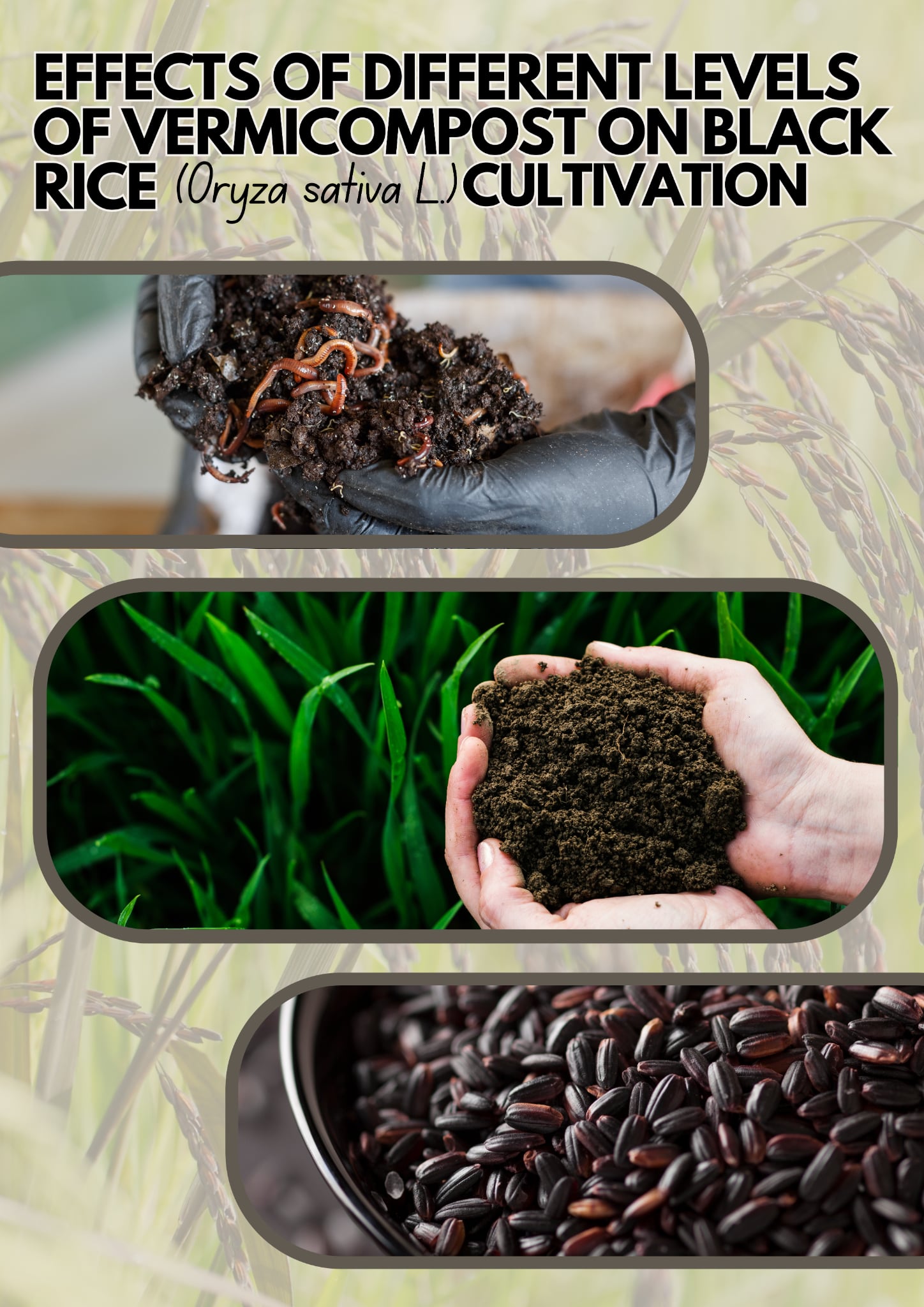
Effects of Different Levels of Vermicompost on Black Rice (Oryza sativa L.) Cultivation
Article Sidebar
Main Article Content
Abstract
Given the growing need to address the challenges of black rice cultivation and the environmental impacts of synthetic fertilizers, this study seeks to evaluate the response of a black rice variety to different levels of vermicompost application. The development of organic farming would bring a healthier environment, safe for humans, and result in increased food production that addresses Sustainable Development Goals (SDGs) such as Life on Land (SDG 15) and Zero Hunger (SDG 2). The experiment was conducted using a Randomized Complete Block Design (RCBD) with four treatments, each replicated three times. The treatments were as follows: A–20 tons of vermicompost per hectare, B – 25 tons of vermicompost per hectare, C–30 tons of vermicompost per hectare, and D – inorganic fertilizer applied at a rate of 90- 30-30 kg NPK per hectare. The results revealed no significant differences among the treatment means at all stages of plant growth, including growth indicators such as the number of tillers and plant height, as well as yield components, including panicle length, fresh and dry grain weight, and the number of filled and unfilled grains. These findings suggest that applying 20, 25, or 30 tons of vermicompost per hectare produces similar effects to using synthetic fertilizer. The study highlights the potential of vermicompost as a sustainable and environmentally friendly alternative to synthetic fertilizers for black rice cultivation, thereby reducing reliance on synthetic fertilizers that may have long-term adverse effects on soil health.
Article Details

This work is licensed under a Creative Commons Attribution-NonCommercial-NoDerivatives 4.0 International License.
References
Kushwaha, U. K. S. Black Rice: Research, History and Development; Springer: 2016. https://doi.org/10.1007/978-3-319-30153-2
Das, M.; Dash, U.; Mahanand, S. S.; Nayak, P. K.; Kesavan, R. K. Black rice: A comprehensive review on its bioactive compounds, potential health benefits, and food applications. Food Chem. Adv. 2023, 3, 100462. https://doi.org/10.1016/j.focha.2023.100462
Panda, D. K.; Jyotirmayee, B.; Mahalik, G. Black rice: A review from its history to chemical makeup to health advantages, nutritional properties, and dietary uses. Plant Sci. Today 2022, 9, 1–15. https://doi.org/10.14719/pst.1817
Dewi, K.; Agustina, R. Z.; Nurmalika, F. Effects of blue light and paclobutrazol on seed germination, vegetative growth, and yield of black rice (Oryza sativa L. 'Cempo Ireng'). Biotropia 2016, 23(2), 85–96. https://doi.org/10.11598/btb.2016.23.2.478
Bhandari, R.; Ansari, M. J.; Alharbi, S. A.; Kushwaha, U. S.; Ghimire, P. Productivity and profitability of black rice as affected by transplanting methods and crop geometry. Heliyon 2024, 10(14), e34741. https://doi.org/10.1016/j.heliyon.2024.e34741
Hijam, L.; Mandal, R.; Chakraborty, M.; Maying, B. Utilization of rice genetic resources for nutritional and medicinal benefits. In Bioprospecting of Ethnomedicinal Plant Resources: Sustainable Utilization and Restoration; Scopus, 2024; pp 351–374.
Tripathi, S.; Srivastava, P.; Devi, R. S.; Bhadouria, R. Influence of synthetic fertilizers and pesticides on soil health and soil microbiology. In Agrochemicals Detection, Treatment and Remediation: Pesticides and Chemical Fertilizers; Elsevier, 2020; pp 25–54. https://doi.org/10.1016/B978-0-08-103017-2.00002-7
Guo, Y.; Wang, J. Spatiotemporal changes of chemical fertilizer application and its environmental risks in China from 2000 to 2019. Int. J. Environ. Res. Public Health 2021, 18(22), 11911. https://doi.org/10.3390/ijerph182211911
Şener, S.; Türemiş, N. F.; Tanır, F. Agrochemical usage for sustainable fruit production and human health. In Agrochemicals Detection, Treatment and Remediation: Pesticides and Chemical Fertilizers; Elsevier, 2020; pp 291–305. https://doi.org/10.1016/B978-0-08-103017-2.00012-X
Tyagi, J.; Ahmad, S.; Malik, M. Nitrogenous fertilizers: Impact on environment sustainability, mitigation strategies, and challenges. Int. J. Environ. Sci. Technol. 2022, 19(11), 11649–11672. https://doi.org/10.1007/s13762-022-04027-9
Anani, O. A.; Adetunji, C. O.; Osarenotor, O.; Inamuddin. Biofertilizer utilization in the agricultural sector. In Biofertilizers: Study and Impact; Wiley, 2021; pp 293–307. https://doi.org/10.1002/9781119724995.ch9
He, H.; Peng, M.; Hou, Z.; Li, J. Organic substitution contrasting direct fertilizer reduction increases wheat productivity, soil quality, microbial diversity and network complexity. Environ. Technol. Innovations 2024, 36, 103784. https://doi.org/10.1016/j.eti.2024.103784
Banerjee, S.; Mitra, S.; Velhal, M.; Desmukh, V.; Ghosh, B. Impact of agrochemicals on the environment and human health: The concerns and remedies. Int. J. Exp. Res. Rev. 2021, 26, 125–140. https://doi.org/10.52756/ijerr.2021.v26.010
Cruz, G. S. J.; Hermes, P. H.; Miriam, S. V.; López, A. M. Benefits of vermicompost in agriculture and factors affecting its nutrient content. J. Soil Sci. Plant Nutr. 2024, 24(3), 4898–4917. https://doi.org/10.1007/s42729-024-01880-0
Hussain, N.; Abbasi, S. A. Efficacy of the vermicomposts of different organic wastes as “clean” fertilizers: State-of-the-art. Sustainability 2018, 10 (4), 1205. https://doi.org/10.3390/su10041205
Guerrero, R. D.; Rafael, D. Vermicomposting improves farm economics. BioCycle 2008, 49(8), 58–60.
Zurbano, L. Y.; Cabanela, J. B.; Orijuela, N. P.; Villanueva, J. B. Response of string beans (Vigna unguiculata subsp. sesquipedalis L.) on saline soil amended with vermicompost. Univ. J. Agric. Res. 2022, 10 (5), 563–568. https://doi.org/10.13189/ujar.2022.100511
International Rice Research Institute. Statistical Tool for Agricultural Research [Computer software]. http://bbi.irri.org (accessed Sep 13, 2025).
Mondal, M. M. A.; Puteh, A. B.; Razi Ismail, M.; Yusop Rafii, M. Optimizing plant spacing for modern rice varieties. Int. J. Agric. Biol. 2013, 15(1), 175–178.
Zhang, J.; Xie, T.; Yang, W.; Zhou, G. Research status and prospect on height estimation of field crop using near-field remote sensing technology. Smart Agric. 2021, 3(1). https://doi.org/10.12133/j.smartag.2021.3.1.202102-SA033
Kumar, C. P. S.; Naik, B. M.; Suji, D. B. Assessment of association analysis for grain yield and its attributing traits in rice (Oryza sativa L.). Plant Arch. 2020, 20, 1733–1737.
Sun, J.; Ren, Z.; Cui, J.; Tang, C.; Luo, T.; Yang, W.; Song, P. A high-throughput method for accurate extraction of intact rice panicle traits. Plant Phenomics 2024, 6, 0213. https://doi.org/10.34133/plantphenomics.0213
Samant, T. K. Impact of front line demonstration on yield and economics of hybrid rice (Rajalaxmi). Indian J. Agric. Res. 2015, 49(1), 88–91. https://doi.org/10.5958/0976-058X.2015.00013.X
Xie, Y.; Zhou, L.; Dai, J.; Chen, J.; Yang, X.; Wang, X.; Wang, Z.; Feng, L. Effects of the C/N ratio on the microbial community and lignocellulose degradation during branch waste composting. Bioprocess Biosyst. Eng. 2022, 45 (7), 1163–1174. https://doi.org/10.1007/s00449-022-02732-w
Ruan, S.; Luo, H.; Zeng, X.; Wen, R.; Wu, F.; Tang, X. Effects of different vermicompost rates on growth, 2-acetyl-1-pyrroline, photosynthesis and antioxidant responses of fragrant rice (Oryza sativa L.) seedlings. Phyton 2021, 90(4), 1273–1283. https://doi.org/10.32604/phyton.2021.015610
Mahanta, K.; Jha, D. K.; Rajkhowa, D. J.; Manoj-Kumar. Microbial enrichment of vermicompost prepared from different plant biomasses and their effect on rice (Oryza sativa L.) growth and soil fertility. Biol. Agric. Hortic. 2012, 28(4), 241–250. https://doi.org/10.1080/01448765.2012.738556
Ramazanoglu, E. Effects of vermicompost application on plant growth and soil enzyme activity in wheat (Triticum aestivum L.) monitored by thermal imaging. Cogent Food Agric. 2024, 10(1), 2373872. https://doi.org/10.1080/23311932.2024.2373872
Sungthongwises, K.; Tanpan, T. Effect of vermicompost-chemical mixed fertiliser on the growth and macronutrient use efficiency of upland rice cv. Sakonnakhon. Songklanakarin J. Sci. Technol. 2018, 40(5), 1039–1042.
Rao, G. B. S.; Baradhan, G.; Sureshkumar, S. M.; Immanuel, R. R.; Ramesh, S. Influence of integrated nutrient management practices on growth and yield of rice–greengram cropping system. Plant Arch. 2019, 19, 441–443.
Xu, C.; Mou, B. Vermicompost affects soil properties and spinach growth, physiology, and nutritional value. HortScience 2016, 51(7), 847–855. https://doi.org/10.21273/hortsci.51.7.847
Aguilar-Benítez, G.; Peña-Valdivia, C. B.; Castro-Rivera, R.; Lara-Ávila, J. P.; Cruz-Crespo, E.; Rojas-Velázquez, A. N. Vermicompost and water stress effects on dry beans (Phaseolus vulgaris L.): Productive parameters and water relations. Phyton-Int. J. Exp. Bot. 2017, 86, 28–39.
Tammam, A. A.; Shehata, M. R. A. M.; Pessarakli, M.; El-Aggan, W. H. Vermicompost and its role in alleviation of salt stress in plants–I. Impact of vermicompost on growth and nutrient uptake of salt-stressed plants. J. Plant Nutr. 2023, 46(7), 1446–1457. https://doi.org/10.1080/01904167.2022.2072741
Manandhar, S.; Tuladhar, R.; Prajapati, K.; Singh, A.; Varma, A. Effect of Azotobacter chroococcum and Piriformospora indica on Oryza sativa in presence of vermicompost. In Mycorrhiza – Nutrient Uptake, Biocontrol, Ecorestoration, 4th ed.; Varma, A., Prasad, R., Tuteja, N., Eds.; Springer, 2018; pp 327–339. https://doi.org/10.1007/978-3-319-68867-1_18
Akbassova, A. D.; Sainova, G. A.; Aimbetova, I. O.; Sunakbaeva, D. K.; Akeshova, M. M. Impact of polyfunctional vermicompost on the productivity of vegetable root crops. Fresenius Environ. Bull. 2016, 25(9), 3755–3759.
Zhang, M.; Liu, Y.; Wei, Q.; Liu, L.; Gu, X.; Gou, J.; Wang, M. Ameliorative effects of vermicompost application on yield, fertilizer utilization, and economic benefits of continuous cropping pepper in Karst areas of Southwest China. Agronomy 2023, 13(6), 1591. https://doi.org/10.3390/agronomy13061591
Liu, X. C.; Chen, L.; Li, S. Q.; Shi, Q. H.; Wang, X. Y. Effects of vermicompost fertilization on soil, tomato yield and quality in greenhouse. Chin. J. Appl. Ecol. 2021, 32(2), 549–556. https://doi.org/10.13287/j.1001-9332.202102.022.
Syed, S.; Saman, R. U.; Manzoor, A.; Arsalan, M.; Latif, A.; Khan, M.; Ullah, R.; Bilal, M.; Latif, R.; Ahmad, E.; Amjad, M.; Aslam, M.; Sarwar, S.; Shah, S. H.; Masood, A. Maximizing vegetable growth potential: Evaluating the synergistic impact of vermicompost and NPK fertilizer amended soil. Pak. J. Agric. Res. 2024, 37(3), 207–216. https://doi.org/10.17582/JOURNAL.PJAR/2024/37.3.207.216
