Anticandidal Activities of Selected Thai Plant Extracts and Essential Oils Against Oral Candidiasis Candida spp. Isolates
Article Sidebar
Main Article Content
Abstract
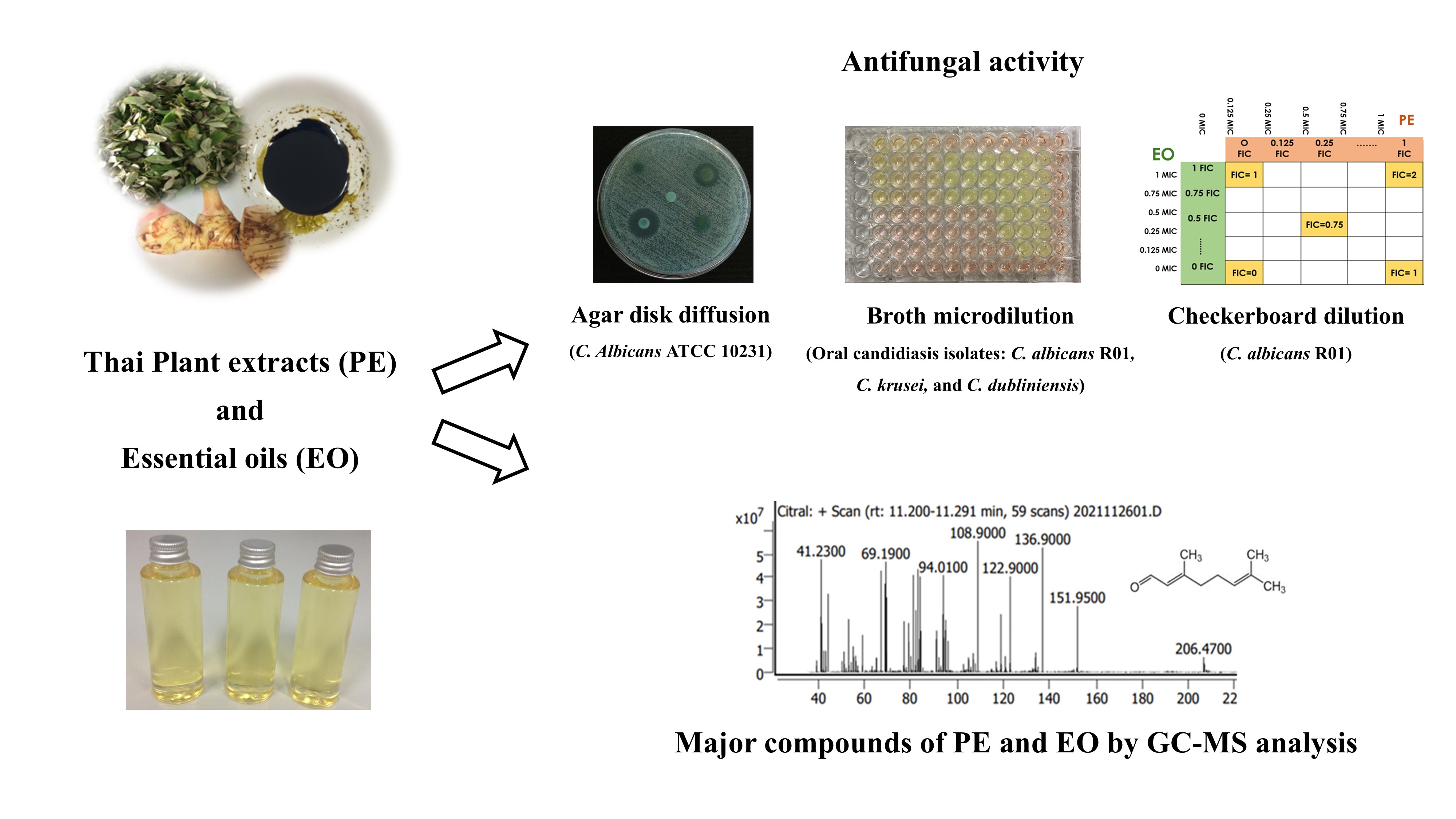
The antifungal properties of 13 ethanol plant extracts (PE) and 6 essential oils (EO) of Thai traditional herbs were screened for their anti-Candida activity against a standard strain of Candida albicans ATCC 10231 using agar disk diffusion and broth microdilution methods. Two PE, Piper betle and Alpinia galanga extracts, showed the lowest MIC and MFC values against C. albicans of 0.313 mg/mL and 0.625 mg/mL, and three EO; cinnamon bark oil exhibited the lowest MIC and MFC value of 0.039 mg/mL, followed by lemongrass oil and clove bud oil. The main compounds of these EO and PE were identified using gas chromatography–mass spectroscopy (GC-MS). The major compounds were geranial (42.7%) and neral (22.2%) in lemongrass oil, eugenol (85.5%) in clove bud oil, cinnamaldehyde (80.6%) in cinnamon bark oil, 4-allyl-1,2-diacetoxybenzene (29.5%) and hydroxychavicol (24.8%) in P. betle extract, and 1’-acetoxychavical acetate (78.0%) in A. galanga extract. All EO and PE showed antifungal activity against three oral candidiasis isolates, including C. albicans R01, C. krusei, and C. dubliniensis, with MIC/MFC ranging from 0.156 – 5.000 mg/mL. The checkerboard dilution method revealed that the combination of EO and PE showed an additive effect on C. albicans R01. In conclusion, the combination of EO with PE lowered the MIC of each agent, which could lead to decreased side effects, and hence this combination could be a promising treatment alternative for oral candidiasis.
Downloads
Article Details

This work is licensed under a Creative Commons Attribution-NonCommercial-NoDerivatives 4.0 International License.
References
Karajacob, A. S.; Azizan, N. B.; Al-Maleki, A. R. M.; Goh, J. P. E.; Loke, M. F.; Khor, H. M.; Ho, G. F.; Ponnampalavanar, S.; Tay, S. T., Candida species and oral mycobiota of patients clinically diagnosed with oral thrush. PLoS One 2023, 18(4), e0284043. https://doi.org/10.1371/journal.pone.0284043
Mousa, M. A.; Lynch, E.; Kielbassa, A. M., Denture-related stomatitis in new complete denture wearers and its association with Candida species colonization: a prospective case-series. Quintessence International 2020, 51(7), p554.
Tata, W.; Thepbundit, V.; Kuansuwan, C.; Preechasuth, K., Distribution of Candida species in oral candidiasis patients: association between sites of isolation, ability to form biofilm, and susceptibility to antifungal drugs. Journal of Associated Medical Sciences 2019, 52(1), 1-7.
Quindós, G.; Gil-Alonso, S.; Marcos-Arias, C.; Sevillano, E.; Mateo, E.; Jauregizar, N.; Eraso, E., Therapeutic tools for oral candidiasis: current and new antifungal drugs. Medicina Oral Patologia Oral y Cirugia Bucal 2019, 24(2), e172-e180. https://doi.org/10.4317/medoral.22978
Adamczak, A.; Ożarowski, M.; Karpiński, T. M., Curcumin, a natural antimicrobial agent with strain-specific activity. Pharmaceuticals (Basel) 2020, 13(7). https://doi.org/10.3390/ph13070153
Kojima-Yuasa, A.; Matsui-Yuasa, I., Pharmacological effects of 1'-acetoxychavicol acetate, a major constituent in the rhizomes of Alpinia galanga and Alpinia conchigera. Journal of Medicinal Food 2020, 23(5), 465-475. https://doi.org/10.1089/jmf.2019.4490
Meccatti, V. M.; Santos, L. F.; de Carvalho, L. S.; Souza, C. B.; Carvalho, C. A. T.; Marcucci, M. C.; Abu Hasna, A.; de Oliveira, L. D., Antifungal action of herbal plants’ glycolic extracts against Candida species. Molecules 2023, 28(6), 2857. https://doi.org/10.3390/molecules28062857
Nayaka, N. M.; Sasadara, M. M.; Sanjaya, D. A.; Yuda, P. E.; Dewi, N. L.; Cahyaningsih, E.; Hartati, R., Piper betle (L): recent review of antibacterial and antifungal properties, safety profiles, and commercial applications. Molecules 2021, 26(8). https://doi.org/10.3390/molecules26082321
Hou, T.; Sana, S. S.; Li, H.; Xing, Y.; Nanda, A.; Netala, V. R.; Zhang, Z., Essential oils and its antibacterial, antifungal and anti-oxidant activity applications: a review. Food Bioscience 2022, 47, 101716. https://doi.org/10.1016/j.fbio.2022.101716
Serra, E.; Hidalgo-Bastida, L. A.; Verran, J.; Williams, D.; Malic, S., Antifungal activity of commercial essential oils and biocides against Candida albicans. Pathogens 2018, 7(1), 15. https://doi.org/10.3390/pathogens7010015
Kermani, F.; Taghizadeh-Armaki, M.; Hosseini, S. A.; Amirrajab, N.; Javidnia, J.; Fami Zaghrami, M.; Shokohi, T., Antifungal resistance of clinical Candida albicans isolates in Iran: a systematic review and meta-analysis. Iranian Journal of Public Health 2023, 52(2), 290-305. https://doi.org/10.18502/ijph.v52i2.11874
Wong, S. S. W.; Kao, R. Y. T.; Yuen, K. Y.; Wang, Y.; Yang, D.; Samaranayake, L. P.; Seneviratne, C. J., In vitro and in vivo activity of a novel antifungal small molecule against Candida infections. PLoS one 2014, 9(1), e85836. https://doi.org/10.1371/journal.pone.0085836
Rodrı́guez-Tudela, J. L.; Cuenca-Estrella, M.; Dı́az-Guerra, T. M.; Mellado, E., Standardization of antifungal susceptibility variables for a semiautomated methodology. Journal of Clinical Microbiology 2001, 39(7), 2513-2517. https://doi.org/10.1128/JCM.39.7.2513-2517.2001
Taweechaisupapong, S.; Aieamsaard, J.; Chitropas, P.; Khunkitti, W., Inhibitory effect of lemongrass oil and its major constituents on Candida biofilm and germ tube formation. South African Journal of Botany 2012, 81, 95-102. https://doi.org/10.1016/j.sajb.2012.06.003
Satthanakul, P.; Taweechaisupapong, S.; Luengpailin, S.; Khunkitti, W., The antifungal efficacy of essential oils in combination with chlorhexidine against Candida spp. Songklanakarin Journal of Science and Technology 2019, 41(1), 144-150.
Lambert, R. J.; Lambert, R., A model for the efficacy of combined inhibitors. Journal of Applied Microbiology 2003, 95(4), 734-43. https://doi.org/10.1046/j.1365-2672.2003.02039.x
Uddin, T. M.; Chakraborty, A. J.; Khusro, A.; Zidan, B. M. R. M.; Mitra, S.; Emran, T. B.; Dhama, K.; Ripon, M. K. H.; Gajdács, M.; Sahibzada, M. U. K.; Hossain, M. J.; Koirala, N., Antibiotic resistance in microbes: history, mechanisms, therapeutic strategies and future prospects. Journal of Infection and Public Health 2021, 14(12), 1750-1766. https://doi.org/10.1016/j.jiph.2021.10.020
Azhari, M.; Sengaji, R. F., Antimicrobial activity of turmeric, ginger, and galangal rhizome ethanol extracts in combination using the checkerboard method. Journal Borneo 2023, 3(3), 139-148. https://doi.org/10.57174/j.born.v3i3.108
Khodavandi, A.; Tahzir, N.; Cheng, P.; Yong, P.; Alizadeh, F.; Harmal, N.; Chong, P., Antifungal activity of Rhizome coptidis and Alpinia galangal against Candida species. Journal of Pure and Applied Microbiology 2013, 7, 1725-1730.
Muruganandam, L.; Krishna, A.; Reddy, J.; Nirmala, G., Optimization studies on extraction of phytocomponents from betel leaves. Resource-Efficient Technologies 2017, 3(4), 385-393. https://doi.org/10.1016/j.reffit.2017.02.007
Shahina, Z.; Ndlovu, E.; Persaud, O.; Sultana, T.; Dahms, T. E., Candida albicans reactive oxygen species (ROS)-dependent lethality and ROS-independent hyphal and biofilm inhibition by eugenol and citral. Microbiology Spectrum 2022, 10(6), e03183-22. https://doi.org/10.1128/spectrum.03183-22
Nordin, M. A.; Wan Harun, W. H.; Abdul Razak, F.; Musa, M. Y., Growth inhibitory response and ultrastructural modification of oral-associated candidal reference strains (ATCC) by Piper betle L. extract. International Journal of Oral Science 2014, 6(1), 15-21. https://doi.org/10.1038/ijos.2013.97
Singburaudom, N., Hydroxychavicol from Piper betel leave is an antifungal activity against plant pathogenic fungi. Journal of Biopesticides 2015, 8, 82-92. https://doi.org/10.57182/jbiopestic.8.2.82-92
Oonmetta-aree, J.; Suzuki, T.; Gasaluck, P.; Eumkeb, G., Antimicrobial properties and action of galangal (Alpinia galanga Linn.) on Staphylococcus aureus. LWT - Food Science and Technology 2006, 39(10), 1214-1220. https://doi.org/10.1016/j.lwt.2005.06.015
Miranda-Cadena, K.; Marcos-Arias, C.; Perez-Rodriguez, A.; Cabello-Beitia, I.; Mateo, E.; Sevillano, E.; Madariaga, L.; Quindós, G.; Eraso, E., In vitro and in vivo anti-Candida activity of citral in combination with fluconazole. Journal of Oral Microbiology 2022, 14(1), 2045813. https://doi.org/10.1080/20002297.2022.2045813
Gupta, P.; Gupta, S.; Sharma, M.; Kumar, N.; Pruthi, V.; Poluri, K. M., Effectiveness of phytoactive molecules on transcriptional expression, biofilm matrix, and cell wall components of Candida glabrata and its clinical isolates. ACS Omega 2018, 3(9), 12201-12214. https://doi.org/10.1021/acsomega.8b01856
Kaur, J.; Nobile, C. J., Antifungal drug-resistance mechanisms in Candida biofilms. Current Opinion in Microbiology 2023, 71, 102237. https://doi.org/10.1016/j.mib.2022.102237
Olejnik, E.; Biernasiuk, A.; Malm, A.; Szymanska, J., Evaluation of antibacterial and antifungal properties of selected mouthwashes: studies. Current Issues in Pharmacy and Medical Sciences 2021, 34(3), 164-168. https://doi.org/10.2478/cipms-2021-0029
Harun, W. H. A. W.; Razak, F. A., An in vitro study on the anti-adherence effect of Brucea javanica and Piper betle extracts towards oral Candida. Archives of Oral Biology 2013, 58(10), 1335-1342. https://doi.org/10.1016/j.archoralbio.2013.07.001
Herman, A.; Herman, A. P., Herbal products and their active constituents used alone and in combination with antifungal drugs against drug-resistant Candida sp. Antibiotics (Basel) 2021, 10(6). https://doi.org/10.3390/antibiotics10060655
Soulaimani, B.; Varoni, E.; Iriti, M.; Mezrioui, N.-E.; Hassani, L.; Abbad, A., Synergistic anticandidal effects of six essential oils in combination with fluconazole or amphotericin B against four clinically isolated Candida strains. Antibiotics 2021, 10(9), 1049. https://doi.org/10.3390/antibiotics10091049
Wang, Y.; Yang, Q.; Zhao, F.; Li, M.; Ju, J., Synergistic antifungal mechanism of eugenol and citral against Aspergillus niger: molecular level. Industrial Crops and Products 2024, 213, 118435. https://doi.org/10.1016/j.indcrop.2024.118435
Wall, G.; Montelongo-Jauregui, D.; Vidal Bonifacio, B.; Lopez-Ribot, J. L.; Uppuluri, P., Candida albicans biofilm growth and dispersal: contributions to pathogenesis. Current Opinion in Microbiology 2019, 52, 1-6. https://doi.org/10.1016/j.mib.2019.04.001
Sonphakdi, T.; Tani, A.; Payaka, A.; Ungcharoenwiwat, P., Antibacterial and toxicity studies of phytochemicals from Piper betle leaf extract. Journal of King Saud University-Science 2024, 36(10), 103430. https://doi.org/10.1016/j.jksus.2024.103430
Arambewela, L. S.; Arawwawala, L. D.; Kumaratunga, K. G.; Dissanayake, D. S.; Ratnasooriya, W. D.; Kumarasingha, S. P., Investigations on Piper betle grown in Sri Lanka. Pharmacognosy Review 2011, 5(10), 159-163. https://doi.org/10.4103/0973-7847.91111
Shanmugasundaram, D., Subchronic toxicological evaluation of EnXtra™ (standardised extract of Alpinia galanga rhizome) in rats. Journal of Complementary and Integrative Medicine 2022, 19(3), 645-659. https://doi.org/10.1515/jcim-2021-0526
Xavier, A.; Rani, S. S.; Shankar, R.; Nisha, A.; Sujith, S.; Uma, R., Evaluation of acute oral toxicity of lemon grass oil and citral in albino rats. The Journal of Phytopharmacology 2022. https://doi.org/10.31254/phyto.2022.11410
Nirmala, M. J.; Shiny, P. J.; Raj, U. S.; Saikrishna, N.; Nagarajan, R., Chapter 39 - Toxicity of clove (Syzygium aromaticum) extract. In Clove (Syzygium aromaticum), Ramadan, M. F., Ed. Academic Press: 2022, pp 663-674. https://doi.org/10.1016/B978-0-323-85177-0.00007-0
Guo, J.; Jiang, X.; Tian, Y.; Yan, S.; Liu, J.; Xie, J.; Zhang, F.; Yao, C.; Hao, E., Therapeutic potential of cinnamon oil: chemical composition, pharmacological actions, and applications. Pharmaceuticals 2024, 17(12), 1700. https://doi.org/10.3390/ph17121700
Adawiyah, R.; Serati-Nouri, H.; Abdul majid, F.; Sarmidi, M.; Aziz, R., Assessment of potential toxicological effects of cinnamon bark aqueous extract in rats. International Journal of Bioscience, Biochemistry and Bioinformatics 2015, 5, 36-44. https://doi.org/10.17706/ijbbb.2015.5.1.36-44
