
Influence of MS Medium Strengths and Types on In Vitro Shoot Multiplication and Development of Nymphaea colorata Peter
Article Sidebar
Main Article Content
Abstract
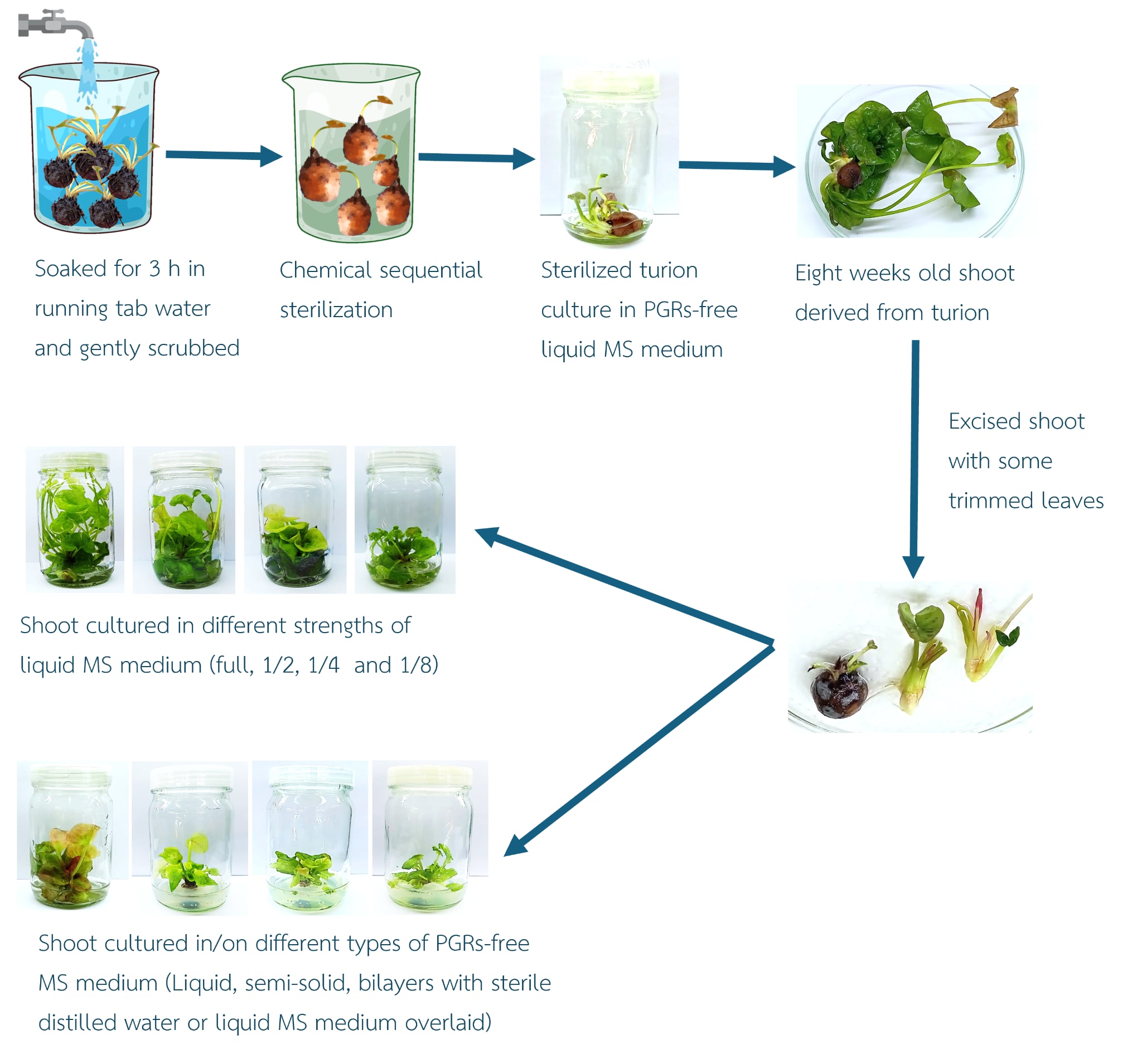
Efficient in vitro propagation systems are essential for the large-scale commercial production and conservation of the important tropical waterlilies (Nymphaea spp.), particularly elite ornamental varieties and species. This study aimed to optimize culture medium conditions by evaluating the effects of Murashige and Skoog (MS) medium strengths and types on the in vitro growth by using Nymphaea colorata as a plant model. The derived shoots obtained from sterilized turions were cultured on different MS medium concentrations and types. The results demonstrated that full-strength MS medium significantly enhanced survival percentage (100%), number of shoot/explant (1.53 shoots), number of leaf/explant (18.86 leaves) leaf width (2.66 cm), and petiole length (11.50 cm) compared to diluted formulations. Among different medium types, semi-solid MS medium effectively supported shoot growth while reducing hyperhydration, a common issue observed in liquid cultures. Shoots cultured on semi-solid MS medium exhibited well-developed leaves and elongated petioles, making them more suitable for subsequent acclimatization. These findings highlight the importance of optimizing both nutrient composition and the physical state of the culture medium to enhance micropropagation efficiency in Nymphaea colorata. The use of full-strength MS medium in combination with semi-solid culture conditions offers a promising approach for high-quality plantlet production subsequent large-scale propagation and conservation of elite waterlily genotypes
Article Details

This work is licensed under a Creative Commons Attribution-NonCommercial-NoDerivatives 4.0 International License.
References
Zhang, L.; Chen, F.; Zhang, X.; Li, Z.; Zhao, Y.; Lohaus, R.; Chang, X.; Dong, W.; Ho, S. Y. W.; Liu, X.; Song, A.; Chen, J.; Guo, W.; Wang, Z.; Zhuang, Y.; Wang, H.; Chen, X.; Hu, J.; Liu, Y.; Tang, H. The water lily genome and the early evolution of flowering plants. Nature 2019, 577(7788), 79-84. https://doi.org/10.1038/s41586-019-1852-5
Xiong, X.; Zhang, J.; Yang, Y.; Chen, Y.; Su, Q.; Zhao, Y.; Wang, J.; Xia, Z.; Wang, L.; Zhang, L.; Chen, F. Water lily research: past, present, and future. Trop. Plants 2023, 2(1), 1-8. https://doi.org/10.48130/tp-2023-0001
Masters, C. O. Encyclopedia of the Water-Lily; TFH Publications: Neptune City, NJ, 1974.
Dumitras, A.; Sabo, G. M.; Singureanu, V.; Csok, E.; Moldovan, G. Flower species used in aquatic landscape design. Bull. Univ. Agric. Sci. Vet. Med. Cluj-Napoca Hortic. 2008, 65(1), 486. https://doi.org/10.15835/buasvmcn-hort:827.
Sunian, E. Development of Sterilisation Procedures and In vitro studies of Nymphaea lotus; Doctoral Dissertation, Universiti Putra Malaysia, 2004. Universiti Putra Malaysia Institutional Repository.
Liu, Q.; Li, S.; Li, T.; Wei, Q.; Zhang, Y. The characterization of R2R3-MYB genes in water lily Nymphaea colorata reveals the involvement of NcMYB25 in regulating anthocyanin synthesis. Plants 2024, 13(21), 2990. https://doi.org/10.3390/plants13212990.
Borsch, T.; Loehne, C.; Mbaye, M.; Wiersema, J. Towards a complete species tree of Nymphaea: shedding further light on subg. Brachyceras and its relationships to the Australian water-lilies. Telopea 2011, 13(1-2), 193-217. https://doi.org/10.7751/telopea20116014.
Li, H.; Shen, Z.; Niu, J.; Yang, S.; Zhu, T. Nymphaea ‘Guifei’, a new intersubgeneric cultivar with flower color transition. HortScience 2024, 59(9), 1391-1392. https://doi.org/10.21273/hortsci18046-24.
Cheng, L.; Han, Q.; Chen, F.; Li, M.; Balbuena, T. S.; Zhao, Y. Phylogenomics as an effective approach to untangle cross-species hybridization event: A case study in the family Nymphaeaceae. Front. Genet. 2022, 13, 1031705. https://doi.org/10.3389/fgene.2022.1031705.
Les, D. H.; Moody, M. L.; Doran, A. S.; Phillips, W. E. A genetically confirmed intersubgeneric hybrid in Nymphaea L. (Nymphaeaceae salisb.). HortScience 2004, 39(2), 219-222. https://doi.org/10.21273/hortsci.39.2.219.
Khan, W. U.; Khan, L. U.; Khan, N. M.; Zhang, J.; Wenquan, W.; Chen, F. Comprehensive kuntze. Bangladesh J. Bot. 2025, 51(4), 697-704. https://doi.org/10.3329/bjb.v51i4.63488.
Huang, X.; Yang, M.; Guo, J.; Liu, J.; Chu, G.; Xu, Y. Genome-wide survey and analysis of microsatellites in waterlily, and potential for polymorphic marker development. Genes 2022, 13(10), 1782. https://doi.org/10.3390/genes13101782.
Chen, F.; Liu, X.; Yu, C.; Chen, Y.; Tang, H.; Zhang, L. Water lilies as emerging models for Darwin’s abominable mystery. Horticulture Res. 2017, 4(1). https://doi.org/10.1038/hortres.2017.51.
Rodboot, N.; Yenchon, S.; Te-Chato, S. Optimization of explant sterilization and plant growth regulators for enhancing the in vitro propagation of Nymphaea colorata Peter. Plant Cell Tissue Organ Cult. (PCTOC) 2024, 159(3). https://doi.org/10.1007/s11240-024-02911-5.
Sivakumar, P.; Chitra, M.; Sasikala, K.; Selvamurugan, M.; Karunakaran, V. An overview of pharmaceutical applications and in vitro micropropagation techniques for rare and endangered plant species. J. Adv. Biol. Biotechnol. 2024, 27(9), 573-585. https://doi.org/10.9734/jabb/2024/v27i91330.
Shukla, S.; Shukla, S. K. Micropropagation for crop improvement and its commercialization potential. In Elsevier eBooks; Elsevier, 2024; pp 271-287. https://doi.org/10.1016/b978-0-443-15924-4.00006-0.
Gupta, S.; Singh, A.; Yadav, K.; Pandey, N.; Kumar, S. Micropropagation for multiplication of disease-free and genetically uniform sugarcane plantlets. In Elsevier eBooks; Elsevier, 2022; pp 31–49. https://doi.org/10.1016/b978-0-323-90795-8.00015-1.
Hasnain, A.; Naqvi, S. A. H.; Ayesha, S. I.; Khalid, F.; Ellahi, M.; Iqbal, S.; Hassan, M. Z.; Abbas, A.; Adamski, R.; Markowska, D.; Baazeem, A.; Mustafa, G.; Moustafa, M.; Hasan, M. E.; Abdelhamid, M. M. A. Plants in vitro propagation with its applications in food, pharmaceuticals, and cosmetic industries; current scenario and future approaches. Front. Plant Sci. 2022, 13, 1009395. https://doi.org/10.3389/fpls.2022.1009395.
Abdalla, N.; El-Ramady, H.; Seliem, M. K.; El-Mahrouk, M. E.; Taha, N.; Bayoumi, Y.; Shalaby, T. A.; Dobránszki, J. An academic and technical overview on plant micropropagation challenges. Horticulturae 2022, 8(8), 677. https://doi.org/10.3390/horticulturae8080677.
Mahanta, M.; Gantait, S. Trends in plant tissue culture and genetic improvement of gerbera. Hortic. Plant J. https://doi.org/10.1016/j.hpj.2024.03.003.
Baby, G.; Rafeekher, M.; Soni, K.; Kumari, P. I.; CR, R.; SheenaA, N.; M, A. R. Advances in micropropagation techniques for aquascaping plants: A comprehensive review. Arch. Curr. Res. Int. 2024, 24(11), 14-22. https://doi.org/10.9734/acri/2024/v24i11944.
Kam, M. Y. Y.; Chin, C. F. Micropropagation of the ornamental aquatic plant, Aponogeton ulvaceus, from immature buber explants. Methods Mol. Biol. 2024, 189-196. https://doi.org/10.1007/978-1-0716-3954-2_13.
Verde, D. D. S. V.; De Souza Mendes, M. I.; Da Silva Souza, A.; Pinto, C. R.; Nobre, L. V. C.; Santos, K. C. F. D.; Da Silva Ledo, C. A. Culture media in the in vitro cultivation of Dioscorea spp. Concilium 2023, 23(9), 459–482. https://doi.org/10.53660/clm-1383-23k63.
Batukaev, A.; Sobralieva, E.; Palaeva, D. Optimization studies of culture media for in vitro clonal micropropagation of new grape varieties. KnE Life Sci. 2021. https://doi.org/10.18502/kls.v0i0.9013.
Murashige, T.; Skoog, F. A Revised Medium for rapid growth and bio assays with tobacco tissue cultures. Physiol. Plant. 1962, 15(3), 473-497. https://doi.org/10.1111/j.1399-3054.1962.tb08052.x.
Pasternak, T. P.; Steinmacher, D. Plant growth regulation in cell and tissue culture in vitro. Plants 2024, 13(2), 327. https://doi.org/10.3390/plants13020327.
Dogan, M. High efficiency plant regeneration from shoot tip explants of Staurogyne repens (Nees) Kuntze. Bangladesh J. Bot. 2022, 51(4), 697-704. https://doi.org/10.3329/bjb.v51i4.63488.
Sheelamary, S.; Nandhini, L. V. Effect of media concentration and growth hormones on shoot regeneration and in vitro rooting of sugarcane varieties (Saccharum spp.). Int. J. Agric. Sci. 2021, 17(1), 89-94. https://doi.org/10.15740/has/ijas/17.1/89-94.
Romanova, M. S.; Khaksar, E. V.; Novikov, O. O.; Leonova, N. I.; Semenov, A. G. The effect of different compositions of growth media on the development of microplants of the Antonina Potato variety. Sib. Her. Agric. Sci. 2020, 50(6), 26-36. https://doi.org/10.26898/0370-8799-2020-6-3.
Donjanthong, R.; Nopchai, N.; Sunlarp, S.; Nattawut, R. Micropropagation of Australian giant waterlily (Nymphaea gigantea). RMUTTO R. J. 2017, 10, 1-7.
Polivanova, O. B.; Bedarev, V. A. Hyperhydricity in plant tissue culture. Plants 2022, 11(23), 3313. https://doi.org/10.3390/plants11233313.
Noimai, Y. Micropropagation of Nymphaea hybrid ‘Chalong-Kwan’. Master’s Thesis, Rajamangala University of Technology Thanyaburi, 2012.
Ubonprasirt, B.; Nopchai, C.; Rungaroon, D. Micropropagation of night blooming waterlily (Nymphaea pubescens). RMUTTO R. J. 2011, 4(2).
Lakshmanan, P. In vitro establishment and multiplication of Nymphaea hybrid 'James Brydon'. Plant Cell Tissue Organ Cult. 1994, 36, 145-148.
Garg, G.; Bharadwaj, A.; Chaudhary, S.; Kataria, S. Nutrient medium and its fortification for in vitro cultivation of medicinal plants. In CRC Press eBooks; CRC Press, 2024; pp 123-133. https://doi.org/10.1201/b23374-6.
Matsneva, O. V.; Tashmatova, L. V.; Khromova, T. M. The influence of the nutrient composition medium on the intensity micropropagation in vitro Fragaria × Ananassa Duch. Vestnik of the Russian Agricultural Science 2024, 1, 26-29. https://doi.org/10.31857/s2500208224010065.
Chen, J.; Li, J.; Li, W.; Li, P.; Zhu, R.; Zhong, Y.; Zhang, W.; Li, T. The optimal ammonium-nitrate ratio for various crops: A meta-analysis. Field Crops Research 2024, 307, 109240. https://doi.org/10.1016/j.fcr.2023.109240.
Sudheer, W.; Praveen, N.; Al-Khayri, J.; Jain, S. Role of plant tissue culture medium components. In Elsevier eBooks; Elsevier, 2022; pp 51–83. https://doi.org/10.1016/b978-0-323-90795-8.00012-6.
De Alcantara, G. B.; Machado, M. P.; De Oliveira, R. A.; Filho, J. C. B. In vitro multiplication of sugar cane with different nitrogen and sucrose concentrations. Científica 2019, 47(1), 70-76. https://doi.org/10.15361/1984-5529.2019v47n1p70-76.
Miranda, N. A.; Titon, M.; Pereira, I. M.; Fernandes, J. S. C.; Santos, M. M.; De Oliveira, R. N. Antioxidants, sucrose, and agar in the in vitro multiplication of Eremanthus incanus. Floresta 2018, 48(3), 311.
Dönmez, D.; Erol, M. H.; Biçen, B.; Şimşek, Ö.; Kaçar, Y. A. The effects of different strength of MS media on in vitro propagation and rooting of Spathiphyllum. Anadolu J. Agric. Sci. 2022, 37(3), 583-592. https://doi.org/10.7161/omuanajas.1082219.
Gonçalves, S.; Correia, P. J.; Martins-Loução, M. A.; Romano, A. A new medium formulation for in vitro rooting of carob tree based on leaf macronutrients concentrations. Biol. Plantarum 2005, 49(2), 277–280. https://doi.org/10.1007/s10535-005-7280-4.
Haque, S. M.; Ghosh, B. Field evaluation and genetic stability assessment of regenerated plants produced via direct shoot organogenesis from leaf explant of an endangered ‘Asthma Plant’ (Tylophora indica) along with their in vitro conservation. Nat. Acad. Sci. Lett. 2013, 36(5), 551-562. https://doi.org/10.1007/s40009-013-0161-z.
Conesa, C. M.; Saez, A.; Navarro-Neila, S.; De Lorenzo, L.; Hunt, A. G.; Sepúlveda, E. B.; Baigorri, R.; Garcia-Mina, J. M.; Zamarreño, A. M.; Sacristán, S.; Del Pozo, J. C. Alternative polyadenylation and salicylic acid modulate root responses to low nitrogen availability. Plants 2020, 9(2), 251. https://doi.org/10.3390/plants9020251.
Munthali, C.; Kinoshita, R.; Onishi, K.; Rakotondrafara, A.; Mikami, K.; Koike, M.; Tani, M.; Palta, J.; Aiuchi, D. A model nutrition control system in potato tissue culture and its influence on plant elemental composition. Plants 2022, 11(20), 2718. https://doi.org/10.3390/plants11202718.
De David, C. H. O.; De Paiva Neto, V. B.; Campos, C. N. S.; Da Silva Liber Lopes, P. M.; Teodoro, P. E.; De Mello Prado, R. Nutritional disorders of macronutrients in Bletia catenulata. HortScience 2019, 54(10), 1836-1839. https://doi.org/10.21273/hortsci14284-19.
Jenks, M.; Kane, M.; Marousky, F.; McConnell, D.; Sheehan, T. In vitro establishment and epiphyllous regeneration of Nymphaea ‘Daubeniana’. HortScience 1990, 25, 1664.
De Klerk, G.; Van Den Dries, N.; Krens, F. Hyperhydricity: underlying mechanisms. Acta Horticulturae 2017, 1155, 269-276. https://doi.org/10.17660/actahortic.2017.1155.39.
Dewir, Y. H.; Indoliya, Y.; Chakrabarty, D.; Paek, K. Biochemical and physiological aspects of hyperhydricity in liquid culture system. In Springer eBooks, 2014, 693-709. https://doi.org/10.1007/978-94-017-9223-3_26.
Marfori, E. D. C. Improving micropropagation of Moringa oleifera: the use of semi-Solid medium for rooting and sucrose-free liquid medium combined with temporary ventilation for hardening. J. Appl. Biol. Biotechnol. 2024, 12, https://doi.org/10.7324/jabb.2024.166818.
Biswas, P.; Kumari, A.; Kumar, N. Impact of salt strength on in vitro propagation and rebaudioside a content in Stevia rebaudiana under semi-solid and liquid MS media. Sci. Rep. 2024, 14(1), https://doi.org/10.1038/s41598-024-70899-1.
Mazri, M. A. Role of cytokinins and physical state of the culture medium to improve in vitro shoot multiplication, rooting and acclimatization of Date Palm (Phoenix dactylifera L.). Boufeggous. J. Plant Biochem. Biotechnol. 2014, 24(3), 268-275. https://doi.org/10.1007/s13562-014-0267-5.
