
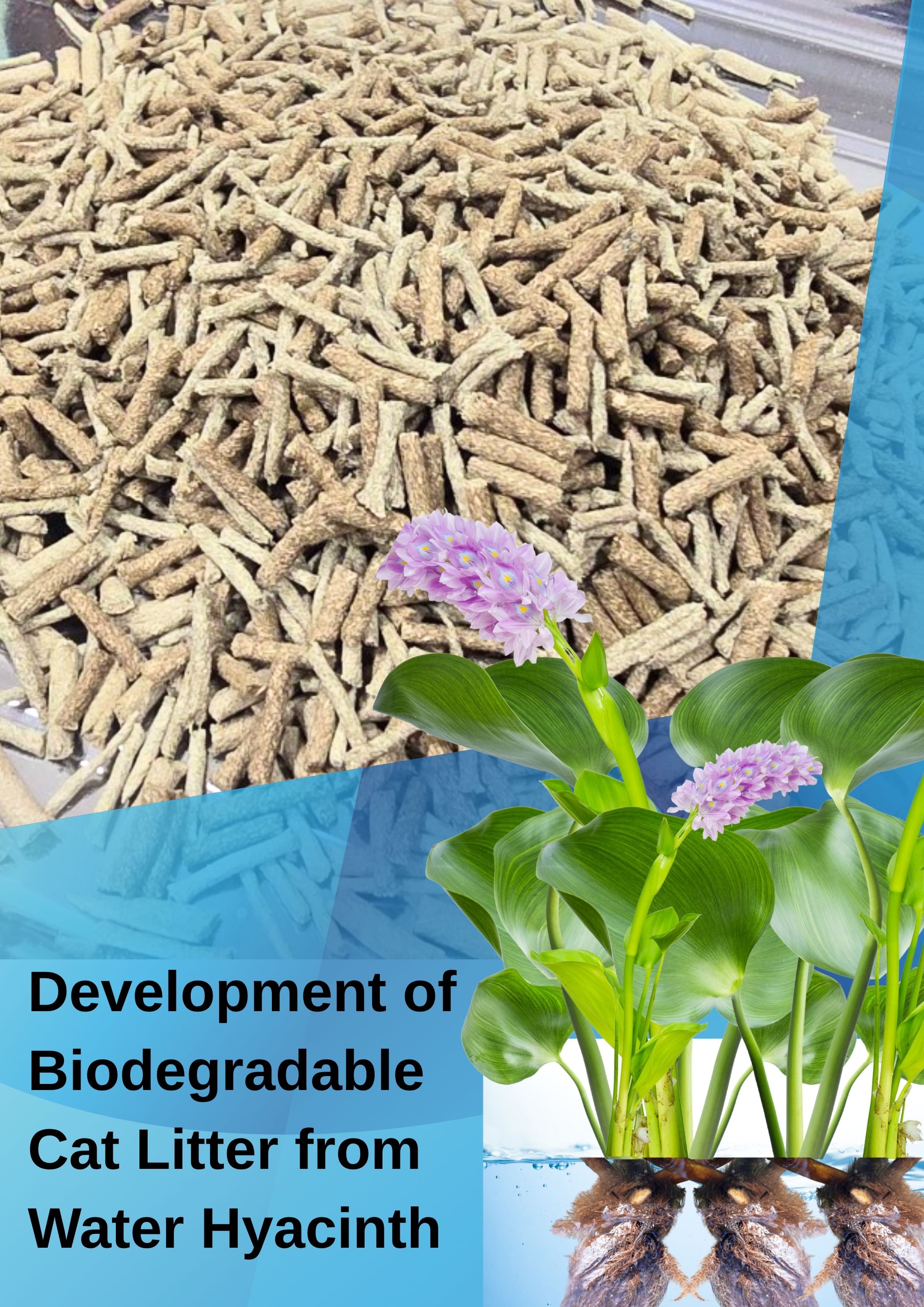
Development of Biodegradable Cat Litter from Water Hyacinth
Article Sidebar
Main Article Content
Abstract
This study focused on the technical feasibility and optimization of formulation performance characteristics to explore the potential of water hyacinth (Eichhornia crassipes) for biodegradable cat litter development. Five water hyacinth-based formulations (T1-T5) were developed and compared with commercial tofu-based cat litter (T6). Formulation T5 exhibited the highest water absorption capacity (64.23 ± 2.31%) compared to T6, the commercial product (47.42 ± 1.00%). T5 contained water hyacinth (61.7 g) and carboxymethyl cellulose (35 g), creating an optimal synergy for moisture retention. Water hyacinth formulations demonstrated superior structural integrity under impact testing, with T2-T5 showing zero breakage when dropped from heights up to 3 m, compared to T6's 2.10% fragmentation rate. Commercial litter dried faster (0.21 g/m²/s) than water hyacinth formulations (0.11-0.17 g/m²/s), presenting an area for optimization. The research demonstrates the viability of water hyacinth as an eco-friendly cat litter material, effectively converting an invasive aquatic plant into a value-added product with absorption capacity and durability advantages over commercial alternatives, while supporting environmental sustainability through the beneficial repurposing of problematic biomass.
Downloads
Article Details

This work is licensed under a Creative Commons Attribution-NonCommercial-NoDerivatives 4.0 International License.
References
National Statistical Office. July 11... World Population Day 2024. https://www.nso.go.th/public/e-book/NSOLetsRead/population.html (accessed 2024-10-28). (In Thai)
BrandAge Team. Pet Humanization the Era When Pets Are Equivalent to Family Members. https://www.brandage.com/article/29294/Pet-Humanization (accessed 2024-08-20).
Marketingoops. Trends in Pet Parenting Thai People Treating Pets Like Children and Spending Big for Their Beloved Pets, Boosting Pet Product and Service Industries.https://www.marketingoops.com/reports/behaviors/pet-parent/ (accessed 2023-07-08). (In Thai)
Nidarath, C. J. Development of cat waste absorbent materials from cassava residues; Master's thesis, Thammasat University. 2019. http://digital.library.tu.ac.th/tu_dc/frontend/Info/item/dc:168836 (accessed 2023-05-16) (In Thai)
Radanova, S. Biodegradable Plant-Based Cat Litter Fillers: Relevance of the Topic in Bulgaria. Eastern Academic Journal. 2021, 4, 78-86.
Hejlik, A. How to choose the best natural cat litter A comprehensive guide. https://soykitty.com/blogs/news/how-to-choose-the-best-natural-cat-litter (accessed 2024-09-02).
Fazal, H.; Mehwish, K.; Iffat, A. K.; Sahid, M.; Tariq, A.; Muhammad, H. Exploring the pathways to sustainability: A comprehensive review of biodegradable plastics in the circular economy. Materials Today Sustainability. 2025, 29, 1-26. https://doi.org/10.1016/j.mtsust.2024.101067.
Jiahao, K.; Dongxu, L.; Qingzhuo, W. Data-Driven Insights into the Pet Industry: Market Dynamics, Trade Policies, and Sustainable Growth Strategies. Accounting, Marketing and Organization. 2025, 1(1), 1000037, 1-29. https://doi.org/10.71204/cwfbwq11 (accessed 2023-04-07)
Metogbe B.D.; Mark O.; Louis C.C.; Fohla M.; Martin P.A. Paradigm shifts for sustainable management of water hyacinth in tropical ecosystems: A review and overview of current challenges, Environmental Challenges. 2023, 11, 100705, https://doi.org/10.1016/j.envc.2023.100705
Prapaiphan, J. Composting Water Hyacinth with Excess Sludge from Wastewater Treatment in Latex Factories and STR 20 Rubber Factories. Master’s Thesis, Prince of Songkla University, 2016. https://kb.psu.ac.th/psukb/handle/2016/12097 (accessed 2023-02-25) (In Thai)
Somchai, J.; Thanongsak, N. Heat Insulation Production Project from Water Hyacinth Fiber and Natural Rubber (Research Report) Naresuan University, July 20, 2023; https://nuir.lib.nu.ac.th/dspace/bitstream/123456789/905/1/Fulltext.pdf. (accessed 2023-12-25) (In Thai)
Umor, N.; Adenan, N. H.; Hajar, N.; Akil, N.; Malik, N.; Ismail, S.; Meskam, Z. Comparing Properties and Potential of Pinewood, Dried Tofu, and Oil Palm Empty Fruit Bunch (EFB) Pellet as Cat Litter; In Proceedings of the International Conference on Cellulose-Based Materials, 2023; 300-308. https://doi.org/10.1201/9781003358084-21
Saikeaw, N.; Rungsardthong, V.; Pornwongthong, P.; Vatanyoopaisarn, S.; Thumthanaruk, B.; Pattharaprachayakul, N.; Wongsa, J.; Mussatto, S. I.; Uttapap, D. Preparation and properties of biodegradable cat litter produced from cassava (Manihot esculenta L. Crantz) trunk; E3S Web of Conferences, 2021, 302. https://doi.org/10.1051/e3sconf/202130202017 (accessed 2023-03-01)
Saxena, S. Rheological properties and applications of carboxymethyl cellulose. Carbohydrate Polymers. 2011, 83(3), 1447–1456. https://doi.org/10.1016/j.carbpol.2010.09.019
R Core Team. (2024). R: A language and environment for statistical computing (Version 4.3.3). R Foundation for Statistical Computing. https://www.R-project.org/ (accessed 2025-06-15)
Jaruwan, N.; Panya, S.; Suchart, S. Study on chemical properties of water hyacinth for development as water-absorbing material. Kasetsart J Res Dev. 2014, 31(3), 405-412.
Somsri, S. Chemical characteristics of water hyacinth fiber grown in the central region of Thailand. J Agric Sci. 2017, 48(2), 112-120.
Maryam, M.; Ali, H.; Mehdi, T.; Aryou, E.; Fatemeh, E. The influence of carboxymethyl cellulose and hydroxypropyl methylcellulose on physicochemical, texture, and sensory characteristics of gluten-free pancake. Food Science & Nutrition. 2023, 12(3), 1-14. https://doi.org/10.1002/fsn3.375819159
Harsono, C.; Trisnawati, C. Y.; Srianta, I.; Nugerahani, I.; Marsono, Y. Effect of carboxymethyl cellulose on the physicochemical and sensory properties of bread enriched with rice bran. Food Research. 2021, 5(4), 322-328.
Damodaran, S.; Parkin, K. L.; Fennema, O. R. Fennema's food chemistry (5th ed.). CRC Press: 2017. https://doi.org/10.1201/9781315372914 (accessed 2024-05-11)
Tang, C. H. Functional and nutritional properties of soy protein products. Food Chemistry. 2017, 231, 577-584. https://doi.org/10.1016/j.foodchem.2017.03.123
Wu, H.; Wang, X. Water absorption characteristics of soy protein gel matrices. Journal of Food Science and Technology. 2020, 57(5), 1202–1210. https://doi.org/10.1007/s13197-019-04147-8
Cliff, M.; Heymann, H. Physical and Sensory Characteristics of Cat Litter. Journal of Sensory Studies. 2007, 6, 255-266. https://doi.org/10.1111/j.1745-459X.1991.tb00518.x
Khantiwatanakul, Y. Effect of xanthan gum and guar gum on physical properties of rice starch https://kukr.lib.ku.ac.th/db/index.php?%2FBKN%2Fsearch_detail%2Fresult%2F155349= (accessed 2024-11-6). (In Thai)
Clarke, D.; Franklin, A. Surface tension and interfacial properties of glycerol-based liquids.The Journal of Chemical Thermodynamics. 2002, 135, 241-251. https://doi.org/10.1006/jcis.2002.8473
Gravelle, M. E. Rheological and functional properties of glycerol as a food additive. Food Hydrocolloids. 2015, 50, 49–58. https://doi.org/10.1016/j.foodhyd.2015.04.001
Choi, S. J. Effect of CMC and other hydrocolloids on the stability and rheology of water-in-oil emulsions. Journal of Food Science and Technology. 2008, 45(5), 413-418. https://doi.org/10.1007/s11483-008-0048-0
BeMiller, J. N.; Whistler, R. L. Guar gum and xanthan gum properties and applications in food systems. Food Hydrocolloids. 1996, 10(1), 79-83. https://doi.org/10.1016/S0268-005X(96)80033-2
Silalai, N.; Sirilert, T.; Tocharoensap, S.; Sarawong, C. Effect of carboxymethyl cellulose on physicochemical properties of composite flour and noodle characteristics. Burapha Science Journal. 2019, 24(3), 1029-1042. https://ojs.lib.buu.ac.th/index.php/science/article/view/6541 (In Thai)
Balart, R.; Montanes, N.; Dominici, F.; Torres-Giner, S.; Boronat, T. Environmentally Friendly Polymers and Polymer Composites; MDPI: Basel, Switzerland, 2021; ISBN 978-3-0365-0036-2.
Potivara, K.; Phisalaphong, M. Development and characterization of bacterial cellulose reinforced with natural rubber. Polymers. 2019, 11, 1142. https://doi.org/10.3390/polym11071142
Chaiwarit, T.; Chanabodeechalermrung, B.; Kantrong, N.; Chittasupho, C.; Jantrawut, P. Fabrication and evaluation of water hyacinth cellulose-composited hydrogel containing quercetin for topical antibacterial applications. Gels. 2022, 8(12), 767. https://doi.org/10.3390/gels8120767.
