
Development of Ultrasonic Extraction Techniques for Bioactive Compounds from Banana Peel Waste: A Comparative Study of Biological Activities
Article Sidebar
Main Article Content
Abstract
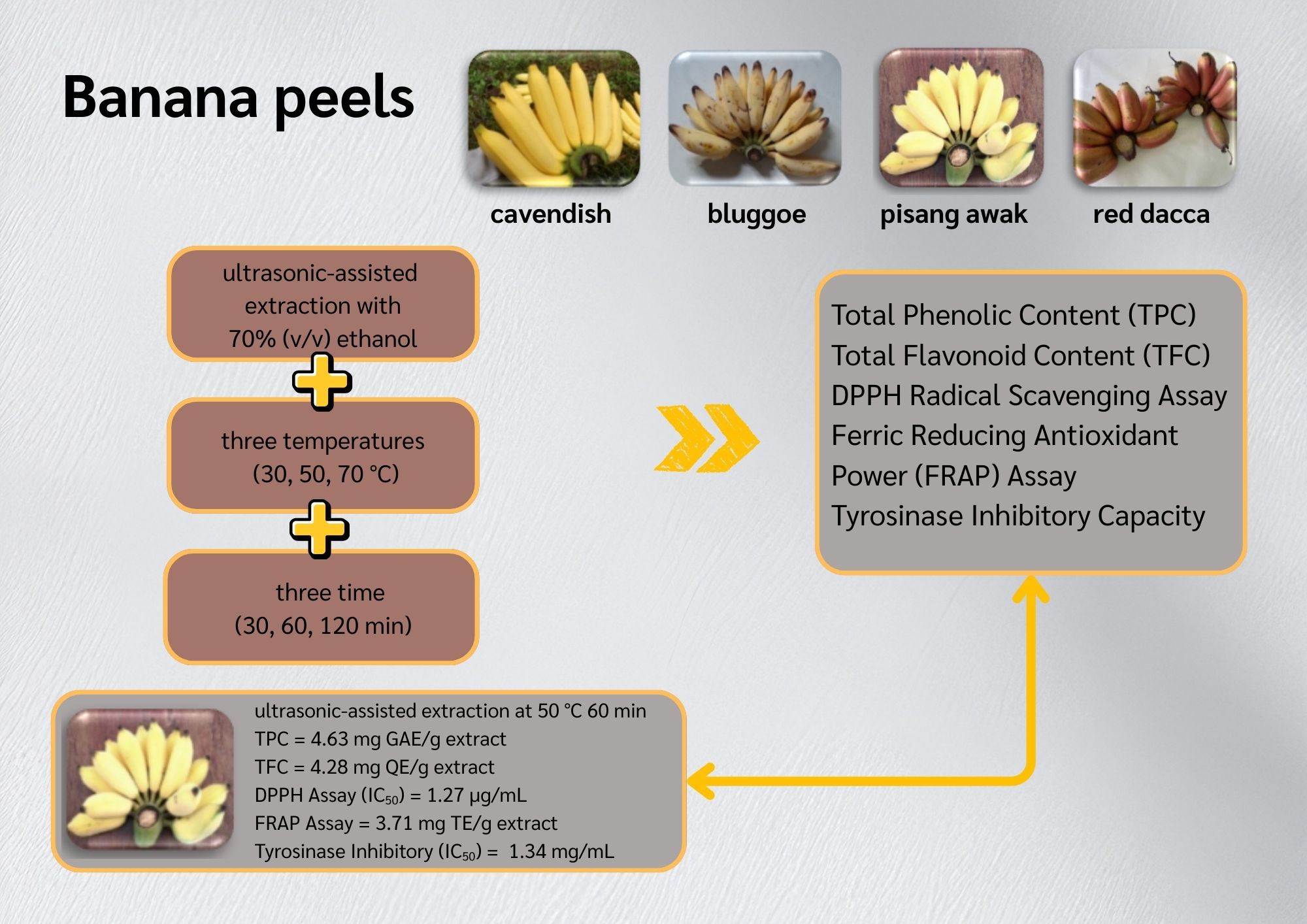
Banana peel (Musa spp.), an abundant agricultural by-product, represents a valuable source of bioactive compounds with potential applications in functional food and cosmeceutical industries. This study investigated the influence of ultrasound-assisted extraction (UAE) on total phenolic content (TPC), total flavonoid content (TFC), antioxidant activity, and tyrosinase inhibitory capacity of peel extracts from four economically important cultivars: Cavendish, Bluggoe, Pisang Awak, and Red Dacca. Extraction was conducted using 70% (v/v) aqueous ethanol under ultrasonic conditions at three temperatures (30, 50, and 70 °C) and three time intervals (30, 60, and 120 min). The results demonstrated that Pisang Awak peel extract exhibited the highest TPC (4.63 mg GAE/g extract) and TFC (4.28 mg QE/g extract). Antioxidant capacity evaluated by 2,2-diphenyl-1-picrylhydrazyl (DPPH) and ferric reducing antioxidant power (FRAP) assays revealed superior activity for Pisang Awak extract (IC50 = 1.27 µg/mL; FRAP = 3.71 mg TE/g extract). This cultivar also demonstrated significant tyrosinase inhibitory activity (IC50= 1.34 mg/mL). Optimization studies identified 50 °C and 60 min as optimal extraction parameters, yielding maximum extraction efficiency across all cultivars. These findings establish UAE as an effective technology for recovering bioactive compounds from banana peel waste, particularly the Pisang Awak cultivar, which shows considerable promise for development into nutraceutical and cosmeceutical formulations. This valorization approach promotes sustainable waste management and circular bioeconomy principles in the agricultural sector.
Article Details

This work is licensed under a Creative Commons Attribution-NonCommercial-NoDerivatives 4.0 International License.
References
Mahato, N.; Sinha, M.; Sharma, K.; Koteswararao, R.; Cho, M. H. Modern extraction and purification techniques for obtaining high purity food-grade bioactive compounds and value-added co-products from citrus wastes. Foods 2019, 8(11), 254. https://doi.org/10.3390/foods8110254
Hasan, S. K.; Ferrentino, G.; Scampicchio, M. Nanoemulsion as advanced edible coatings to preserve the quality of fresh-cut fruits and vegetables: A review. Int. J. Food Sci. Technol. 2020, 55(1), 1–10. https://doi.org/10.1111/ijfs.14275
Pereira, A.; Maraschin, M. Banana (Musa spp) from peel to pulp: Ethnopharmacology, source of bioactive compounds and its relevance for human health. J. Ethnopharmacol. 2015, 160, 149–163. https://doi.org/10.1016/j.jep.2014.11.042
Sulaiman, S. F.; Yusoff, N. A. M.; Eldeen, I. M.; Seow, E. M.; Sajak, A. A. B.; Ooi, K. L. Correlation between total phenolic and mineral contents with antioxidant activity of eight Malaysian bananas (Musa sp.). J. Food Compos. Anal. 2011, 24(1), 1–10. https://doi.org/10.1016/j.jfca.2010.04.005
Kamal, M. M.; Ali, M. R.; Rahman, M. M.; Shishir, M. R. I.; Yasmin, S.; Sarker, M. S. H. Effects of processing techniques on drying characteristics, physicochemical properties and functional compounds of green and red chilli (Capsicum annum L.) powder. J. Food Sci. Technol. 2019, 56(7), 3185–3194. https://doi.org/10.1007/s13197-019-03841-2
Zaini, H. M.; Roslan, J.; Saallah, S.; Munsu, E.; Sulaiman, N. S.; Pindi, W. Banana peels as a bioactive ingredient and its potential application in the food industry. J. Funct. Foods 2022, 92, 105054. https://doi.org/10.1016/j.jff.2022.105054
Phirom-on, K.; Apiraksakorn, J. Development of cellulose-based prebiotic fiber from banana peel by enzymatic hydrolysis. Food Biosci. 2021, 41, 101083. https://doi.org/10.1016/j.fbio.2021.101083
Vázquez, M. B.; Comini, L. R.; Martini, R. E.; Montoya, S. N.; Bottini, S.; Cabrera, J. L. Comparisons between conventional, ultrasound-assisted and microwave-assisted methods for extraction of anthraquinones from Heterophyllaea pustulata Hook f. (Rubiaceae). Ultrason. Sonochem. 2014, 21(2), 478–484. https://doi.org/10.1016/j.ultsonch.2013.08.002
Kamal, M. M.; Kumar, J.; Mamun, M. A. H.; Ahmed, M. N. U.; Shishir, M. R. I.; Mondal, S. C. Extraction and characterization of pectin from Citrus sinensis peel. J. Biosyst. Eng. 2021, 46(1), 16–25. https://doi.org/10.1007/s42853-021-00084-z
Matos, G. S.; Pereira, S. G.; Genisheva, Z. A.; Gomes, A. M.; Teixeira, J. A.; Rocha, C. M. Advances in extraction methods to recover added-value compounds from seaweeds: Sustainability and functionality. Foods 2021, 10(3), 516. https://doi.org/10.3390/foods10030516
Khan, M. K.; Abert-Vian, M.; Fabiano-Tixier, A. S.; Dangles, O.; Chemat, F. Ultrasound-assisted extraction of polyphenols (flavanone glycosides) from orange (Citrus sinensis L.) peel. Food Chem. 2010, 119 (2), 851–858. https://doi.org/10.1016/j.foodchem.2009.08.046
Ghafoor, K.; Choi, Y. H.; Jeon, J. Y.; Jo, I. H. Optimization of ultrasound-assisted extraction of phenolics, antioxidants, and anthocyanins from grape seeds. J. Agric. Food Chem. 2009, 57(11), 4988–4994. https://doi.org/10.1021/jf9001439
Vuong, Q. V.; Hirun, S.; Roach, P. D.; Bowyer, M. C.; Phillips, P. A.; Scarlett, C. J. Effect of extraction conditions on total phenolic compounds and antioxidant activities of Carica papaya leaf aqueous extracts. J. Herb. Med. 2013, 3(3), 104–111. https://doi.org/10.1016/j.hermed.2013.04.004
Singleton, V. L.; Rossi, J. A. Colorimetry of total phenolics with phosphomolybdic-phosphotungstic acid reagents. Am. J. Enol. Vitic. 1965, 16(3), 144–158. https://doi.org/10.5344/ajev.1965.16.3.144
González-Montelongo, R.; Lobo, M. G.; Gonzalez, M. The effect of extraction temperature, time and number of steps on the antioxidant capacity of methanolic banana peel extracts. Sep. Purif. Technol. 2010, 71 (3), 347–355. https://doi.org/10.1016/j.seppur.2009.12.024
Chang, C. C.; Yang, M. H.; Wen, H. M.; Chern, J. C. Estimation of total flavonoid content in propolis by two complementary colorimetric methods. J. Food Drug Anal. 2002, 10(3), 178–182. https://doi.org/10.38212/2224-6614.2748
Zhishen, J.; Mengcheng, T.; Jianming, W. The determination of flavonoid contents in mulberry and their scavenging effects on superoxide radicals. Food Chem. 1999, 64(4), 555–559. https://doi.org/10.1016/S0308-8146(98)00102-2
Brand-Williams, W.; Cuvelier, M. E.; Berset, C. L. W. T. Use of a free radical method to evaluate antioxidant activity. LWT–Food Sci. Technol. 1995, 28(1), 25–30. https://doi.org/10.1016/S0023-6438(95)80008-5
Molyneux, P. The use of the stable free radical diphenylpicrylhydrazyl (DPPH) for estimating antioxidant activity. Songklanakarin J. Sci. Technol. 2004, 26(2), 211–219.
Sharma, O. P.; Bhat, T. K. DPPH antioxidant assay revisited. Food Chem. 2009, 113(4), 1202–1205. https://doi.org/10.1016/j.foodchem.2008.08.008
Thaipong, K.; Boonprakob, U.; Crosby, K.; Cisneros-Zevallos, L.; Byrne, D. H. Comparison of ABTS, DPPH, FRAP, and ORAC assays for estimating antioxidant activity from guava fruit extracts. J. Food Compos. Anal. 2006, 19(6–7), 669–675. https://doi.org/10.1016/j.jfca.2006.01.003
Rivadeneira, J. P.; Wu, T.; Ybanez, Q.; Dorado, A. A.; Migo, V. P.; Nayve, F. R. P., Jr.; Castillo-Israel, K. A. T. Microwave-assisted extraction of pectin from “Saba” banana peel waste: Optimization, characterization, and rheology study. Int. J. Food Sci. 2020, 2020, 8879425. https://doi.org/10.1155/2020/8879425
Bello, U.; Amran, N. A.; Samsuri, S.; Ruslan, M. S. H. Kinetics, thermodynamic studies, and parametric effects of supercritical CO₂ extraction of banana peel wastes. Sustain. Chem. Pharm. 2023, 31, 100912. https://doi.org/10.1016/j.scp.2023.100912
Granella, S. J.; Bechlin, T. R.; Christ, D.; Machado, S. R. C.; Triques, C. C.; da Silva, E. A. Pretreated banana peels as a source for the recovery of phenolic compounds: Extraction kinetics, ultrasound optimization, and conventional extraction methods. J. Appl. Res. Med. Aromat. Plants 2023, 34, 100484. https://doi.org/10.1016/j.jarmap.2023.100484
Cegledi, E.; Dobroslavić, E.; Pedisić, S.; et al. Green approaches for the extraction of banana peel phenolics using deep eutectic solvents. Molecules 2024, 29(15), 3672. https://doi.org/10.3390/molecules29153672
Zhang, J.; Wang, Y.; Yang, B.; et al. Profiling of phenolic compounds of fruit peels of different ecotype bananas derived from domestic and imported cultivars with different maturity. Horticulturae 2022, 8(1), 70. https://doi.org/10.3390/horticulturae8010070
Bashmil, Y. M.; Ali, A.; Bk, A.; et al. Screening and characterization of phenolic compounds from Australian grown bananas and their antioxidant capacity. Antioxidants 2021, 10(10), 1521. https://doi.org/10.3390/antiox10101521
Liu, Y.; Liu, X.; Cui, Y.; Yuan, W. Ultrasound for microalgal cell disruption and product extraction: A review. Ultrason. Sonochem. 2022, 87, 106054. https://doi.org/10.1016/j.ultsonch.2022.106054
Zhao, F.; Wang, Z.; Huang, H. Physical cell disruption technologies for intracellular compound extraction from microorganisms. Processes 2024, 12(10), 2059. https://doi.org/10.3390/pr12102059
Vu, H. T.; Scarlett, C. J.; Vuong, Q. V. Maximising recovery of phenolic compounds and antioxidant properties from banana peel using microwave assisted extraction and water. J. Food Sci. Technol. 2019, 56 (3), 1360–1370. https://doi.org/10.1007/s13197-019-03610-2
Islam, M. R.; Kamal, M. M.; Kabir, M. R.; et al. Phenolic compounds and antioxidant activity of banana peel extracts: Testing and optimization of enzyme-assisted conditions. Measurement: Food 2023, 10, 100085. https://doi.org/10.1016/j.meafoo.2023.100085
Ishak, N. A.; Razak, N. A. A.; Dek, M. S. P.; Baharuddin, A. S. Production of high tannin content and antioxidant activity extract from unripe peel of Musa acuminata using ultrasound-assisted extraction (UAE). BioResources 2020, 15(1), 1877–1893.
Darsini, D. T. P.; Maheshu, V.; Vishnupriya, M.; Sasikumar, J. M. In vitro antioxidant activity of banana (Musa spp. ABB cv. Pisang Awak). Indian J. Biochem. Biophys. 2012, 49, 124–129.
Anal, A. K.; Jaisanti, S.; Noomhorm, A. Enhanced yield of phenolic extracts from banana peels (Musa acuminata Colla AAA) and cinnamon barks (Cinnamomum varum) and their antioxidative potentials in fish oil. J. Food Sci. Technol. 2014, 51(10), 2632–2639. https://doi.org/10.1007/s13197-012-0793-x
Chaaban, H.; Ioannou, I.; Chebil, L.; et al. Effect of heat processing on thermal stability and antioxidant activity of six flavonoids. J. Food Process. Preserv. 2017, 41(5), e13203. https://doi.org/10.1111/jfpp.13203
Khamsaw, P.; Sommano, S. R.; Wongkaew, M.; et al. Banana peel (Musa ABB cv. Nam Wa Mali-Ong) as a source of value-adding components and the functional properties of its bioactive ingredients. Plants 2024, 13(5), 593. https://doi.org/10.3390/plants13050593
Arista, N.; Siregar, R. M. Antioxidant activity test of Barangan banana peel extract with DPPH method. Indones. J. Chem. Sci. Technol. 2023, 6(2), 171. https://doi.org/10.24114/ijcst.v6i2.49373
Mahora, M. C.; Kigundu, A.; Waihenya, R. Screening of phytochemicals, antioxidant activity, and safety profile of hydroethanolic peel extract of Musa sapientum. Plant Trends 2024, 2(1), 1–15. https://doi.org/10.5455/pt.2024.01
Wani, K. M.; Dhanya, M. Unlocking the potential of banana peel bioactives: Extraction methods, benefits, and industrial applications. Discover Food 2025, 5(1), 8. https://doi.org/10.1007/s44187-025-00276-y
Hernández-Carranza, P.; Ávila-Sosa, R.; Guerrero-Beltrán, J. A.; et al. Optimization of antioxidant compounds extraction from fruit by-products: Apple pomace, orange and banana peel. J. Food Process. Preserv. 2016, 40(1), 103–115. https://doi.org/10.1111/jfpp.12588
Chaudhry, F.; Ahmad, M. L.; Hayat, Z.; et al. Exploring the anti-diabetic potential of banana peel extracts: Impact of maceration and ultrasonication on bioactive compounds and glycemic control in diabetic rabbits. Ultrason. Sonochem. 2025, 109, 107426. https://doi.org/10.1016/j.ultsonch.2025.107426
Khalangre, A.; Mirza, A.; Sharma, A. K.; et al. Effect of drying temperature on preservation of banana peel and degradation of targeted phytochemicals by LC-Orbitrap-MS. Biomass Convers. Biorefin. 2024, 1–16. https://doi.org/10.1007/s13399-024-06008-z
Fidrianny, I.; Rizkiya, A.; Ruslan, K. Antioxidant activities of various fruit extracts from three Solanum spp. using DPPH and ABTS method and correlation with phenolic, flavonoid, and carotenoid content. J. Chem. Pharm. Res. 2015, 7(5), 666–672.
Linsaenkart, P.; Yooin, W.; Jiranusornkul, S.; et al. Valorization of Hom Thong banana peel as an anti-melanogenic agent through inhibition of pigmentary genes and molecular docking. Int. J. Mol. Sci. 2024, 25(23), 13202. https://doi.org/10.3390/ijms252313202
Phacharapiyangkul, N.; Thirapanmethee, K.; Sa-Ngiamsuntorn, K.; et al. Effect of sucrier banana peel extracts on inhibition of melanogenesis through the ERK signaling pathway. Int. J. Med. Sci. 2019, 16(4), 602. https://doi.org/10.7150/ijms.32137
Toh, P. Y.; Leong, F. S.; Chang, S. K.; Khoo, H. E.; Yim, H. S. Optimization of extraction parameters on the antioxidant properties of banana waste. Acta Sci. Pol. Technol. Aliment. 2016, 15(1), 65–78. https://doi.org/10.17306/J.AFS.2016.1.7
Zolghadri, S.; Bahrami, A.; Hassan Khan, M. T.; et al. A comprehensive review on tyrosinase inhibitors. J. Enzyme Inhib. Med. Chem. 2019, 34(1), 279–309. https://doi.org/10.1080/14756366.2018.1545767
