
Solving Transshipment Problem in Glove Manufacturing Under the FSC Standard
Article Sidebar
Main Article Content
Abstract
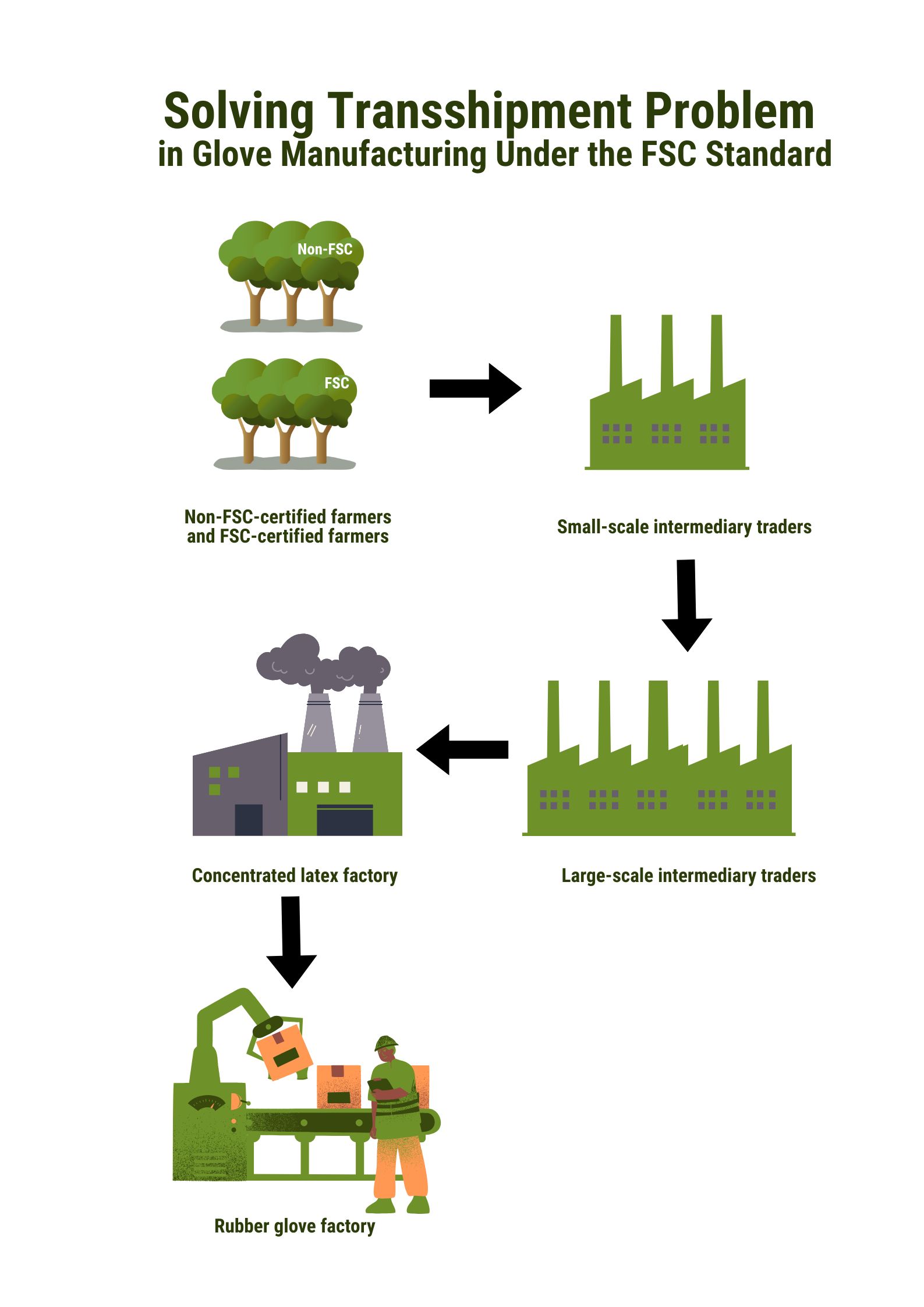
This study proposes a mathematical transshipment model to optimize transportation in glove manufacturing by Forest Stewardship Council (FSC) standards. The objective is to minimize total transportation costs across a multi-tiered network comprising rubber farmers, small-scale intermediary traders, large-scale intermediary traders, a concentrated latex factory, and a rubber glove factory. Unlike conventional transshipment models, this approach explicitly distinguishes parallel product flows from FSC-certified and non-FSC-certified sources, reflecting segregation requirements mandated by FSC standards. This dual-flow structure introduces unique routing constraints and decision variables that are rarely addressed in the existing literature. The model incorporates real-world constraints related to supply availability, demand fulfillment, and transportation capacity, based on empirical data from a representative case study. The optimization problem was solved using LINGO software. The case study involved 250 farmers (125 non-FSC-certified and 125 FSC-certified), 125 small-scale intermediary traders, 6 large-scale intermediary traders, a concentrated latex factory, and a rubber glove factory producing approximately 50% FSC-certified and 50% non-FSC-certified gloves. This separation is critical for ensuring FSC compliance and achieving precise cost optimization. Before implementation, transportation costs totaled 82,228 baht per million gloves produced. Upon applying the model, costs decreased to 75,503.33 baht per million gloves, indicating a reduction of 6,724.67 baht or approximately 8.18%. These results affirm the effectiveness of mathematical modeling in reducing logistics costs within sustainable supply chains and offer a framework adaptable to other industries with similarly structured supply chains.
Downloads
Article Details

This work is licensed under a Creative Commons Attribution-NonCommercial-NoDerivatives 4.0 International License.
References
Kanitasart. Situation of Thai Rubber Glove Production and Export during the COVID-19 Pandemic; Thai Economic Research Institute: Bangkok, 2020; pp 45-58.
Cp Corporation. FSC CERTIFICATED: What It Is and Why It Is Important; https://www.epccorps.com/knowhow/what-is-fsc-certificated-and-why-important/ (accessed November 10, 2022).
Tetrapak. Unpacking Opportunities: What is FSC™; https://www.tetrapak.com/en-th/insights/cases-articles/what-is-fsc (accessed November 15, 2022).
Taha, H. A. Operations Research: An Introduction, 10th ed.; Pearson: Boston, 2017.
Chopra, S.; Meindl, P. Supply Chain Management: Strategy, Planning, and Operation, 7th ed.; Pearson: Boston, 2019.
Glover, F.; Kochenberger, G. A. Handbook of Metaheuristics, 2nd ed.; Springer: New York, 2010.
Dantzig, G. B.; Thapa, M. N. Linear Programming 1: Introduction; Springer: New York, 2003.
Mula, J.; Peidro, D.; Díaz-Madroñero, M.; Vicens, E. Math. Program. Models Supply Chain Prod. Transp. Plan. Eur. J. Oper. Res. 2010, 204, 377-390. https://doi.org/10.1016/j.ejor.2009.09.008
Ahumada, O.; Villalobos, J. R. Application of planning models in the agri-food supply chain: A review. Eur. J. Oper. Res. 2009, 196, 1-20. https://doi.org/10.1016/j.ejor.2008.02.014
Lingo Systems. Lingo Optimization Software: Overview and Applications in Logistics; https://www.lingosystems.com (accessed December 28, 2024).
Santoso, T.; Ahmed, S.; Goetschalckx, M.; Shapiro, A. A stochastic programming approach for supply chain network design under uncertainty. Eur. J. Oper. Res. 2005, 167, 96-115. https://doi.org/10.1016/j.ejor.2004.01.046
Banasik, A.; Kanellopoulos, A.; Bloemhof, J. M.; van der Vorst, J. G. A multi-echelon stochastic programming approach for planning fresh food supply chains. Int. J. Prod. Econ. 2017, 193, 11-21.
Nguyen Dat Minh; Duong Trung Kien; Pham Khac Hau. Applying Milk run Method to Optimize Cost of Transport: An Empirical Evidence. Int. J. Supply Oper. Manage. 2020, 7(2), 178-188. https://doi.org/10.22034/IJSOM.2020.2.6.
Puspita, F. M.; Melati, R.; Simanjuntak, A. S. Br; Yuliza, E.; Octarina, S. Robust Counterpart Open-Capacitated Vehicle Routing Problem with Time Windows and Deadline (RCOCVRPTWD) Model in Optimization of Waste Transportation in Subdistrict Kalidoni, Palembang Using LINGO 13.0. J. Phys. Conf. Ser. 2021, 1940, 012017. https://doi.org/10.1088/1742-6596/1940/1/012017 (accessed Nov 8, 2023).
Nurdiansyah, D. Optimasi Biaya Pengiriman Telur Ayam Menggunakan Pendekatan Model Transportasi NWC dan Software LINGO. J. Lebesgue J. Ilm. Pendidik. Mat., Mat. Stat. 2021. https://doi.org/10.46306/lb.v2i3.77
Yuliza, E.; Puspita, F. M.; Yahdin, S.; Emiliya, R. Solving Capacitated Vehicle Routing Problem Using of Clarke and Wright Algorithm and LINGO in LPG Distribution. J. Phys. Conf. Ser. 2021, 1663, 012055. https://doi.org/10.1088/1742-6596/1663/1/012027
Buakum, D.; Wisittipanich, W. A Mathematical Model for Internal Task Scheduling in Cross Docking. Proc. IEEE Int. Conf. Ind. Eng. Eng. Manag., 2019, 1-8. https://doi.org/10.1109/IEEM44572.2019.8978692.
Van der Vorst, J. G. A.; Tromp, S. O.; Zee, D. J. Simulation modeling for food supply chain redesign. Br. Food J. 2009, 111, 762-775.
