
W UMa-type Light-Curve Analysis V700 Cyg Binary Star
Article Sidebar
Main Article Content
Abstract
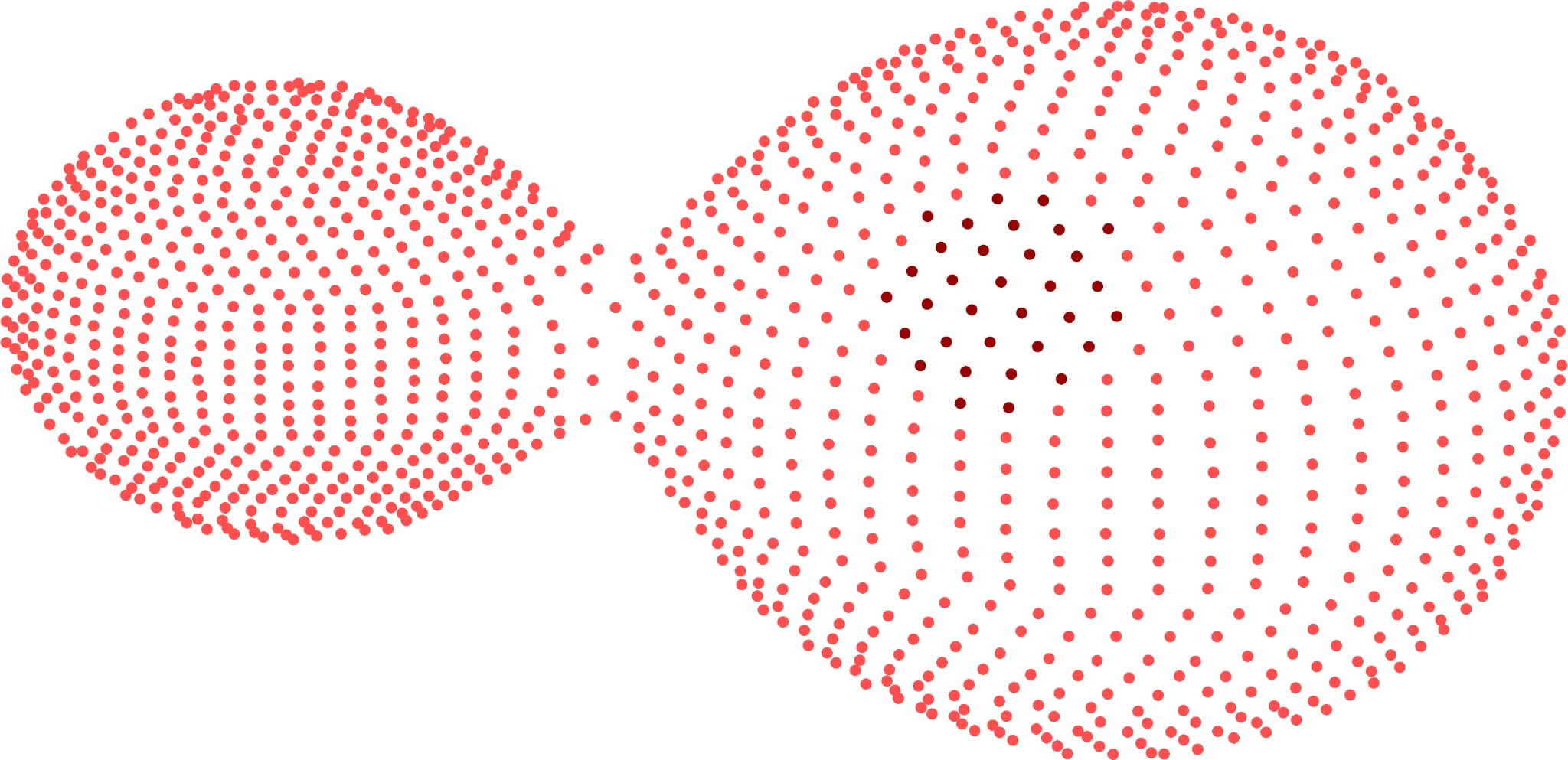
V700 Cyg is a W Ursae Majoris (W UMa)-type contact binary star located in the constellation Cygnus. Photometric observations were conducted using a 0.7-meter reflecting telescope equipped with a CCD photometric system and B and V filters at the Regional Observatory for the Public, Songkhla, operated by the National Astronomical Research Institute of Thailand (Public Organization), during the night of August 6–7, 2021. The observational data were analyzed using the Wilson-Devinney method to generate a synthetic light curve that best represents the physical properties of the system. The results indicate that the effective temperatures of the primary and secondary components are 7692 K and 6078 K, respectively, with a mass ratio (q) of 2.98 and a degree of contact of 3.48%.
Article Details

This work is licensed under a Creative Commons Attribution-NonCommercial-NoDerivatives 4.0 International License.
References
Hilditch, R. W. An Introduction to Close Binary Stars; Cambridge University Press, 2001. https://doi.org/10.1017/CBO9781139163576
Lucy, L. B. The structure of contact binaries. Astrophys. J. 1968, 151, 1123–1131. https://doi.org/10.1086/149510
Rucinski, S. M. W UMa-type binaries. Mon. Not. R. Astron. Soc. 2001, 326, 1279–1284.
Wilson, R. E.; Devinney, E. J. Realization of accurate close-binary light curves: application to MR Cygni. Astrophys. J. 1971, 166, 605–619. https://doi.org/10.1086/150986
Wilson, R. E. Eccentric orbit generalization and simultaneous solution of binary star light and velocity curves. Astrophys. J. 1979, 234, 1054–1066. https://doi.org/10.1086/157588
Prša, A.; Zwitter, T. A computational guide to physics of eclipsing binaries. I. Demonstrations and perspectives. Astrophys. J. 2005, 628, 426–438. https://doi.org/10.1086/430591
Yang, Y. G.; Dai, H. F. A new photometric study for the weak-contact binary V700 Cygni. Publ. Astron. Soc. Jpn. 2009, 61(3), 577–584. https://doi.org/10.1093/pasj/61.3.577
Liao, W. P.; Qian, S. B.; Liu, N. P. A CCD photometric study of the contact binary star GSC 03526-01995. Astron. J. 2012, 144 (6), 178. https://doi.org/10.1088/0004-6256/144/6/178
Maithong, W. Physical Properties of an Eclipsing Binary System V523 Cas. Sci. Technol. Nakhon Sawan Rajabhat Univ. J. 2019, 14 (11), 87–93. (In Thai)
SIMBAD Astronomical Database - CDS (Strasbourg). (Accessed 2021-09-14). http://simbad.u-strasbg.fr/simbad/.
Wilson, R. E. Accuracy and efficiency in the binary star reflection effect. Astrophys. J. 1990, 356, 613–622. https://doi.org/10.1086/168867
Wilson, R. E. The modeling of eclipsing binary stars: outstanding problems and new directions. New Astron. Rev. 2004, 48 (9), 695–701. https://doi.org/10.1016/j.newar.2004.03.015
Wilson, R. E. The effect of spots on light curves of eclipsing binary stars. Astrophys. J. 2008, 672 (1), 575–583. https://doi.org/10.1086/523634
Wilson, R. E. Eclipsing binary solutions with apsidal motion. Astron. J. 2012, 144 (3), 73.
Kim, C. H.; Jeong, J. H. V700 Cygni: a dynamically active W UMa-type binary star II. J. Astron. Space Sci. 2012, 29(2), 151–161. https://doi.org/10.5140/JASS.2012.29.2.151
Ostadnezhad, S.; Forozani, G.; Ghanaatian, M. New BVR photometric observations and light curve analysis of eclipsing binary V700 Cyg. New Astron. 2019, 71, 25–32. https://doi.org/10.1016/j.newast.2019.03.003
Knote, M.; Caballero-Nieves, S.; Gokhale, V.; Johnston, K.; Perlman, E. Characteristics of Kepler Eclipsing Binaries Displaying a Significant O’Connell Effect. Astrophys. J. Suppl. Ser. 2022, 262(1), 1–32. https://doi.org/10.3847/1538-4365/ac770f
Liu, Q.; Yang, Y. A Possible Explanation of the O'Connell Effect in Close Binary Stars. Chin. J. Astron. Astrophys. 2003, 3(2), 142–150. https://doi.org/10.1088/1009-9271/3/2/142
