
Quality-based assessment of natural ripening agents as alternatives to calcium carbide in ‘Latundan’ banana using mixed statistical methods
Article Sidebar
Main Article Content
Abstract
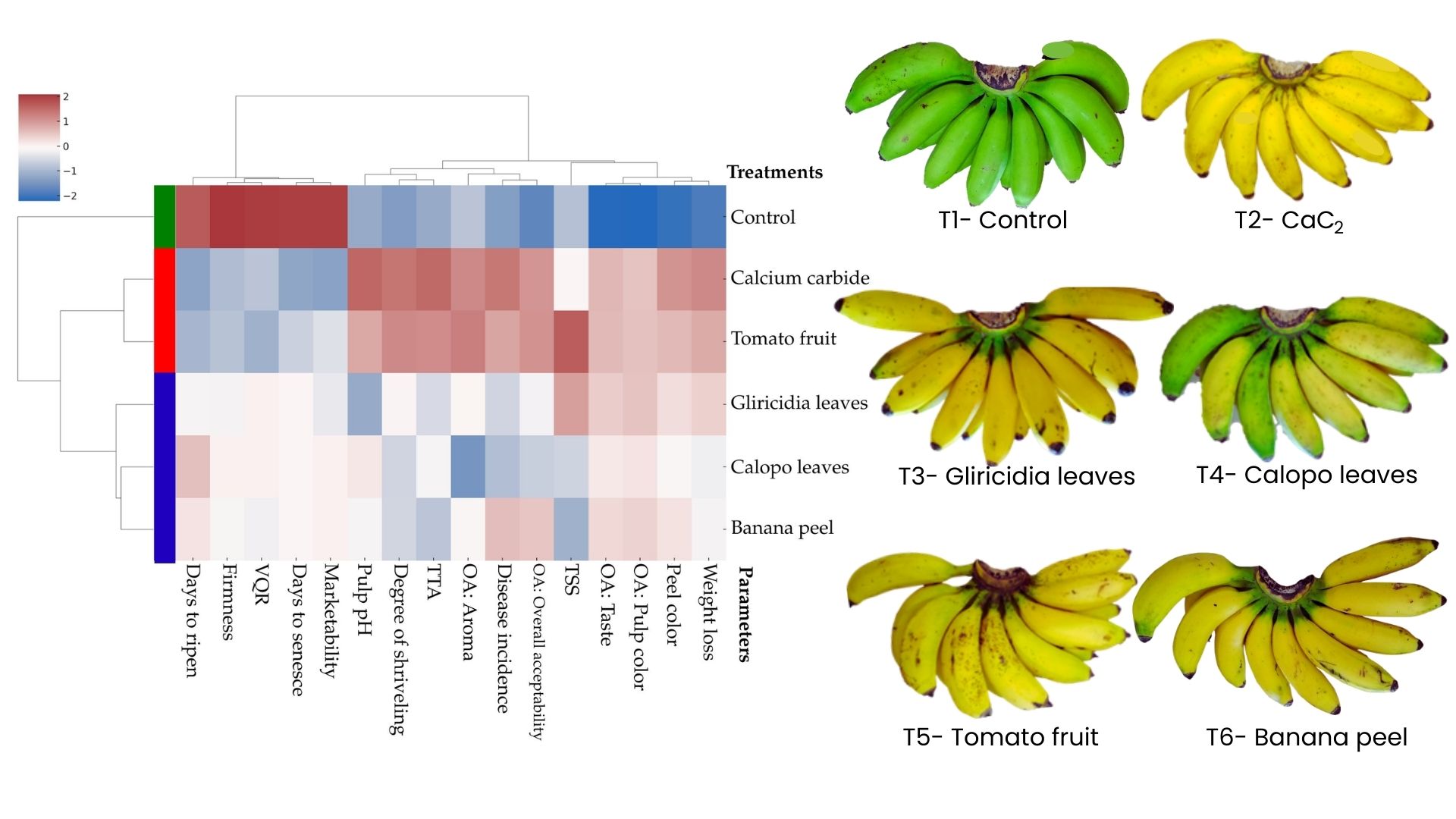
Calcium carbide (CaC2) is widely utilized for its affordability and efficiency in ripening fruits. However, it poses health risks, which makes natural ethylene-rich alternatives a safer choice. This study evaluated the effectiveness of natural ripening agents such as Gliricidia leaves, Calopo leaves, tomato fruit, and banana peel, as alternatives to CaC₂ in enhancing the postharvest quality of ‘Latundan’ banana (Musa × paradisiaca, AAB Group). Treated fruits were assessed for multiple quality parameters, including peel color, sensory firmness, chemical properties, organoleptic attributes, weight loss, shriveling, visual quality rating, disease incidence, and shelf life. A one-way analysis of variance (ANOVA) was performed to determine treatment effects, followed by Tukey’s HSD test (p ≤ 0.05) for mean separation. For non-normally distributed variables, the Kruskal-Wallis test was applied. To further evaluate treatment similarities based on overall trait performance, hierarchical cluster analysis (HCA) was conducted using Ward’s method and Euclidean distance on standardized trait means. Results showed that CaC2 significantly enhanced ripening characteristics, followed closely by tomato fruit. Natural agents, particularly the leaves of Gliricidia and Calopo, and banana peel, provided moderate improvements across several parameters, while the untreated control consistently ranked lowest. Although CaC₂ induced rapid ripening, it resulted in earlier deterioration and a shorter shelf life. Moreover, HCA revealed three distinct clusters: (1) CaC2 and tomato fruit, (2) Gliricidia and Calopo leaves, and banana peel, and (3) control. These findings support the use of natural agents, especially tomato fruit, as viable alternatives for inducing uniform ripening and maintaining acceptable postharvest quality in bananas.
Article Details

This work is licensed under a Creative Commons Attribution-NonCommercial-NoDerivatives 4.0 International License.
References
Voora, V.; Larrea, C.; Bermudez, S. Global Market Report: Bananas; International Institute for Sustainable Development: Winnipeg, Canada, 2020.
Maduwanthi, S. D. T.; Marapana, R. A. U. J. Induced ripening agents and their effect on fruit quality of banana. Int. J. Food Sci. 2019, 2019, 1–10. https://doi.org/10.1155/2019/2520179
Mahajan, B. V. C.; Kaur, T.; Gill, M. I. S.; Dhaliwal, H. S.; Ghuman, B. S.; Chahil, B. S. Studies on optimization of ripening techniques for banana. J. Food Sci. Technol. 2010, 47, 315–319. https://doi.org/10.1007/s13197-010-0050-0
Okeke, E. S.; Okagu, I. U.; Okoye, C. O.; Ezeorba, T. P. C. The use of calcium carbide in food and fruit ripening: Potential mechanisms of toxicity to humans and future prospects. Toxicology 2022, 468, 153112. https://doi.org/10.1016/j.tox.2022.153112
Essien, E. B.; Onyegeme-Okerenta, B. M.; Onyema, J. O. Calcium carbide as an artificial fruit-ripening agent and its physiological effects on Wistar rats. Clin. Exp. Med. Sci. 2018, 6(1), 47–61. https://doi.org/10.12988/cems.2018.865
Danish, M.; Fatima, A.; Khanam, S.; Jyoti, S.; Ali, F.; Naz, F.; et al. Evaluation of the toxic potential of calcium carbide in the third instar larvae of transgenic Drosophila melanogaster (hsp70-lacZ) Bg9. Chemosphere 2015, 139, 469–478. https://doi.org/10.1016/j.chemosphere.2015.07.077
Basak, P.; Akter, B. Comprehensive investigation on banana ripening by using natural agents and chemicals. Ann. Food Sci. Technol. 2018, 19(2), 307–315.
Acedo, A. L. Ripening Requirements and Changes of ‘Saba’ Bananas (Musa, BBB Group) Treated with Ethylene from Gliricidia Leaves (Gliricidia sepium Steud.) [Ph.D. Thesis], University of the Philippines Los Baños, 1989. Available online: http://www.uplb.edu.ph.
Lacap, A. T.; Bayogan, E. R. V.; Lubaton, C. D. S.; Joyce, D. C. Responses of ‘Carabao’ mango to various ripening agents. Philipp. J. Sci. 2019, 148(3).
Ajayi, A. R.; Mbah, G. O. Identification of indigenous ripening technologies of banana and plantain fruits among women-marketers in southeastern Nigeria. Agro-Sci. 2007, 6(2), 60–66. https://doi.org/10.4314/as.v6i2.1572
Ademe, B. E.; Tanga, A. A. Retrospective analysis of moringa leaf as a substitute to ethylene gas in hastening ripening of banana fruit. Am. J. Food Technol. 2017, 12(3), 186–192. https://doi.org/10.3923/ajft.2017.186.192
Bautista, O. K.; Tirtosoekotjo, M. S.; Soliven, M. L. S.; Nasrullah, S. T. Enhancing accumulation of ethylene from various leaves for tomato ripening. ASEAN Food J. 1990, 5 (4), 142–151.
Dapar, M. L. G.; Alejandro, G. J. D.; Meve, U.; Liede-Schumann, S. Ethnomedicinal importance and conservation status of medicinal trees among indigenous communities in Esperanza, Agusan del Sur, Philippines. J. Complement. Med. Res. 2020, 11(1), 59–71. https://doi.org/10.5455/jcmr.2020.11.01.08
Gandhi, S.; Sharma, M.; Bhatnagar, B. Comparative study on the ripening ability of artificial ripening agent (calcium carbide) and natural ripening agents. Glob. J. Biol. Agric. Health Sci. 2016, 5, 106–110.
Roy, M.; Langthasa, S.; Hazarika, D. N. Indigenous ripening methods for banana cv. Amritsagar. J. Pharmacogn. Phytochem. 2021, 10(3), 432–436.
Cua, A. U.; Uy, W. T.; Wijanco, J. E.; dela Paz, A. C.; Lizada, M. C. C. Physico-chemical and physiological characteristics of ‘Saba’ bananas at different color stages. Postharvest Res. Notes 1984, 1(3), 81–83.
Santoso, V. R.; Pramitasari, R.; Anugrah, D. S. B. Development of indicator film based on cassava starch–chitosan incorporated with red dragon fruit peel anthocyanins–Gambier catechins to detect banana ripeness. Polymers 2023, 15(17), 3609. https://doi.org/10.3390/polym15173609
Bejaei, M.; Cliff, M. A.; Singh, A. Multiple correspondence and hierarchical cluster analyses for the profiling of fresh apple customers using data from two marketplaces. Foods 2020, 9(7), 873. https://doi.org/10.3390/foods9070873
Zheng, P.; Zhang, M.; Wang, Z.; Wang, T.; Tang, L.; Ma, E.; et al. Comprehensive evaluation of the fruit quality of the main cultivars of pear (Pyrus spp.) in North China. Erwerbs-Obstbau 2022, 64(2), 219–227. https://doi.org/10.1007/s10341-021-00609-y
Manigo, B. I.; Limbaga, C. Effect of 1-methylcyclopropene (1-MCP) postharvest application on quality of ‘Lakatan’ banana fruit. Int. J. Agric. Innov. Res. 2019, 8(1), 1–10.
Thompson, A. K.; Supapvanich, S.; Sirison, J. Banana Ripening: Science and Technology; Springer Nature: Cham, Switzerland, 2019. https://doi.org/10.1007/978-3-030-27739-0
Mishra, B. B.; Gautam, S.; Chander, R.; Sharma, A. Characterization of nutritional, organoleptic and functional properties of intermediate moisture shelf-stable ready-to-eat Carica papaya cubes. Food Biosci. 2015, 10, 69–79. https://doi.org/10.1016/j.fbio.2015.02.001
Gunathilake, D. M. C. C.; Tiwari, A. K.; Kahandawala, K. T. Efficacy of washing treatment for extending the post-harvest shelf-life of papaya (Carica papaya). Int. J. Chem. Stud. 2018, 6, 2173–2177. https://doi.org/10.22271/chemi.2018.v6.i4ai.05
Basan, R. J. P.; Piadozo, M. E. S.; Pabuayon, I. M. Analysis of consumer demand for table banana characteristics in production and consumption-based areas in the Philippines.
Tucker, G.; Yin, X.; Zhang, A.; Wang, M.; Zhu, Q.; Liu, X.; et al. Ethylene and fruit softening. Food Qual. Saf. 2017, 1(4), 253–267. https://doi.org/10.1093/fqsafe/fyx024
Chandar, M. M.; Smith, A. A. Artificial ripening of banana - An overview. Res. J. Pharm. Technol. 2019, 12(10), 5101–5106. https://doi.org/10.5958/0974-360X.2019.00884.9
