
Agri-Fishery Practices through Product Resource Management, Value Addition and Commercialization Enhancement Project of Villages in Daram, Samar
Article Sidebar
Main Article Content
Abstract
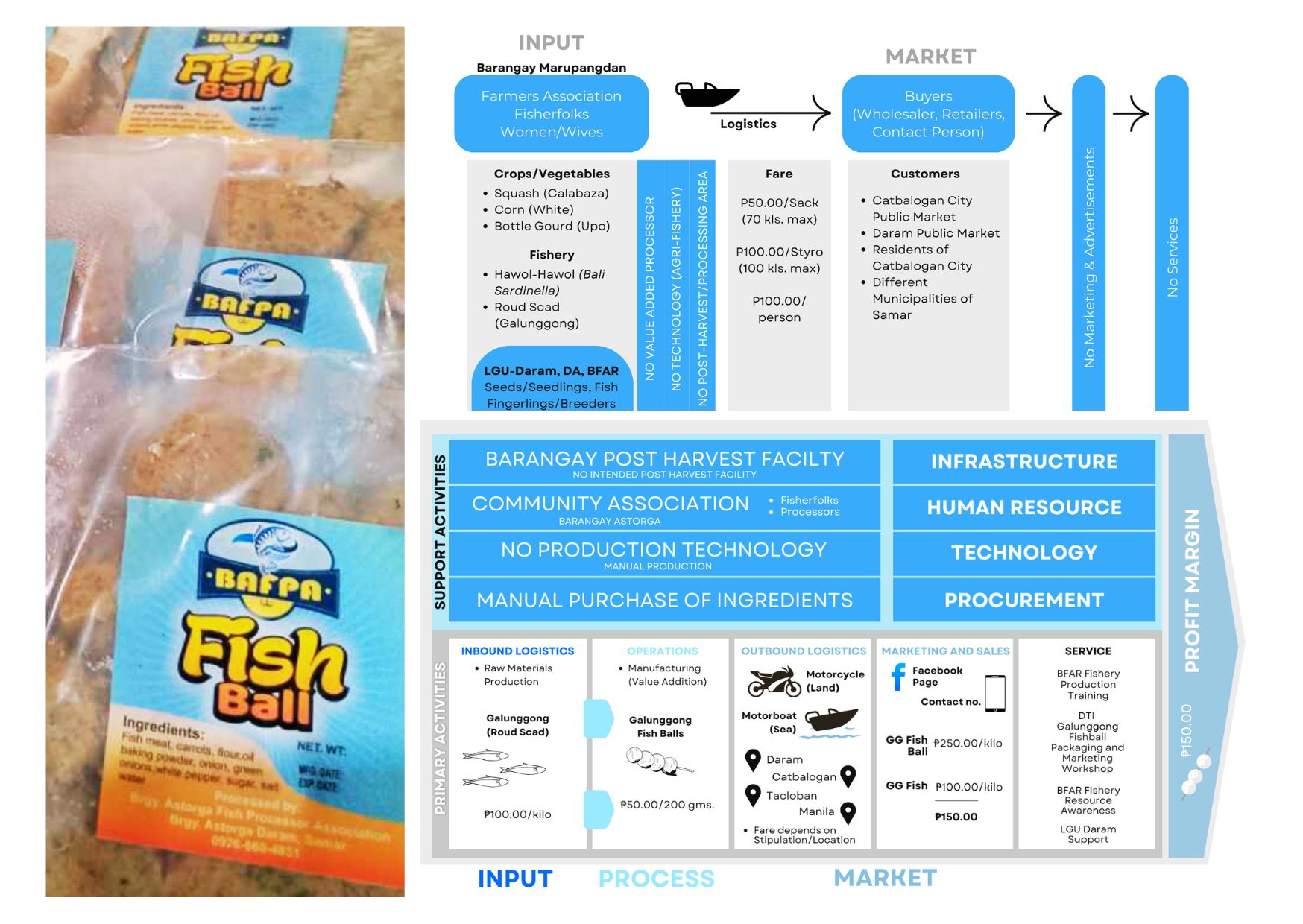
The study revealed the prevailing conditions of agri-fishery practices and value-added production in Barangays Marupangdan and Astorga in Daram, Samar. Findings indicated that Barangay Marupangdan remained dependent on traditional crop and fish harvests with minimal post-harvest technology, no value-added processing, and limited market access, resulting in low profit margins. Overproduction of hawol-hawol (Bali Sardinella) and vegetables led to waste due to the absence of storage, processing, and market linkages. In contrast, Barangay Astorga demonstrated active value addition through products galunggong-based fish balls, significantly increasing income per unit sold. Porter’s Value Chain analysis showed that Astorga's community benefited from interventions by DTI and LGU Daram in providing equipment, packaging materials, and access to trade fairs. However, both barangays still lacked essential post-harvest facilities, ICT integration, and formal marketing strategies. Women in both communities actively participated in agri-fishery production, but their associations in Marupangdan remained unregistered, limiting support opportunities. Farmers and fisherfolk expressed willingness to adopt technology and undergo training, showing potential for scaling up productivity. The study highlighted the importance of institutional aid and local government support in capacitating communities to develop sustainable agri-fishery value chains. With targeted interventions, Marupangdan could replicate Astorga’s best practices to enhance food security, income, and community resilience.
Article Details

This work is licensed under a Creative Commons Attribution-NonCommercial-NoDerivatives 4.0 International License.
References
News Bharati. Asia Has 60% of World’s Hungry Population. News Bharati, July 16, 2019. https://www.newsbharati.com/Encyc/2019/7/16/Asia-has-60-of-hungry-people-.html.
World Economic Forum. This Map Shows How Much Each Country Spends on Food. World Econ. Forum, December 21, 2016. https://www.weforum.org/stories/2016/12/this-map-shows-how-much-each-country-spends-on-food.
Asian Development Bank. Food Security in Asia and the Pacific; Asian Development Bank: Manila, Philippines, 2013. https://www.adb.org/publications/food-security-asia-and-pacific.
Cooperative Development Authority. Performance of Cooperatives by Type as of December 2015–2016; Cooperative Development Authority: Quezon City, Philippines, 2016; based on reporting data of 9,432 cooperatives. https://cda.gov.ph/resources/updates/statistics.
Khan, N.; Fahad, S.; Naushad, M.; Faisal, S. Analysis of Livelihood in the World and Its Impact on World Economy. SSRN 2020. https://doi.org/10.2139/ssrn.3717265
Israr, M.; Khan, H. An Analysis of Livelihood Sources in Hilly Areas of Northern Pakistan. Sarhad J. Agric. 2010, 26(4), 665–672.
Babu, S. C.; Davis, K. Private Technical Assistance Approaches in Brazil. In Knowledge Driven Development; 2015. https://doi.org/10.1016/B978-0-12-802231-3.00006-1
Kuldeep; et al. Livelihood Enhancement through Value Addition and Marketing of Turmeric in Dang District of Gujarat. Int. J. Commer. Bus. Manag. 2013, 6(2).
PhilAtlas. Barangay Marupangdan and Astorga, Daram, Samar. PhilAtlas 2020. https://www.philatlas.com.
Philippine Statistics Authority. Poverty Statistics; Philippine Statistics Authority: Manila, Philippines, 2021.
Kaplinsky, R.; Morris, M. A Handbook for Value Chain Research; Institute of Development Studies: Brighton, UK, 2001.
Hasan, K.; Sambo, M.; Muchlis, R. A.; Yahya, M. Optimization of Marketing Communications of Fisheries, Marine and Food Agriculture of Lhokseumawe City. Proc. Int. Conf. Soc. Sci. Polit. Humanit. (ICoSPOLHUM 2020) 2021. https://doi.org/10.2991/ASSEHR.K.210125.008
Dieffenbacher, S.; Dieffenbacher, S. Michael Porter Value Chain Analysis Model: Examples & Applying Steps. Digital Leadership, April 30, 2024. https://digitalleadership.com/unite-articles/porters-value-chain/.
Tejaswini, C.; Rao, T. S.; Reddy, M. K. Value Addition in Horticulture: A Sustainable Approach for Farmer Income Enhancement. Int. J. Agric. Sci. 2021, 13(3), 8991–8994.
Ayoo, C.; Bonti-Ankomah, S.; Aryee, A. N. Constraints to Value Addition to Agricultural Byproducts. In Byproducts from Agriculture and Fisheries; Wiley: Hoboken, NJ, 2019. https://doi.org/10.1002/9781119383956.ch32
Secretaria, M. B. Resistance to Technological Adoption in Philippine Agri-Fisheries: Barriers and Solutions. Philipp. J. Rural Dev. 2019, 41(1), 85–98.
Gartanti, W. T.; Triwardhani, I. J.; Putra, R. P. The Development of Village Entrepreneurship through Digital Marketing Communication. Adv. Soc. Sci. Humanit. Res. 2020. https://doi.org/10.2991/assehr.k.200225.029
Luthfiana, N.; Widodo, H.; Susanti, R. Digital Marketing Strategies for Empowering Farmers in Southeast Asia. J. Agric. Econ. Dev. 2024, 15(1), 23–35.
Mustacisa-Lacaba, M.; Villanueva, R.; Tadios, L.K.; Tan, N. Increasing Sweet Potato (Ipomoea batatas) Root Crop Yield Based Scientific Participatory Research. ASEAN J. Sci. Technol. Rep. 2023, 26(3), 24–35. https://doi.org/10.55164/ajstr.v26i3.249375
