
Early Root Development and Yield Performance of Different Corn (Zea mays L.) Varieties Under Alkaline Soil
Article Sidebar
Main Article Content
Abstract
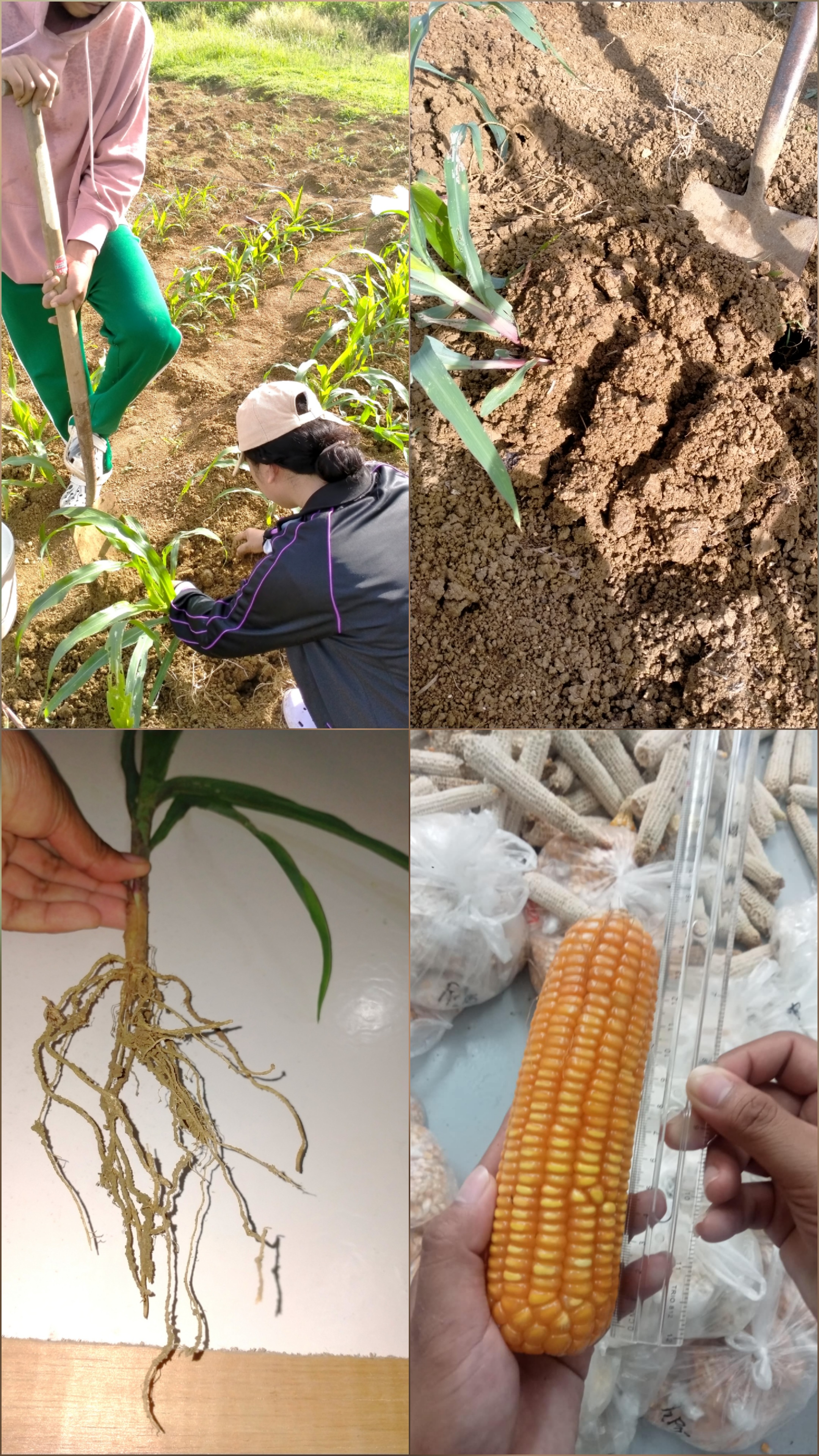
Early root vegetative stages of corn are critical in transitioning to the independent phase, wherein roots support development and improved nutrient uptake that may influence yield. Thus, the study assessed the root development of different corn varieties at the vegetative 4 (V4) stage and its relationship to yield, and to evaluate its performance under alkaline soil using a Randomized Complete Block Design. Data on root morphological traits were measured at the V4 stage, while yield parameters were assessed after harvest. Data were analyzed using ANOVA in RCBD, and the relationship between early root growth and yield was assessed using Pearson's correlation. The results showed that varieties TCT 476A and TCT 1868 significantly outperformed, producing higher yields across parameters, with computed yields of 9.23 t/ha and 9.27 t/ha, respectively, while CGUARD VII-002 exhibited reduced performance, having significantly lower yield. Results demonstrated that differences in yield performance among varieties can be attributed to genotype-environment interactions. Moreover, root morphological traits at the V4 stage showed no significant differences, indicating that all varieties exhibit comparable root morphological characteristics at this stage. However, root morphological traits at the V4 stage revealed no significant linear relationship with yield and yield components, suggesting that the early vegetative stage is not a reliable predictor of yield. The findings highlight that the V4 stage primarily supports establishment rather than yield formation, and fertilizer application strategies must align with efficient nutrient demand to optimize yield. Further research on later stages of root development is suggested to corroborate the preliminary findings.
Article Details

This work is licensed under a Creative Commons Attribution-NonCommercial-NoDerivatives 4.0 International License.
References
Erenstein, O.; Jaleta, M.; Sonder, K.; Mottaleb, K.; Prasanna, B. M. Global maize production, consumption and trade: Trends and R&D implications. Food Secur. 2022, 14(5), 1295–1319. https://doi.org/10.1007/s12571-022-01288-7
U.S. Department of Agriculture, Foreign Agricultural Service. Corn: Production Data; USDA: Washington, DC, 2024. https://www.fas.usda.gov/data/production/commodity/0440000
Biñas, E. E., Jr. The use of organic and inorganic fertilizers and its effect on the quality of corn products in the Philippines: A review. Galaxy Int. Interdiscip. Res. J. 2021, 9(5), 83–100. https://doi.org/10.17605/osf.io/puc7a
Amper, B. M., Jr.; Amper, Z. H. S. Precarity among corn farmers in the uplands of Cebu, the Philippines. Aghamtao 2021, 29, 42–57.
Amanullah; Fahad, S. Corn – Production and Human Health in Changing Climate; IntechOpen, 2018. https://doi.org/10.5772/intechopen.74074
Gaikwad, D. J.; Ubale, N. B.; Pal, A.; Singh, S.; Ali, M. A.; Maitra, S. Abiotic stresses impact on major cereals and adaptation options—A review. Res. Crops 2022, 23(4), 913–920. https://doi.org/10.31830/2348-7542.2022.roc-913
Fu, J.; Xiao, Y.; Wang, Y.-F.; Liu, Z.-H.; Yang, K. Saline–alkaline stress in growing maize seedlings is alleviated by Trichoderma asperellum through regulation of the soil environment. Sci. Rep. 2021, 11(1), 11546. https://doi.org/10.1038/s41598-021-90675-9
Enojada, G. R.; Asio, V. B. Morphological, physical, and chemical characteristics of soils derived from limestone rocks in Barili, Cebu. ResearchGate 2015. https://www.researchgate.net/publication/327366666
Lynch, J.; Marschner, P.; Rengel, Z. Effect of internal and external factors on root growth and development. In Marschner’s Mineral Nutrition of Higher Plants; Marschner, P., Ed.; Elsevier Ltd.: London, 2012; pp 331–346. https://doi.org/10.1016/B978-0-12-384905-2.00013-3
De Araujo Rufino, C.; Fernandes-Vieira, J.; Martín-Gil, J.; De Souza Abreu Júnior, J.; Tavares, L. C.; Fernandes-Correa, M.; Martín-Ramos, P. Water stress influence on the vegetative period yield components of different maize genotypes. Agronomy 2018, 8(8), 151. https://doi.org/10.3390/agronomy8080151
Nleya, T.; Chungu, C.; Kleinjan, J. Chapter 5: Corn growth and development. In iGrow Corn: Best Management Practices; South Dakota State University, 2016. Chapter 5.
Penn State Extension. Corn Growth Stages; Penn State College of Agricultural Sciences, n.d. https://extension.psu.edu/corn-growth-stages (accessed October 8, 2025).
Fageria, N. K. The Role of Plant Roots in Crop Production; CRC Press: Boca Raton, FL, 2012. https://doi.org/10.1201/b12365
Rodríguez, M. N. S.; Cassab, G. I. Primary root and mesocotyl elongation in maize seedlings: Two organs with antagonistic growth below the soil surface. Plants 2021, 10(7), 1274. https://doi.org/10.3390/plants10071274
Niu, L.; Hao, R.; Wu, X.; Wang, W. Maize mesocotyl: Role in response to stress and deep‐sowing tolerance. Plant Breeding 2020, 139 (3), 466–473. https://doi.org/10.1111/pbr.12804
Poffenbarger, H. J.; Barker, D. W.; Helmers, M. J.; Miguez, F. E.; Olk, D. C.; Sawyer, J. E.; Six, J.; Castellano, M. J. Genotypic variation on root growth and nutrient uptake in corn and soybean. Agric. Environ. Lett. 2019, 4(1), 180018.
Gu, S.; dos Santos Diniz, M. H.; Mukhametov, A.; Kondrashev, S. Comparative study on the response of corn hybrids to different irrigation techniques and moisture levels. Arch. Agron. Soil Sci. 2025, 71(1), 1–15.
Elmundo, E. M.; Alcantara, C. G.; Bautista, E. R. Yield performance of ten white corn hybrids under Claveria condition. Mindanao J. Sci. Technol. 2011, 9(1), 45–58.
Puyod, S.E.G.; Pascual, P.R. Varietal performance of hybrid corn fertilized with ammonium fertilizers in an alkaline soil under drought conditions. ASEAN J. Sci. Tech. Report. 2025, 28(4), e257403. https://doi.org/10.55164/ajstr.v28i4.257403
Vilas-Boas, J. K.; Steiner, F.; Zuffo, A. M.; González Aguilera, J.; Zaratin Alves, C. Tolerance of high-yielding corn hybrids to drought stress during the early growth stage. Rev. Ciênc. Agron. 2025, 56, e20250040. https://doi.org/10.5935/1806-6690.20250040
Tripathi, S.; Tiwari, K.; Mahra, S.; Victoria, J.; Rana, S.; Tripathi, D. K.; Sharma, S. Nanoparticles and root traits: Mineral nutrition, stress tolerance, and interaction with rhizosphere microbiota. Planta 2024, 260(2), 409.
Rasheed, A.; Li, H.; Tahir, M. M.; Mahmood, A.; Nawaz, M.; Shah, A. N.; Aslam, M. T.; Negm, S.; Moustafa, M.; Hassan, M. U.; Wu, Z. The role of nanoparticles in plant biochemical, physiological, and molecular responses under drought stress: A review. Front. Plant Sci. 2022, 13, 976179.
Zhan, A.; Lynch, J. P. Reduced frequency of lateral root branching improves water and nitrate capture in maize (Zea mays L.) under low nitrogen stress. Plant Physiol. 2015, 168(1), 117–129.
Gao, Y.; Lynch, J. P. Reduced crown root number improves water acquisition under water deficit stress in maize (Zea mays L.). J. Exp. Bot. 2016, 67(15), 4545–4557. https://doi.org/10.1093/jxb/erw243
Hund, A.; Trachsel, S.; Stamp, P. Rooting depth and water use efficiency of tropical maize inbred lines differing in drought tolerance. Plant Soil 2009, 318, 311–325. https://doi.org/10.1007/s11104-008-9843-6
Magsayo, N. J.; Jamio, E.; Canunayon, M.; Tangpos, D.; Caritan, J.; Pascual, P. R. Root length and diameter at flag leaf stage correlate with important yield parameters in corn (Zea mays L.) grown in alkaline soil under drought conditions. ASEAN J. Sci. Technol. Rep. 2025, 28(5), e259419. https://doi.org/10.55164/ajstr.v28i5.259643
