
Sustainable Organic Vegetable Production in Low-Cost Greenhouses and Post-Harvest Safety: A Community-Based Approach in Phatthalung Province, Thailand
Article Sidebar
Main Article Content
Abstract
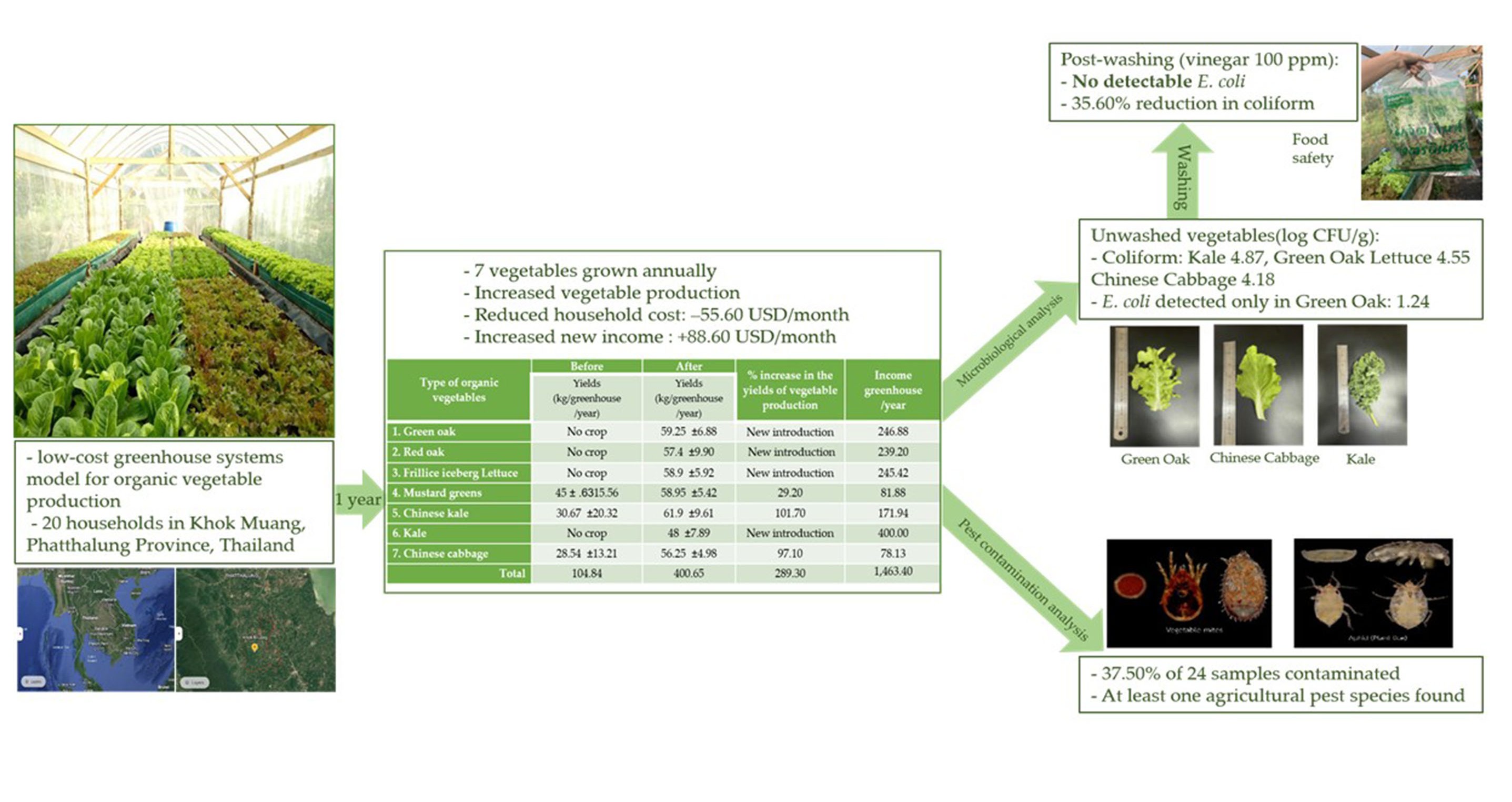
This participatory action research assessed a community model for organic vegetable production using low-cost greenhouse systems among 20 households in Khok Muang sub-district, Phatthalung Province, Thailand. The study evaluated organic vegetable production efficiency and microbial safety involved three parts of research: 1) evaluating organicvegetable production in low-cost greenhouses, 2) detecting fecal coliform and Escherichia coli (E. coli) contamination in fresh vegetable produce and 3) Analysis of contamination of parasite in fresh vegetables; results demonstrated successful knowledge transfer, with participating households reducing monthly vegetable expenses by 55.6 USD while generating a monthly income of 88.6 USD through the cultivation of seven vegetable types annually. Microbiological analysis revealed Coliform contamination in unwashed vegetables at 4.87, 4.55, and 4.18 log CFU/g for Kale (Brassica oleracea L.), Green Oak Lettuce (Lactuca sativa L.), and Chinese cabbage (Brassica sativa var. crispa L.), respectively, with E. coli detected only in Green Oak Lettuce (1.24 log CFU/g). Post-washing, Coliform levels decreased to 3.71, 3.58, and 3.06 log CFU/g, respectively, with no detectable E. coli. Vinegar (100 ppm) treatment significantly reduced Coliform levels by 35.60%. Parasite analysis of three vegetable types across 7 greenhouses found 37.5% of 24 samples contaminated with at least one parasite species, with Green Oak Lettuce showing highest contamination rates. The community model successfully improved household food security and income while highlighting the importance of proper post-harvest handling practices to meet Thai public health standards for commercialising fresh produce.
Article Details

This work is licensed under a Creative Commons Attribution-NonCommercial-NoDerivatives 4.0 International License.
References
Ministry of Agriculture and Cooperatives. 5-Year Strategic Action Plan for Agriculture and Cooperatives in Phatthalung Province (2023–2027); accessed Aug 15, 2024. https://www.opsmoac.go.th/phatthalung-strategic-files-461191791796.
Economic Research Division of Rubber Authority of Thailand. Rubber Production by Office of Agricultural Economics; 2024; accessed Nov 20, 2024. https://www.thainr.com/uploadfile/20230915155043.pdf.
Johnson, M. B.; Yovo, E. R. D.; Saito, K. Farmers’ Perception and Management of Water Scarcity in Irrigated Rice-Based Systems in Dry Climatic Zones of West Africa. Agron. Sustain. Dev. 2023, 43. https://doi.org/10.1007/s13593-023-00878-9
Muhie, S. H. Novel Approaches and Practices to Sustainable Agriculture. J. Agric. Food Res. 2022, 10, 100446. https://doi.org/10.1016/j.jafr.2022.100446
TNAU Agritech Portal – Horticulture. Greenhouse Cultivation; 2013; accessed Aug 15, 2024. https://agritech.tnau.ac.in/horticulture/horti_Greenhouse%20cultivation.html.
Dalai, S.; Mohanta, S.; Barsha, T.; Sahu, B. Green-houses: Types and Structure Components. In Protected Cultivation and Smart Agriculture; New Delhi Publishers: New Delhi, 2020; pp 9–17. https://doi.org/10.30954/NDP-PCSA.2020.2
Best, J. W. Research in Education, 4th ed.; Prentice Hall: New Jersey, 1981.
Bhati, P.; Saikia, A. R.; Chaudhary, S.; Bahadur, R.; Nengparmoi, T.; Talukdar, N.; Hazarika, S. Integrated Farming Systems for Environment Sustainability: A Comprehensive Review. J. Sci. Res. Rep. 2024, 30, 143–155. https://doi.org/10.9734/jsrr/2024/v30i11834
Aguiari, I. Processual Approach to Community Agriculture: Between Structuralist and Individualist Explanations. Sociology Lens 2024, 37, 447–467. https://doi.org/10.1111/johs.12463
Bseiso, A.; Abels, B.; Ferguson, S.; Lusch, P.; Mehta, K. A Decision Support Tool for Greenhouse Farmers in Low-Resource Settings. Global Humanitarian Technology 2015, 1–7. https://doi.org/10.1109/GHTC.2015.7343987
Bukchin, S.; Kerret, D. Character Strengths and Sustainable Technology Adoption by Smallholder Farmers. Heliyon 2020, 6, e04694. https://doi.org/10.1016/j.heliyon.2020.e04694.
Wiseansart, A. Factors Affecting Decision-Making on Greenhouse Farming and Cost-Benefit Analysis of Greenhouse Vegetable Crops and Melons in Northeastern Thailand. Int. J. Agric. Technol. 2023, 19, 1939–1952.
Ma, W.; Rahut, D. B.; Sonobe, T.; Gong, B. Linking Farmers to Markets: Barriers, Solutions, and Policy Options. Econ. Anal. Policy 2024, 82, 1102–1112. https://doi.org/10.1016/j.eap.2024.05.005.
Touch, V.; Tan, D. K. Y.; Cook, B. R.; Liu, D. L.; Cross, R.; Tran, T. A.; Utomo, A.; Yous, S.; Grunbuhel, C.; Cowie, A. Smallholder Farmers’ Challenges and Opportunities: Implications for Agricultural Production, Environment and Food Security. J. Environ. Manage. 2024. https://doi.org/10.1016/j.jenvman.2024.122536
Rahman, M.; Azad, O. K.; Uddain, J. J.; Adnan, A. C.; Al-Mujahidy, J.; Roni, Z. K.; Rahman, M. S.; Islam, J.; Rahman, H.; Choi, K. Y.; Naznin, M. T. Microbial Quality Assessment and Efficacy of Low-Cost Disinfectants on Fresh Fruits and Vegetables Collected from Urban Areas of Dhaka, Bangladesh. Foods 2021, 10, 1325. https://doi.org/10.3390/foods10061325.
Alegbeleye, O. O.; Singleton, I.; Sant’Ana, A. S. Sources and Contamination Routes of Microbial Pathogens to Fresh Produce during Field Cultivation: A Review. Food Microbiol. 2018, 73, 177–208. https://doi.org/10.1016/j.fm.2018.01.003
Nascimento, M. S.; Silva, N.; Catanozi, M. P. I. M.; Silva, K. C. Effects of Different Disinfection Treatments on the Natural Microbiota of Lettuce. J. Food Prot. 2003, 66(9), 1697–1700. https://doi.org/10.4315/0362-028X-66.9.1697
Alreshoodi, F. M.; Alsuliman, B.; Alotaibi, N. M.; Althobaiti, A.; Mukhtar, L. E.; Alsaleh, S.; Alajlan, A. A.; Alakeel, S. I.; Alshabrmi, F. M.; Sarwar, T.; Alajel, S. M. Impact of Various Washing Protocols on the Mitigation of E. coli Contamination in Raw Salad Vegetables. Microorganisms 2024, 12, 2103. https://doi.org/10.3390/microorganisms12102103.
Atter, A.; Amewowor, D.; Awua, W. K. A. The Effectiveness of Water, Salt and Vinegar in Reducing the Bacteria Population in Fresh Green Cabbage. Food Sci. Qual. Manag. 2014, 28, 29–34.
Traoré, S.; Cornelius, E. W.; Samaké, F.; Essilfie, G.; Babana, A. H.; Bengaly, M.; Koné, A.; Cissé, H.; Acheampong, M. A. Efficiency of Common Washing Treatments in Reducing Microbial Levels on Lettuce in Mali. J. Appl. Ecol. 2020, 28(2), 64–74.
Srisamran, J.; Atwill, E. R.; Chuanchuen, R.; Jeamsripong, S. Detection and Analysis of Indicator and Pathogenic Bacteria in Conventional and Organic Fruits and Vegetables Sold in Retail Markets. Food Qual. Saf. 2022, 6, 1–10. https://doi.org/10.1093/fqsafe/fyac013
Laoraksawong, P.; Bunkasem, U. Prevalence of Intestinal Parasitic Contamination in Fresh Vegetables in Bangkok, Thailand, and Surrounding Areas: A Cross-Sectional Survey. Parasite Epidemiol. Control 2025, 29, e00416. https://doi.org/10.1016/j.parepi.2025.e00416
Dokmaikaw, A.; Suntaravitun, P.; Singsook, C.; Tanathakorn, N. Prevalence of Helminth Contamination of Fresh Vegetables from Cultivation Plots in Bang Khla District, Chachoengsao Province, Thailand. Southeast Asian J. Trop. Med. Public Health 2024, 55.
Ounis, S.; György, T.; Kiss, J. Arthropod Pests, Nematodes, and Microbial Pathogens of Okra (Abelmoschus esculentus) and Their Management—A Review. Agronomy 2024, 14, 2841. https://doi.org/10.3390/agronomy14122841.
Zahid, R.; Song-hua, H.; Wan-jun, C.; Abdullah, A.; Chen-wen, X. Importance of Ticks and Their Chemical and Immunological Control in Livestock. J. Zhejiang Univ. Sci. B 2006, 7, 912–921. https://doi.org/10.1631/jzus.2006.B0912
Nahhas, S. A.; Aboualchamat, G. Investigation of Parasitic Contamination of Salad Vegetables Sold by Street Vendors in Damascus. Food Waterborne Parasitol. 2020, 3, e00090. https://doi.org/10.1016/j.fawpar.2020.e00090
