
Green Extraction of Bioactive Compounds from Tomato Pomace Using Fatty Acid Ethyl Esters Derived from Krabok Seed Oil
Article Sidebar
Main Article Content
Abstract
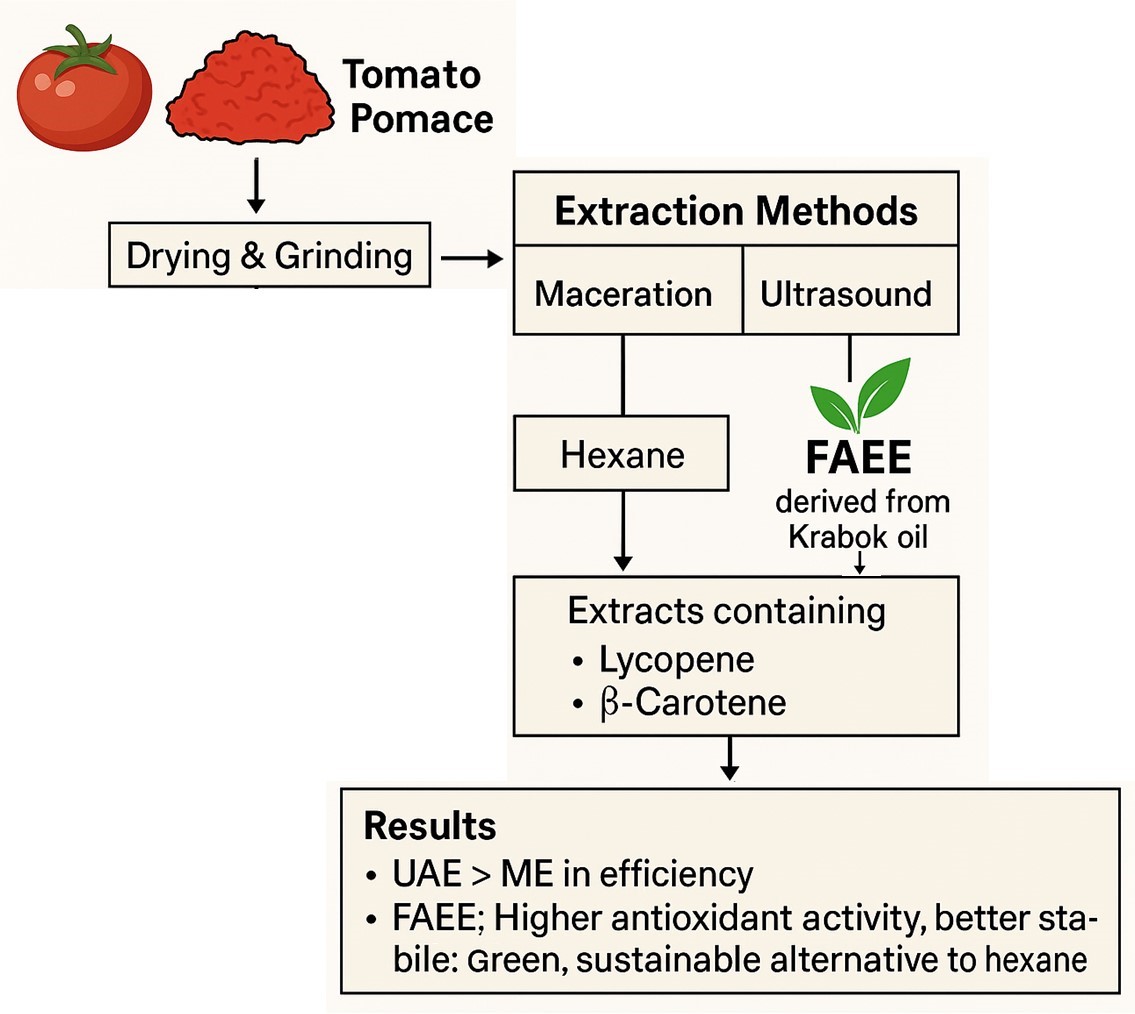
Tomato pomace, a byproduct of food processing, is rich in bioactive carotenoids such as lycopene and β-carotene, which are valued for their antioxidant properties but typically extracted using toxic organic solvents. This study aimed to develop an environmentally friendly approach for extracting and quantifying these compounds using fatty acid ethyl esters (FAEE) derived from Krabok seed oil, in comparison with hexane. Conventional maceration extraction (ME) and ultrasonic-assisted extraction (UAE) were applied, and the extracts were analyzed for lycopene and β-carotene content, antioxidant activity, and storage stability. The results showed that the UAE was more efficient than ME, while hexane provided higher extraction yields due to its lower viscosity, with lycopene and β-carotene contents of 67.97–75.33 and 10.51–11.50 mg/100 g dry weight (DW), respectively. FAEE extraction yielded slightly lower amounts (59.92–63.60 mg/100 g DW lycopene and 1.63–7.01 mg/100 g DW β-carotene) but exhibited superior antioxidant activity, with DPPH inhibition up to 92.05% when combined with the extracted compounds. Stability tests further revealed that FAEE-extracted carotenoids were more resistant to degradation, retaining up to 90% lycopene and 85% β-carotene after 56 days, whereas hexane-extracted compounds degraded rapidly. Overall, FAEE demonstrates strong potential as a sustainable, non-toxic solvent for the recovery of bioactive carotenoids from tomato pomace, supporting applications in the food and cosmetic industries.
Article Details

This work is licensed under a Creative Commons Attribution-NonCommercial-NoDerivatives 4.0 International License.
References
Kutrasaeng, N.; Prapatigul, P.; Martwanna, N. Pesticide application behaviors in tomato production of farmers in Sakon Nakhon Province. Journal of Agriculture 2017, 33, 235–244.
Yosying, S.; Choenkwan, S.; Phumchantuk, P.; Palinthorn, F. Fresh tomato production of smallscale farmers along the Mekong River in the northeastern region of Thailand. KKU Research Journal (Graduate Studies) 2022, 22, 61–74.
Przybylska, S.; Tokarczyk, G. Lycopene in the prevention of cardiovascular diseases. International Journal of Molecular Sciences 2022, 23, 1957. https://doi.org/10.3390/ijms23041957
Leh, H.E.; Lee, L.K. Lycopene: A potent antioxidant for the amelioration of type II diabetes mellitus. Molecules 2022, 27, 2335. https://doi.org/10.3390/molecules27072335
Eslami, E.; Carpentieri, S.; Pataro, G.; Ferrari, G.A. Comprehensive overview of tomato processing byproduct valorization by conventional methods versus emerging technologies. Foods 2023, 12, 166. https://doi.org/10.3390/foods12010166
Flais, D.; Oroian, M. Extraction of bioactive compounds from oxheart tomato pomace (Lycopersicon esculentum L.) using different solvents: Characterization of extracts. Applied Sciences 2024, 14, 7143. https://doi.org/10.3390/app14167143
Sharma, M.; Hussain, S.; Shalima, T.; Aav, R.; Bhat, R. Valorization of seabuckthorn pomace to obtain bioactive carotenoids: An innovative approach of using green extraction techniques (ultrasonic and microwaveassisted extractions) synergized with green solvents (edible oils). Industrial Crops and Products 2022, 175, 114257. https://doi.org/10.1016/j.indcrop.2021.114257
YaraVarón, E.; Li, Y.; Balcells, M.; FabianoTixier, A.S.; Chemat, F. Vegetable oils as alternative solvents for green oleoextraction, purification, and formulation of food and natural products. Molecules 2017, 22, 1474. https://doi.org/10.3390/molecules22091474
Diacon, A.; Călinescu, I.; Vinatoru, M.; Chipurici, P.; Vlaicu, A.; Boscornea, A.C.; Mason, T.J. Fatty acid ethyl esters (FAEE): A new, green, and renewable solvent for the extraction of carotenoids from tomato waste products. Molecules 2021, 26, 4388. https://doi.org/10.3390/molecules26144388
Roschat, W.; Phewphong, S.; Pholsupho, P.; Namwongsa, K.; Wongka, P.; Moonsin, P.; Yoosuk, B.; Promarak, V. The synthesis of a highquality biodiesel product derived from Krabok (Irvingia malayana) seed oil as a new raw material of Thailand. Fuel 2022, 308, 122009. https://doi.org/10.1016/j.fuel.2021.122009
Thangthong, A.; Roschat, W.; Hachai, C.; Inthikhot, K.; Kiinti, K.; Thammayod, A.; Phewphong, S.; Leelatam, T.; Tawil, S.; Moonsin, P.; Promarak, V. Synthesis of the fatty acid ethyl esters (FAEE) from Krabok (Irvingia malayana) seed oil for use as the main ingredient in the production of herbal massage oil. Trends in Sciences 2024, 21(11), 8444. https://doi.org/10.48048/tis.2024.8444
Fish, W.W. Refinements of the attending equations for several spectral methods that provide improved quantification of βcarotene and/or lycopene in selected foods. Postharvest Biology and Technology 2012, 66, 16–22. https://doi.org/10.1016/j.postharvbio.2011.08.007
Chu, C.C.; Hasan, Z.A.B.; Chua, S.K.; Nyam, K.L. Formulation and characterization of novel nanostructured lipid carriers with photoprotective properties made from carnauba wax, beeswax, pumpkin seed oil, and UV filters. Journal of the American Oil Chemists’ Society 2020, 97(5), 531–542. https://doi.org/10.1002/aocs.12340
Preecharram, S.; Phosri, S.; Theansungnoen, T.; Roschat, W.; Arthan, S.; Lasopha, S.; Jandaruang, J. Nutritional values and their potential applications in food products of Krabok seed (Irvingia malayana). Trends in Sciences 2024, 21(1), 7316. https://doi.org/10.48048/tis.2024.7316
Phewphong, S.; Roschat, W.; Namwongsa, K.; Wonam, A.; Kaisri, T.; Duangpakdee, P.; Leelatam, T.; Moonsin, P.; Promarak, V. Evaluation of the nutritional, minerals, and antioxidant potential of Roselle (Hibiscus sabdariffa Linn.) seeds from Roi Et Province in the Northeastern Region of Thailand. Trends in Sciences 2023, 20(6), 6664. https://doi.org/10.48048/tis.2023.6664
Diacon, A.; Călinescu, I.; Vinatoru, M.; Chipurici, P.; Vlaicu, A.; Boscornea, A.C.; Mason, T.J. Fatty acid ethyl esters (FAEE): A new, green and renewable solvent for the extraction of carotenoids from tomato waste products. Molecules 2021, 26(14), 4388. https://doi.org/10.3390/molecules26144388
Sharma, M.; Bhat, R. Extraction of carotenoids from pumpkin peel and pulp: Comparison between innovative green extraction technologies (ultrasonic and microwaveassisted extractions using corn oil). Foods 2021, 10(4), 787. https://doi.org/10.3390/foods10040787
Li, J.; Pettinato, M.; Casazza, A.A.; Perego, P. A comprehensive optimization of ultrasoundassisted extraction for lycopene recovery from tomato waste and encapsulation by spray drying. Processes 2022, 10(2), 308. https://doi.org/10.3390/pr10020308
Carneiro, C.R.; Alhaji, A.M.; da Silva, C.A.S.; de Sousa, R.C.S.; Monteiro, S.; Coimbra, J.S.R. Potential challenges of the extraction of carotenoids and fatty acids from Pequi (Caryocar brasiliense) oil. Foods 2023, 12(9), 1907. https://doi.org/10.3390/foods12091907
Chaudhary, K.; Khalid, S.; Zahid, M.; Ansar, S.; Zaffar, M.; Hassan, S.A.; Naeem, M.; Maan, A.A.; Aadil, R.M. Emerging ways to extract lycopene from waste of tomato and other fruits: A comprehensive review. Journal of Food Process Engineering 2024, 47(9), e14720. https://doi.org/10.1111/jfpe.14720
CamposLozada, G.; Pérez Marroquín, X.A.; CallejasQuijada, G.; CamposMontiel, R.G.; Morales Peñaloza, A.; LeónLópez, A.; AguirreÁlvarez, G. The effect of highintensity ultrasound and natural oils on the extraction and antioxidant activity of lycopene from tomato (Solanum lycopersicum) waste. Antioxidants 2022, 11, 1404. https://doi.org/10.3390/antiox11071404
Rahimi, S.; Mikani, M. Lycopene green ultrasoundassisted extraction using edible oil accompanied with response surface methodology (RSM) optimization performance: Application in tomato processing wastes. Microchemical Journal 2019, 146, 1033–1042. https://doi.org/10.1016/j.microc.2019.02.039
LeónLópez, A.; FuentesJiménez, L.; HernándezFuentes, A.D.; CamposMontiel, R.G.; AguirreÁlvarez, G. Hydrolysed collagen from sheepskins as a source of functional peptides with antioxidant activity. International Journal of Molecular Sciences 2019, 20, 3931. https://doi.org/10.3390/ijms20153931
Rattanabun, W.; Keawbankrud, W.; Pimpila, S.; Roekudomsak, K.; Phocharoen, C.; Suthiporn, P.; Nantakarat, S. Hair treatment products containing pigeon pea oil as chemical properties and antioxidant activity. Creative Science 2024, 16(3), 256828. https://doi.org/10.55674/cs.v16i3.256828
Sanmanoch, W.; Surapat, W.; Phosri, S.; Yaraksa, N. Antioxidant activity and cytotoxicity against the cervical epithelial carcinoma (HeLa) cell line of crude Ganoderma lucidum mycelial extracts: Antioxidant activity and cytotoxicity of crude Ganoderma lucidum mycelial extracts. Creative Science 2024, 16(1), 254094. https://doi.org/10.55674/cs.v16i1.254094
da Silva Lima, R.; Nunes, I.L.; Block, J.M. Ultrasoundassisted extraction for the recovery of carotenoids from guava's pulp and waste powders. Plant Foods for Human Nutrition 2020, 75(1), 63–69. https://doi.org/10.1007/s11130-019-00784-0
