
Valorization of White Shrimp Shell Waste: Development of Chitosan-Based Pellet Feed for Enhanced Nile Tilapia (Oreochromis niloticus) Nutrition
Article Sidebar
Main Article Content
Abstract
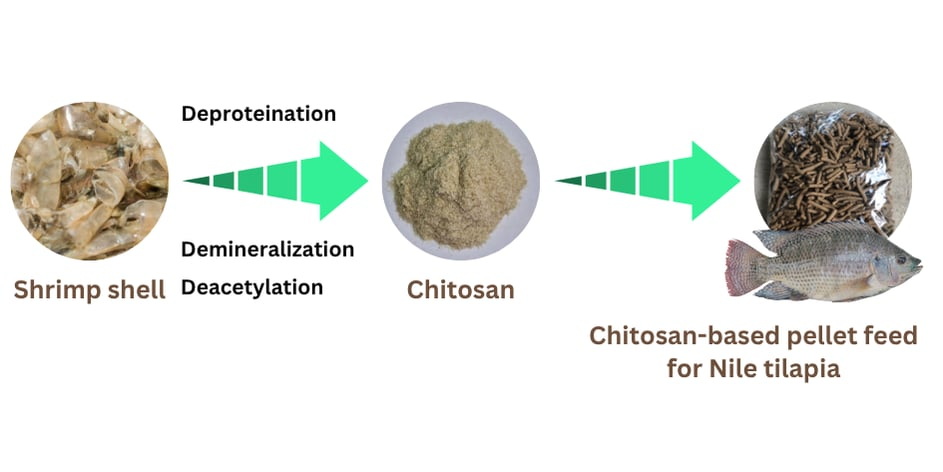
This study demonstrates the development and application of an eco-friendly Nile tilapia (Oreochromis niloticus) feed formulation incorporating chitosan extracted from white shrimp shells. The extraction process yielded purified chitosan through ultrasonic deproteinization, acid demineralization, and alkaline deacetylation, confirmed by FTIR spectrophotometry. Three experimental feed formulations containing varying chitosan levels (10%, 15%, and 20%) were prepared and evaluated through proximate analysis. Formula 2 (15% chitosan) was identified as optimal, meeting standard nutritional requirements for aquafeeds while maximizing protein content and minimizing ash levels. A 14-week growth trial using the optimal feed showed that tilapia exhibited healthy growth performance, with an average weight of 14.90 g, length of 10.05 cm, and a survival rate of 77.50%. Water quality parameters remained within acceptable ranges, confirming the environmental compatibility of the feed. These results align with previous findings that chitosan supplementation enhances feed conversion and growth in aquaculture species. This work underscores the value of converting shrimp shell waste into a functional feed additive, offering a sustainable solution for improving aquafeed quality and promoting circular economy practices in aquaculture. By integrating waste valorization and local feed production, this research contributes to safer, more sustainable fish farming while reducing reliance on chemical additives. The approach supports both environmental stewardship and community livelihood development in regions where aquaculture is an essential economic sector.
Article Details

This work is licensed under a Creative Commons Attribution-NonCommercial-NoDerivatives 4.0 International License.
References
Hoffmann, K.; Gabriele, D.; Marina, K.; Werner-Michael, K.; Heike, M.; Bernward, B.; Friedhelm, M. Genetic Improvement of Bacillus licheniformis Strains for Efficient Deproteinization of Shrimp Shells and Production of High-Molecular-Mass Chitin and Chitosan. Appl. Environ. Microbiol. 2010, 76, 8211–8221. https://doi.org/10.1128/AEM.01404-10
van der Lubben, I. M.; Verhoef, J. C.; Borchard, G.; Junginger, H. E. Chitosan and Its Derivatives in Mucosal Drug and Vaccine Delivery. J. Pharm. Sci. 2001, 90, 207–214. https://doi.org/10.1016/S0928-0987(01)00172-5
Qurashi, M. T.; Blair, H. S.; Allen, S. J. Studies on Modified Chitosan Membrane. II. Dialysis of Low Molecular Weight Metabolites. J. Appl. Polym. Sci. 1992, 46, 263–269. https://doi.org/10.1002/app.1992.070460207
Singh, D. K.; Ray, A. R. Graft Copolymerization of 2-Hydroxyethyl Methacrylate onto Chitosan Films and Their Blood Compatibility. J. Appl. Polym. Sci. 1994, 53, 1115–1121. https://doi.org/10.1002/app.1994.070530814
Chung, Y.-C.; Li, Y.-H.; Chen, C.-C. Pollutant Removal from Aquaculture Wastewater Using the Biopolymer Chitosan at Different Molecular Weights. J. Environ. Sci. Health A 2005, 40, 1775–1790. https://doi.org/10.1081/ESE-200068058
Huang, C.; Chen, S.; Pan, J. R. Optimal Condition for Modification of Chitosan: A Biopolymer for Coagulation of Colloidal Particles. Water Res. 2000, 34, 1057–1062. https://doi.org/10.1016/S0043-1354(99)00211-0
Lertsutthiwong, P.; Sutti, S.; Powtongsook, S. Optimization of Chitosan Flocculation for Phytoplankton Removal in Shrimp Culture Ponds. Aquacult. Eng. 2009, 41, 188–193. https://doi.org/10.1016/j.aquaeng.2009.07.006
Dautremepuits, C.; Betoulle, S.; Paris-Palacios, S.; Vernet, G. Immunology-Related Perturbations Induced by Copper and Chitosan in Carp (Cyprinus carpio L.). Arch. Environ. Contam. Toxicol. 2004, 47, 370–378. https://doi.org/10.1007/s00244-004-3115-0
Kumar, S. R.; Ahmed, V. P. I.; Parameswaran, V.; Sudhakaran, R.; Babu, V. S.; Hameed, A. S. S. Potential Use of Chitosan Nanoparticles for Oral Delivery of DNA Vaccine in Asian Sea Bass (Lates calcarifer) to Protect from Vibrio (Listonella anguillarum). Fish Shellfish Immunol. 2008, 25, 47–56. https://doi.org/10.1016/j.fsi.2007.12.004
Polk, A.; Amsden, B.; Scarlett, D.; Gonzalez, A.; Okonmafe, O.; Goosen, M. Oral Delivery in Aquaculture: Controlled Release of Proteins from Chitosan–Alginate Microcapsules. Aquacult. Eng. 1994, 13, 311–323. https://doi.org/10.1016/0144-8609(94)90018-3
Niu, J.; Liu, Y. J.; Lin, H. Z.; Mai, K. S.; Yang, H. J.; Liang, G. Y.; Tian, L. X. Effects of Dietary Chitosan on Growth, Survival, and Stress Tolerance of Postlarval Shrimp, Litopenaeus vannamei. Aquac. Nutr. 2011, 17, 406–412. https://doi.org/10.1111/j.1365-2095.2010.00775.x
APHA. Standard Methods for the Examination of Water and Wastewater, 20th ed.; American Public Health Association: Washington, DC, 1998; pp 1–1325.
USEPA. Method 352.1: Nitrogen, Nitrate (Colorimetric, Brucine) by Spectrophotometer; United States Environmental Protection Agency: Washington, DC, 1971; pp 11–15.
APHA. Standard Methods for the Examination of Water and Wastewater, 18th ed.; American Public Health Association: Washington, DC, 1992; pp 1–1100.
Somsueb, P. Aquafeed Analysis for Monitoring and Feed Quality Control. E-Thai Fish. Gaz. 2021, 4, 102–128.
Wu, S. Growth Performance, Body Composition, and Nonspecific Immunity of Tilapia (Oreochromis niloticus) Affected by Chitosan. Int. J. Biol. Macromol. 2020, 145, 682–685. https://doi.org/10.1016/j.ijbiomac.2019.12.235
Rangkuti, P.; Suharman, I.; Siagian, D. R. Effect of Chitosan Extracted from Vannamei Shrimp (Litopenaeus vannamei) Shells in Feed on the Growth Performance and Digestibility of Nile Tilapia (Oreochromis niloticus). J. Nat. Indones. 2025, 23, 1–9. https://doi.org/10.31258/jnat.23.1.1-9
Harikrishnan, R.; Kim, J. S.; Balasundaram, C.; Heo, M.-S. Immunomodulatory Effects of Chitin and Chitosan-Enriched Diets in Epinephelus bruneus against Vibrio alginolyticus Infection. Aquaculture 2012, 326–329, 46–52. https://doi.org/10.1016/j.aquaculture.2011.11.034
El-Sherif, M. S.; El-Feky, A. M. I. Performance of Nile Tilapia (Oreochromis niloticus) Fingerlings. I. Effect of pH. Int. J. Agric. Biol. 2009, 11, 297–300.
Boyd, C. E. Water Quality in Warmwater Fish Ponds; Auburn University, Agricultural Experiment Station: Auburn, AL, 1979; p 359.
Boyd, C. E. Water Quality in Ponds for Aquaculture; Auburn University, Agricultural Experiment Station: Auburn, AL, 1990; p 482.
Abdel-Tawwab, M.; Hagras, A. E.; Elbaghdady, H. A. M.; Monier, M. N. Dissolved Oxygen Level and Stocking Density Effects on Growth, Feed Utilization, Physiology, and Innate Immunity of Nile Tilapia, Oreochromis niloticus. J. Appl. Aquac. 2014, 26, 340–355. https://doi.org/10.1080/10454438.2014.959830
Tsadik, G.; Kutty, M. Influence of Ambient Oxygen on Feeding and Growth of the Tilapia Oreochromis niloticus (Linnaeus). Port Harcourt, Nigeria, 1987.
